Different materials, different numbers
Diamond and moissanite are two different materials: carbon in a cubic crystal against silicon carbide in a hexagonal one. A different material behaves differently with light, weight and wear. Gemologists record that behavior as a short list of numbers.
You don't need to memorize the list. You need to know what each line predicts. Every test that separates the two stones is one of these numbers, turned into something you can see.
The card
| Property | Diamond | Moissanite | What it predicts | More on it |
|---|---|---|---|---|
| Refractive index | 2.417 | 2.648 to 2.691 | How strongly the stone bends light | refractive index, instruments |
| Critical angle | 24.4° | 22.2° | Which light stays inside the stone | refractive index |
| Optic character | singly refractive | doubly refractive (uniaxial positive) | Whether light splits in two | loupe test, instruments |
| Birefringence | none | 0.043 | How far the two rays split | loupe test |
| Dispersion | 0.044 | 0.104 | How much white light spreads into colors (fire) | fire |
| Specific gravity | 3.52 | 3.22 | Weight for its size | carat and size |
| Mohs hardness | 10 | 9.25 | Resistance to scratching | wear and care |
| Toughness | good along its cleavage directions, exceptional in others | excellent; no cleavage found | Resistance to chipping and breaking | wear and care |
| Luster | adamantine | subadamantine | How the surface reflects | – |
| Heat conduction | very high | close to diamond's | What a thermal tester says | testers |
Reading the lines
Refractive index is how much light slows down and bends when it enters the stone. Moissanite has two indices, one for each of the two rays it splits light into. The gap between them is its birefringence, 0.043. Diamond has a single index, so it has no gap.
Critical angle comes from the index. Inside the stone, light that meets a facet at more than this angle from the facet's perpendicular reflects back in. A higher index gives a smaller critical angle. That is why moissanite's critical angle is smaller than diamond's.
Dispersion is how differently the stone bends red and violet light. It is measured as the difference in index between a red and a violet line of the spectrum (686.7 and 430.8 nm). Moissanite's figure is about 2.4 times diamond's.
Specific gravity compares the stone's weight with the weight of the same volume of water. Diamond is 3.52 times as heavy, moissanite 3.22 times.
Hardness and toughness are two different things. Hardness is resistance to scratching. Toughness is resistance to chipping and breaking. Diamond is the hardest gem, but it has cleavage: directions along which a hard knock can split it. GIA's researchers smashed a moissanite cube with a hammer. It broke with curved, shell-like fractures and showed no cleavage.
One warning about Mohs: it is a ranking, not a ruler. In measured indentation hardness, the jump from sapphire (9) to moissanite (9.25) is larger than the whole step from topaz (8) to sapphire. And diamond, at 10, is far harder than either.
Heat conduction is the odd one out. Here the two are so close that the classic thermal diamond tester can't separate them. Our page on diamond testers and moissanite shows what to use instead.
Try it yourself
- Open 3D Gemstone Simulator with the T73 Round Brilliant in diamond, 1.00 carat.
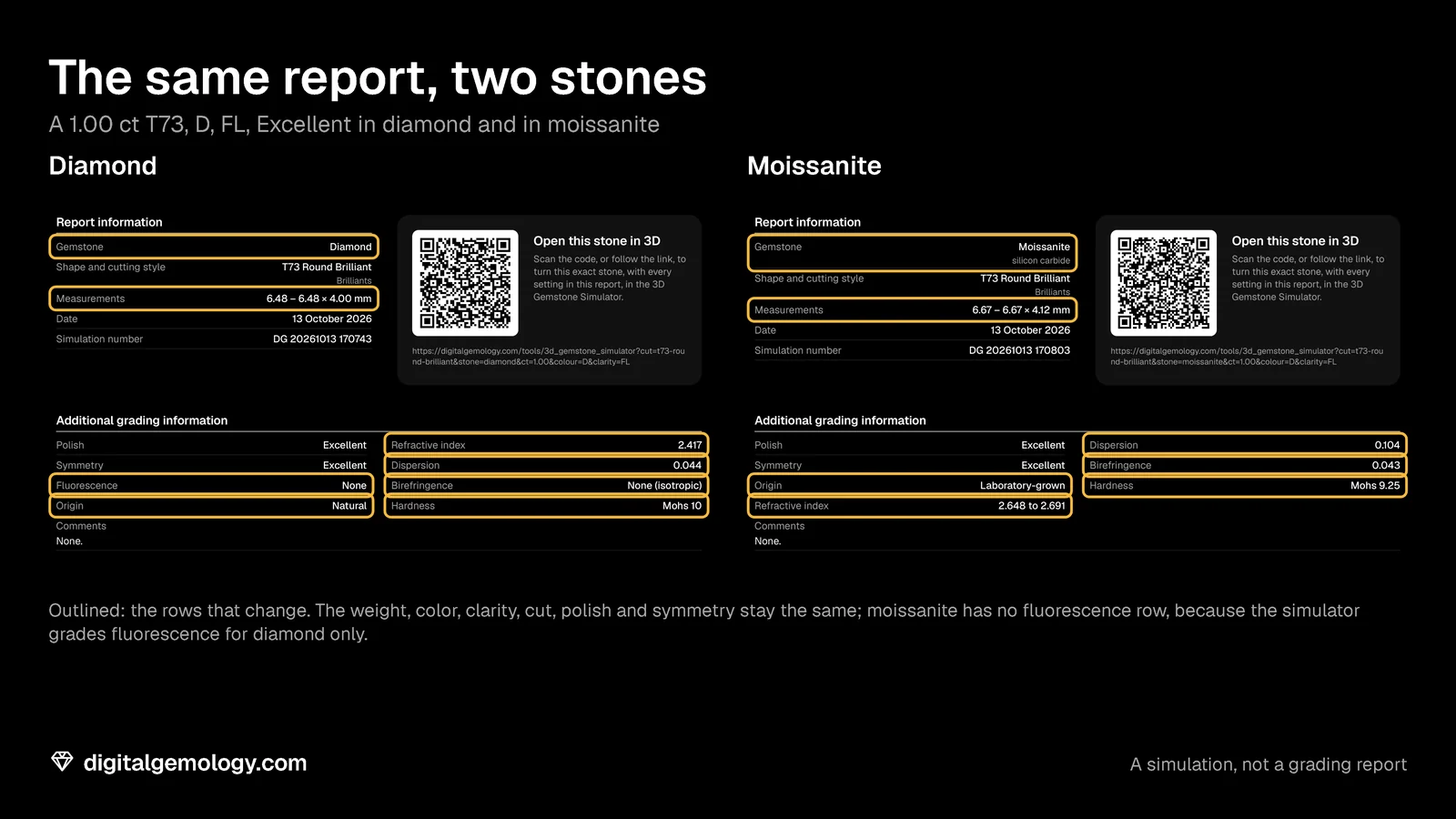
- Scroll the report to Additional grading information. Note the refractive index, dispersion, birefringence and hardness.
- Scroll down to Light performance and note the critical angle.
- Change the gemstone to moissanite. Write down every row that changes.
- Look for the row that disappears. Also look for one number at the top of the report that changed, although you didn't touch it.
What the simulator report shows
Five property rows changed: refractive index, dispersion, birefringence, hardness and critical angle. The Origin row locked to Laboratory-grown (see what the two stones are made of). The Fluorescence row disappeared, because in the simulator only diamond is graded for it (see color and fluorescence). The Light Return bar shifted too; moissanite's refractive index explains why. And the Measurements at the top grew from 6.48 to 6.67 mm across, at the same 1.00 carat. That's specific gravity at work: see same size, different weight.
Everything else on the card turns into something you can see:
- the index turns into the way a cut returns light;
- dispersion turns into fire;
- birefringence turns into doubled facet edges.
Key points
- Diamond's index is 2.417. Moissanite's is 2.648 to 2.691: two indices, because it is doubly refractive.
- Moissanite's dispersion, 0.104, is about 2.4 times diamond's 0.044.
- Moissanite is lighter for its size: specific gravity 3.22 against 3.52.
- Diamond is harder (Mohs 10 against 9.25) but has cleavage. Moissanite showed none.
- Their heat conduction is so close that a thermal tester calls both "diamond".
Go further: our gemstone constants page lists the same numbers for all seven gemstones. It also shows how we calculate each angle.
Try it free
- Refractometer: Read the shadow edges of seven gemstones on a gem refractometer.
- 3D Gemstone Simulator: Turn a cut in seven gemstones and set its carat, color, clarity and cut grade.
Free, in your browser, no account.
Quick quiz
Five questions on this lesson, a couple of minutes. Pick an answer and see at once if you got it, and why.
Cuts in this lesson
We sell the files of these cuts: 3D models and cutting files, with a personal-use license.
Keep exploring
- Next lesson: Moissanite's refractive index, and why it needs its own cut
- Try another topic · The four Cs of diamonds: Carat weight vs size: why a 2 ct diamond isn't twice as big
Previous lesson · Diamond vs moissanite: all lessons · All topics