Transcript
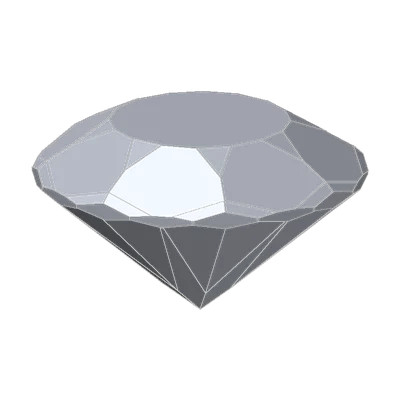
This 10-second clip has no sound. What you see:
The T73 and DG-Anteros, both in moissanite, turning side by side.
A pattern that vanishes
Here's a trick to start with. Open a Hearts & Arrows viewer on a perfectly cut round brilliant in diamond: eight crisp arrows face-up, eight hearts face-down. Now change nothing about the cut. Not one facet, not one angle. Only change the stone, from diamond to moissanite.
Both patterns fall apart.
The cause is the first number on the property card: the refractive index. This page is about that one number, and about the cut we drew because of it.
What refractive index is
Light slows down when it enters a stone. The refractive index (RI) tells you how much. It is the speed of light in air (strictly, in a vacuum) divided by its speed in the stone.
- In diamond (RI 2.417), light crawls along at about 124,000 km per second.
- In moissanite (RI 2.648, and 2.691 for its second ray), it's down to about 113,000 km per second.
Slower light bends more where it crosses a surface at an angle. So moissanite bends every ray that enters or leaves it further than diamond does. (Its second index has its own effect: it doubles the facet edges.)
Two things follow:
- Off the scale. A gem refractometer reads only up to about 1.81, the index of its contact liquid. Both stones are far beyond the end of the scale and read "over the limit". So the standard instrument can't read the most important number on this page.
- A tighter trap. Inside a stone, light can escape through a facet only near straight-on. The limit is the critical angle. Beyond that angle, the facet is a perfect mirror. Diamond's critical angle is 24.4°; moissanite's is 22.2°. Moissanite's escape window is narrower, so it holds light more easily.
Why a diamond cut misfires in moissanite
A round brilliant is a light machine. Light comes in through the top, bounces off the pavilion and comes back up toward your eye. The crown and pavilion angles are set to make that happen. The T73's angles go back to 1919, and they were worked out for diamond's index, 2.417.
Put those same angles in moissanite, and every ray bends a little further. It meets the pavilion at a different angle and leaves at a slightly different place. The stone still holds light, but it doesn't send the light where the design intended. Most moissanite is cut to diamond proportions like this.
That's why we drew DG-Anteros: the T73's 73-facet layout, with the crown and pavilion re-solved for moissanite's index.
Try it yourself
- Open Hearts & Arrows Scope. It starts with the T73 in diamond. Set the gemstone to Moissanite and watch both patterns go.
- Look at the two Symmetry readings. Still 100%?
- Set the cut to DG-Anteros, still in moissanite. Note its pavilion and crown angles in the panel.
- Switch DG-Anteros to Diamond.
- The rescue challenge. Go back to the T73 in moissanite. Using only the Pavilion angle and Crown angle controls, bring the hearts and arrows back. Which angles work?
- In 3D Gemstone Simulator, turn on Light map. Read the Light Return bar for the T73 in diamond, the T73 in moissanite, and DG-Anteros in moissanite.
What the scope and the light map show
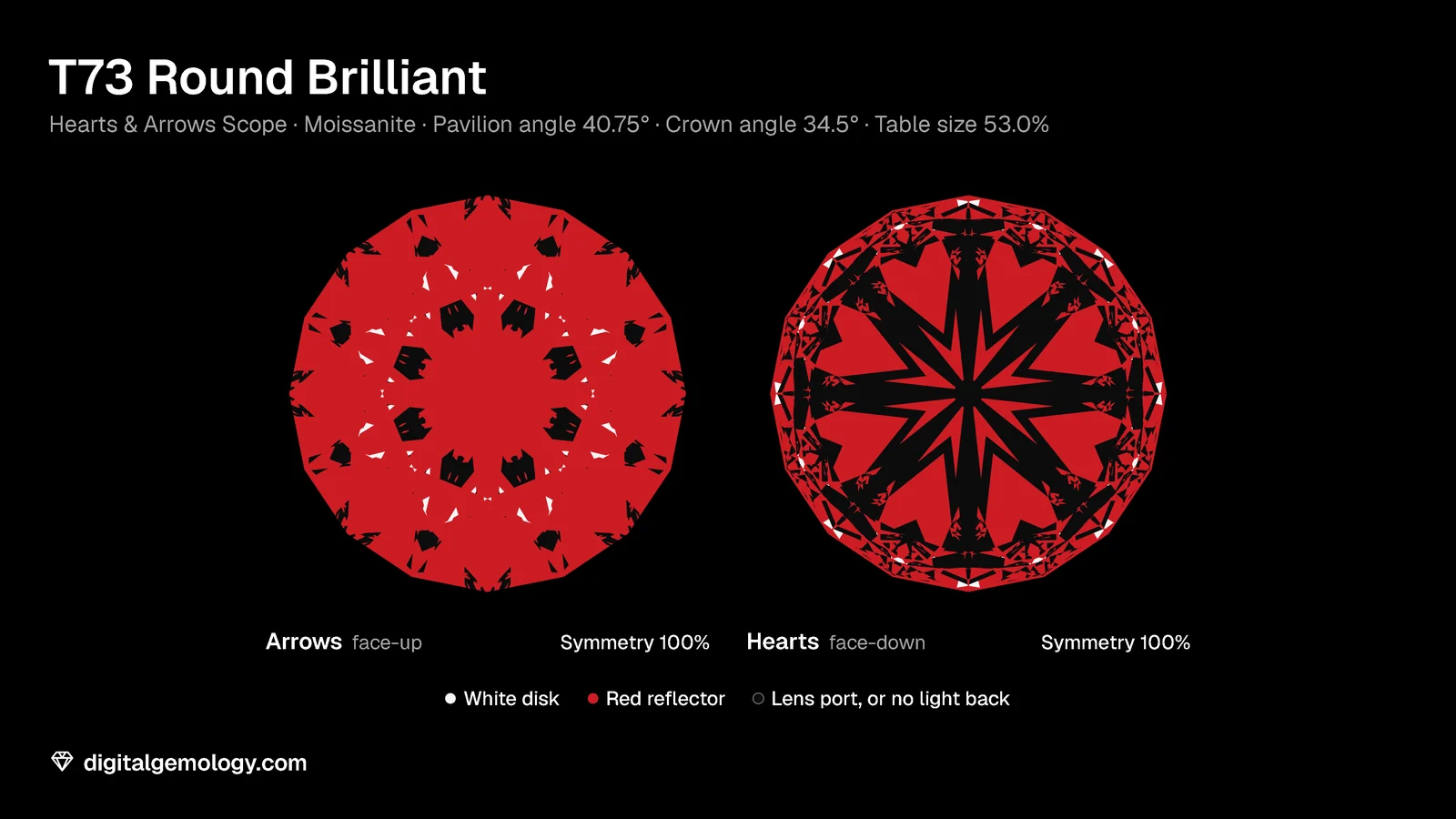
In moissanite, the T73's arrows dissolve into a red field with scattered dark marks, and its hearts melt into a dark star. But symmetry stays at 100%: all sixteen halves still match each other. Symmetry makes a pattern even. The proportions, matched to the index, make the pattern exist.
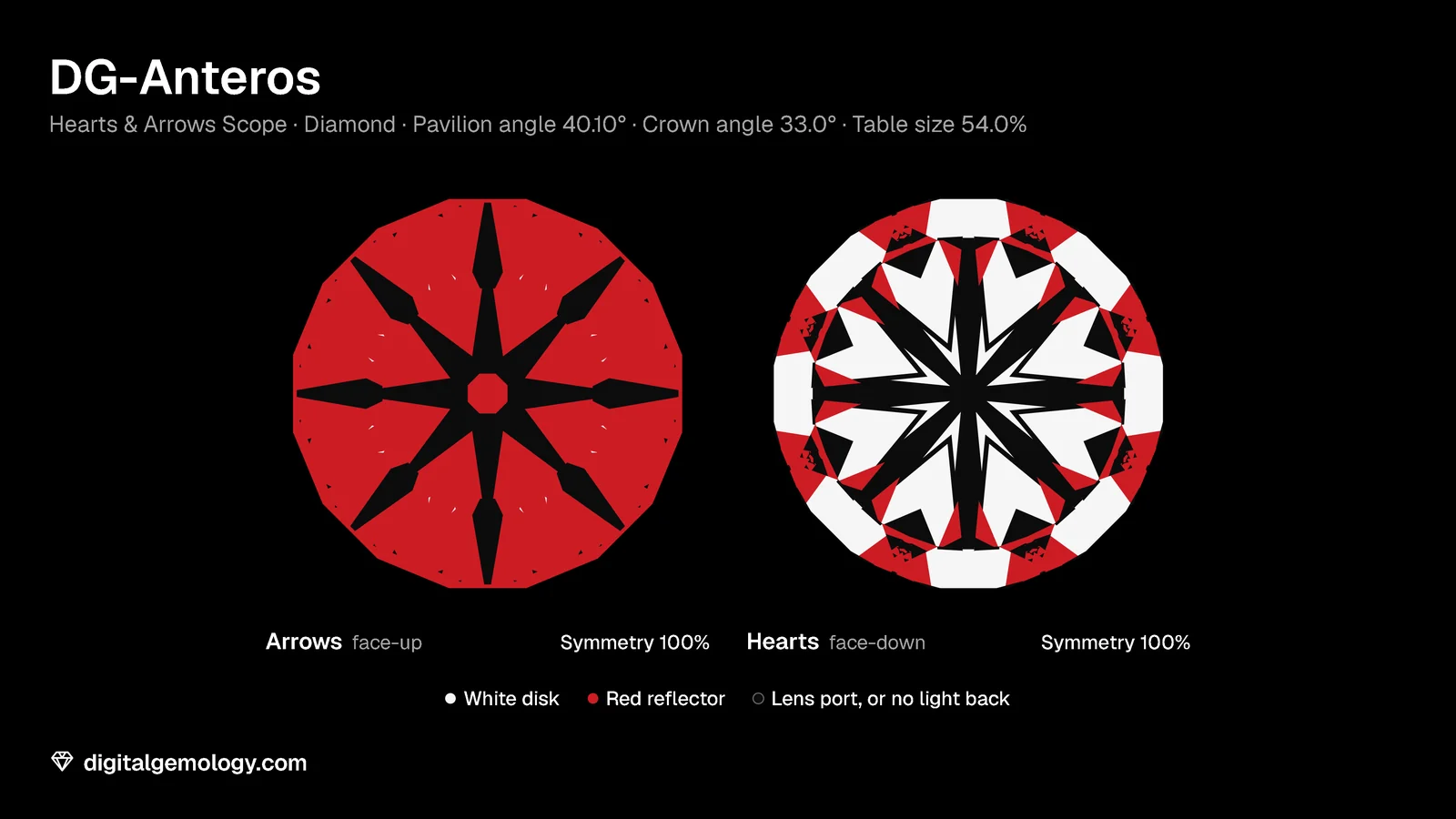
DG-Anteros has a pavilion of 40.1° and a crown of 33° in the scope; the T73 has 40.75° and 34.5°. In moissanite, DG-Anteros shows crisp white arrows and eight clean hearts. Switch it to diamond and the trick runs backwards: its arrows go dark and its hearts flood. A cut is matched to its material, not better in general.
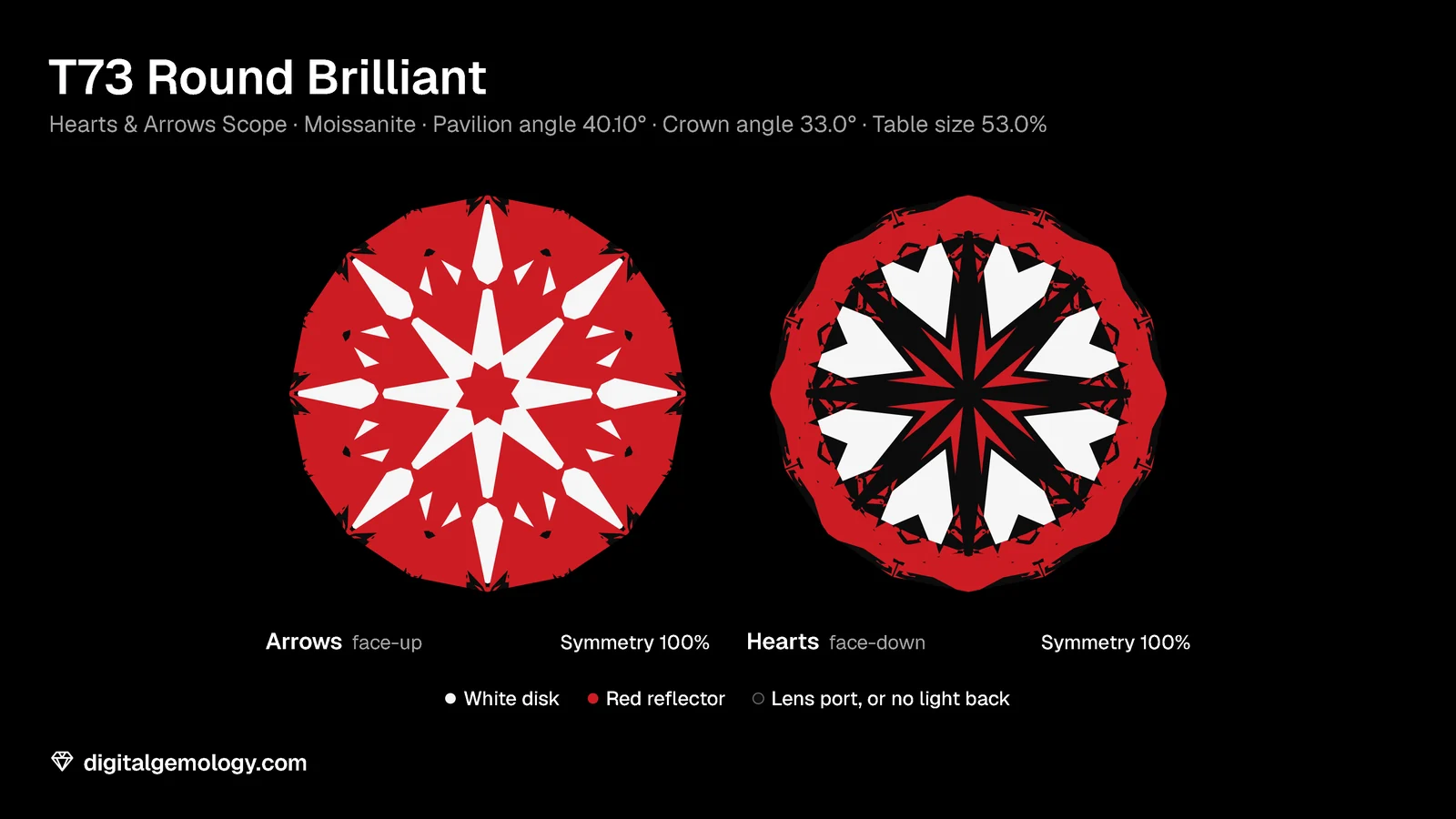
The rescue works too. Set the T73 in moissanite to around 40.1° pavilion and 33° crown, and the arrows and hearts come back. Two sliders find the whole idea of DG-Anteros.
The light map shows what happens to the light itself. Light Return sorts the face-up stone by where its light comes from:
- direct: bright light from above, 15° to 45° off your line of sight;
- indirect: light from lower angles;
- contrast: where your own head blocks the light;
- leakage: light lost through the pavilion.
| Stone | Direct | Indirect | Contrast | Leakage |
|---|---|---|---|---|
| T73 in diamond | 68% | 5% | 22% | 5% |
| T73 in moissanite | 49% | 28% | 11% | 12% |
| DG-Anteros in moissanite | 62% | 13% | 23% | 2% |
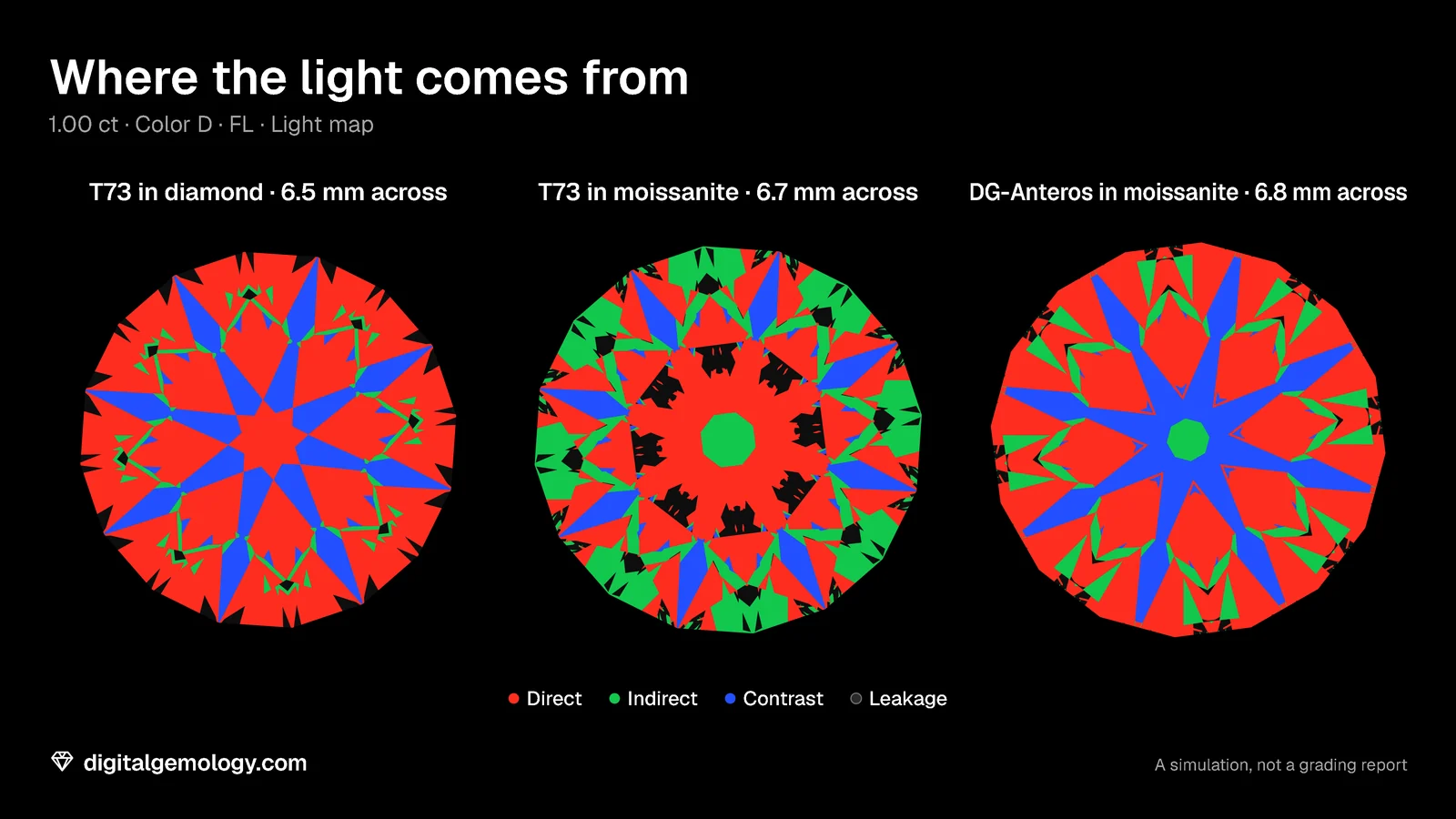
In moissanite, the T73 swaps bright overhead light for low-angle light. It loses contrast, and it leaks more than twice as much. DG-Anteros brings back the direct light and the contrast, and it leaks least of all three. On the Cut Performance Wheel, it lifts brilliance in moissanite from the T73's 86 to 92.
Key points
- Refractive index is how much a stone slows light: diamond 2.417, moissanite about 2.65. A higher index bends light more.
- Both stones are beyond a refractometer's scale and read "over the limit".
- Moissanite's critical angle (22.2°) is smaller than diamond's (24.4°), so it traps light more easily.
- A cut's angles are solved for one index. The T73 loses its hearts and arrows in moissanite, but its symmetry stays 100%.
- DG-Anteros re-solves the T73 for moissanite: crisp hearts and arrows, more direct light, less leakage. In diamond it misfires. A cut is matched to its material.
Go further: the DG-Anteros cut page shows the cut in both stones. It also has the cutting files and 3D models.
Try it free
- Hearts & Arrows Scope: See the arrows face up and the hearts face down as you change the cut.
- 3D Gemstone Simulator: Turn a cut in seven gemstones and set its carat, color, clarity and cut grade.
Free, in your browser, no account.
Quick quiz
Five questions on this lesson, a couple of minutes. Pick an answer and see at once if you got it, and why.
Cuts in this lesson
We sell the files of these cuts: 3D models and cutting files, with a personal-use license.
Keep exploring
- Next lesson: Why moissanite shows more fire than diamond
- Try another topic · Diamond anatomy and proportions: Star length and lower half length in a round brilliant
Previous lesson · Diamond vs moissanite: all lessons · All topics