The number you can see
On the property card, moissanite has a line that diamond doesn't: birefringence, 0.043. Moissanite's higher index changes a whole pattern of light. Birefringence does something smaller and more useful: it doubles the edges you see through the stone. It's the most reliable clue you can check with a loupe. GIA's first study of gem moissanite named it as the way to separate the two.
Why the edges double
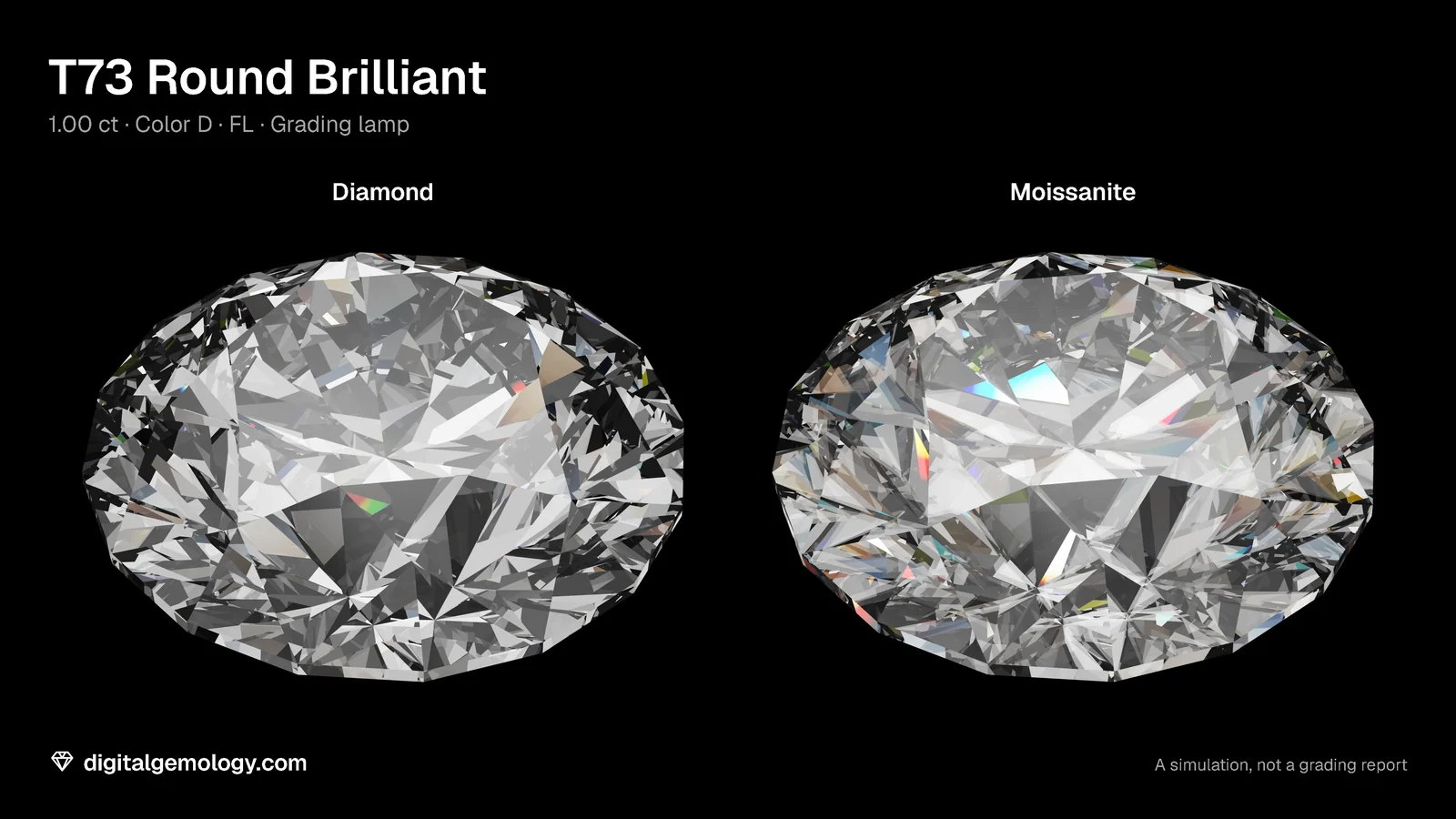
Moissanite is doubly refractive. Light that enters it splits into two rays. The two rays travel at slightly different speeds and bend by slightly different amounts. Look through the stone at a facet edge on the far side. You see the edge twice, along two slightly different paths: two thin lines where there should be one.
Diamond is singly refractive. Light stays one ray, and every edge you see through a diamond is single, from any direction.
The trap: looking straight down
Moissanite has one direction in which light doesn't split: along its optic axis. Cutters usually set that axis straight up through the table, square to it. So when you look straight down through the table, you see no doubling, and the stone can pass for diamond. (A stone cut off its axis can show some doubling even face-up.)
You have to look another way:
- Through a crown facet, at an angle: the pavilion facet edges behind it double.
- Through the pavilion, from below: the crown facet edges double.
- Straight down, but focused past the culet: the reflections of the table and crown facets double.
GIA noted that in larger stones, you can sometimes see the doubling without a loupe.
Try it yourself
Use the biggest window you have. The doubling is a few pixels wide.
- Open 3D Gemstone Simulator with the T73 Round Brilliant in moissanite.
- Under View, choose At an angle. Set Turn to Off. Leave Facet mesh off: the mesh draws the true edges on top and hides the effect.
- Look through a crown facet near you at the pavilion edges behind it. Look for edges that come in pairs, slightly ghosted.
- Switch to Face up. Look through the table. What happened to the doubling?
- Switch the gemstone to diamond and repeat steps 2 to 4.
What the simulator shows
At an angle, moissanite's edges seen through the crown come in ghosted pairs. The simulator traces both rays. Its report notes that the effect is strongest through the crown and at an angle. Face-up, through the table, most of the doubling disappears, because you look close to the optic axis. In diamond, every edge stays single at every angle.
Doubling proves that the stone is doubly refractive, so not diamond. It doesn't prove moissanite on its own. Other doubly refractive look-alikes, such as synthetic rutile, double too. That's why you collect more clues.
The other loupe clues
GIA's 1997 study listed what else a loupe or microscope shows in moissanite:
- Needles: thin white needles, roughly parallel to each other, that run straight down from the table, along the optic axis. Sometimes fine reflective "stringers" in the same direction, and pinpoints.
- Rounded facet junctions, where a diamond's are knife-sharp.
- Polish lines that all point the same way, facet after facet. Diamond is harder in some directions than in others, so the cutter works each of its facets at its own angle. Moissanite has no such grain, so the cutter can work it one way throughout. If the lines on every facet you check run the same way, the stone isn't a diamond. But that still doesn't prove moissanite.
- The girdle: frosted, polished or striated, without the fine hairlike "bearding" a diamond girdle can show.
What you don't find in moissanite is just as telling. None of GIA's samples showed the mineral crystals, feathers, strain or cleavage typical of diamond. A diamond, in turn, can show:
- included crystals;
- feathers;
- graining;
- bearding;
- a "natural" (a bit of the original crystal skin left on the girdle);
- a waxy to granular girdle surface.
Two cautions. First, GIA's samples were early material, and polish improved even during the study. So today's moissanite may have sharper edges. The doubling doesn't go away, because it comes from the material itself. Second, GIA's researchers treated what you see under magnification as an indication. In their view, only very experienced eyes can call it diagnostic. Doubling is the strongest of these clues; the others add weight to it.
Key points
- Moissanite's birefringence doubles the facet edges you see through it. Diamond never doubles.
- Cutters usually set the optic axis square to the table. So look through a crown facet, through the pavilion, or past the culet, never only straight down.
- Doubling proves "not diamond". Add more clues before you say "moissanite".
- Other loupe clues:
- parallel needles that run down from the table;
- rounded facet junctions;
- polish lines that run one way on every facet;
- a frosted, polished or striated girdle.
- No diamond-type inclusions, strain or cleavage in moissanite.
Go further: our double refraction notes explain how the simulator traces both rays.
Try it free
- 3D Gemstone Simulator: Turn a cut in seven gemstones and set its carat, color, clarity and cut grade.
Free, in your browser, no account.
Quick quiz
Five questions on this lesson, a couple of minutes. Pick an answer and see at once if you got it, and why.
Cuts in this lesson
We sell the files of these cuts: 3D models and cutting files, with a personal-use license.
Keep exploring
- Next lesson: Moissanite vs diamond: same size, different carat weight
- Try another topic · The four Cs of diamonds: How a diamond cut grade is set: proportions, polish and symmetry
Previous lesson · Diamond vs moissanite: all lessons · All topics