Transcript
White light is a mix of colors. The index is higher for violet than for red.
Dispersion is the index at 430.8 nm minus the index at 686.7 nm.
Diamond: 0.044. Moissanite: 0.104, about 2.4 times as much.
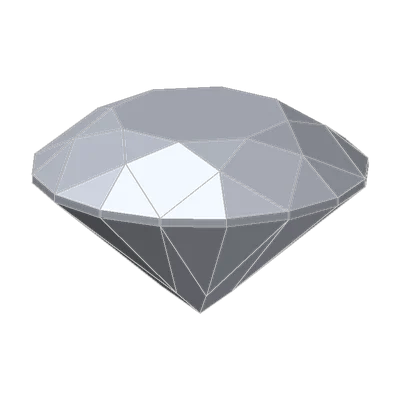
Light leaves a cut stone through its top facets. Look at one crown facet.
Close up: one ray of white light meets the facet at 15.0° inside.
Snell's law gives the angle outside. Each color has its own index n.
Red leaves at 38.5° from the dashed line.
Violet bends more. It leaves at 39.4°.
The other colors fill the gap. In diamond, the fan is 0.84° wide.
Now moissanite, at the same facet and the same angle inside.
The fan opens to 2.14°, about 2.5 times as wide as in diamond.
Every facet the light crosses opens the fan further.
The Wheel measures fire in 3D. T73: 78 in diamond, 97 in moissanite.
Across the 37 cuts we score, moissanite out-fires diamond in 36.
The one exception: DG-Elongated Hexagon, 97 in diamond and 93 in moissanite.
The difference you see first
Put a diamond and a moissanite under the same spotlight and turn them. Long before anyone mentions refractive index or doubled facets, one thing jumps out. The moissanite throws flashes of red, orange, green and blue that are bigger, brighter and more frequent.
That's fire. Of all the optical differences between these two stones, it's the one you'll see first and see most. This page shows where fire comes from, how big the gap is, and when fire vanishes.
Every color bends differently
Refractive index decides how much a stone bends light. Here's the twist: the index isn't one number. It's slightly higher for violet light than for red. White light is a mix of every color. When it crosses a facet at an angle, the violet part bends a little more than the red part, and the colors fan apart.
That fan of colors is dispersion. It's measured as the difference between the stone's index for a red line and for a violet line of the spectrum (686.7 and 430.8 nm):
- Diamond: 0.044
- Moissanite: 0.104, about 2.4 times as much.
Every time light passes through a facet, the fan opens a little further. In moissanite it opens about 2.4 times as wide. So when the light reaches your eye, the colors are far enough apart to see as separate flashes. Moissanite's index, critical angle and weight differ from diamond's by around a tenth. Its dispersion is more than double.
A prism you can play with
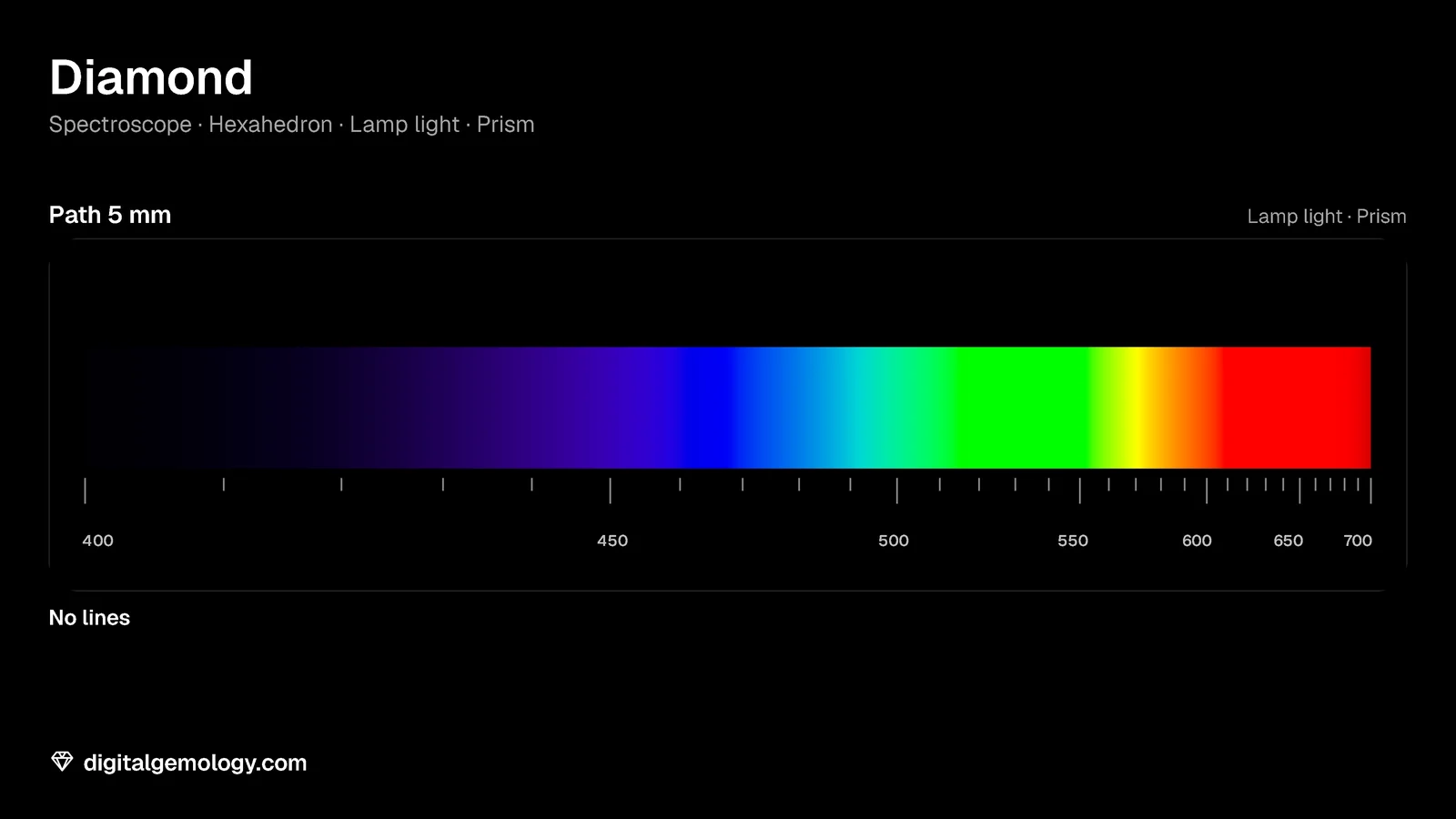
A prism is dispersion you can watch. Our Spectroscope has one: a 60° prism of dense flint glass that spreads lamp light into a rainbow. It bends violet (400 nm) by about 75.5° and red (700 nm) by about 64.7°. So the colors land about 11° apart. A faceted gem does the same thing at every facet, many times over, in every direction.
Try it yourself
- The prism. Open Spectroscope and choose diamond (it absorbs nothing, so the spectrum is clean). Set Spread by to Prism. That rainbow is dispersion.
- The scoreboard. Open Cut Performance Wheel with the T73 in moissanite. (
?cut=t73-round-brilliant&stone=moissanite&vsstone=diamondcompares it with the T73 in diamond.) Read brilliance, fire and scintillation for both. - The light show. Open 3D Gemstone Simulator with the T73 in moissanite, Turn set to Slow. Go through four lightings: Cloudy day, Sunny day, Red carpet, Club. Then switch to diamond and repeat.
- The hunt. Go back to the Wheel. Set the comparison gemstone to diamond and try other cuts. Find: (a) the cut where moissanite gains the most fire over diamond; (b) the one cut where diamond comes out ahead.
What the tools show
The scoreboard. The T73 in moissanite scores 97 for fire against 78 in diamond: 19 points more. Brilliance goes the other way, 86 against 93. Scintillation doesn't move at all (80 and 80): sparkle comes from the pattern of facets, and the cut is the same. Of the three, fire is where the stones differ most. GIA's researchers saw the same in 1997: dispersion well above diamond's, brilliance slightly below.
The hunt. Across the 37 cuts we score, moissanite out-fires diamond in 36. The biggest gain is DG-M5, a cut drawn for moissanite: fire 67 in diamond, 100 in moissanite. The one exception is DG-Elongated Hexagon: 97 in diamond against 93 in moissanite. It pays for that fire with a brilliance of only 12 in diamond and 20 in moissanite. Diamond's fieriest cuts are fancy shapes that trade brilliance for color: the Oval reaches 92 for fire but only 47 for brilliance. The ten best brilliants in diamond (ranked on our gemstone page) top out at 82 for fire. All ten of the best brilliants in moissanite score 90 or more.
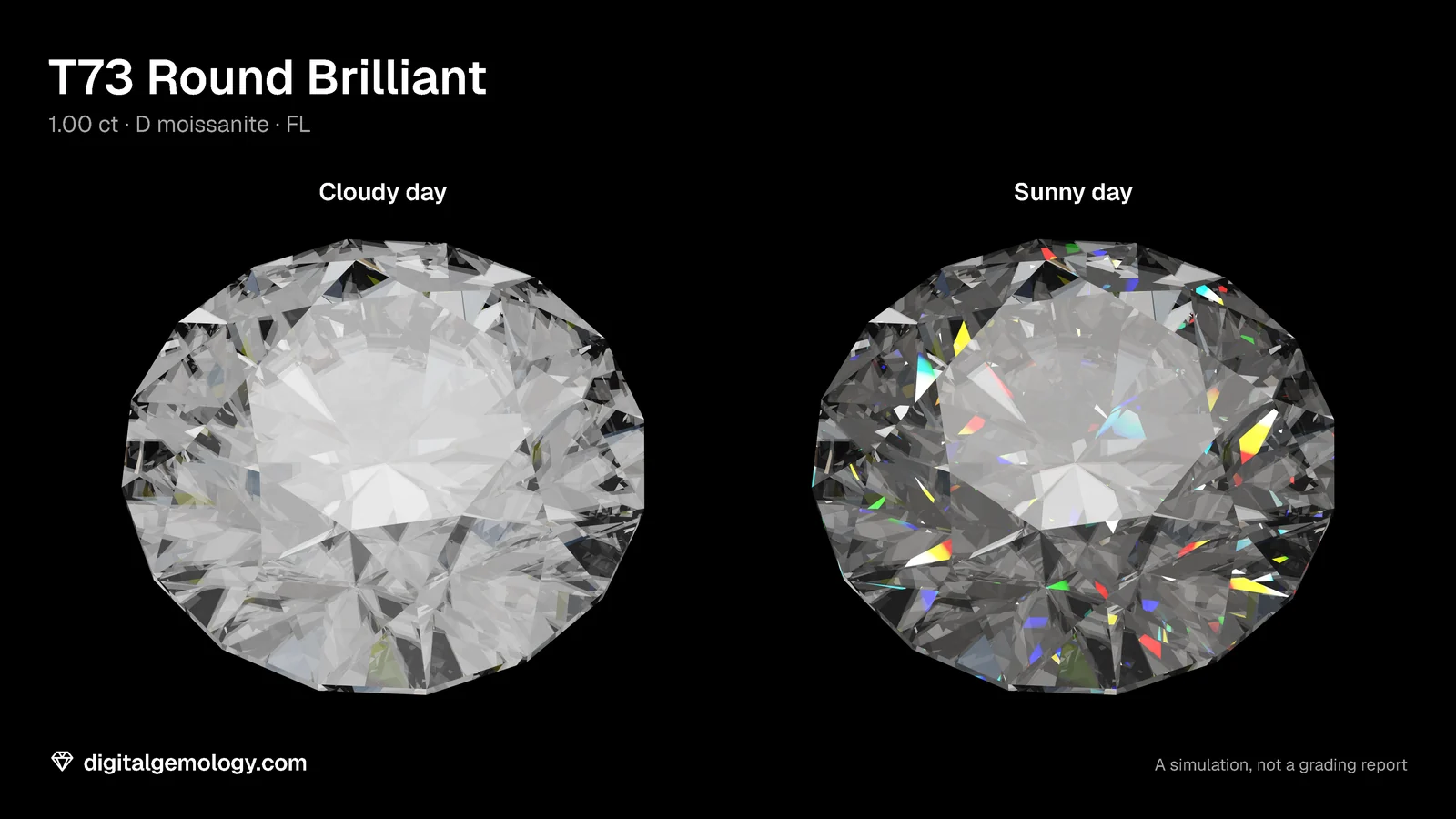
The light show. Under a cloudy sky, soft light arrives from everywhere. The colored fans overlap and wash out, and even moissanite looks calm and white. Under direct sun, colored flashes appear. Then come the photographers' flashes on the red carpet and the isolated spots of the club. There the moissanite erupts with color. Under exactly the same light, the diamond flashes less often and in smaller sparks. Fire needs small, bright light sources: the same moissanite can look quiet at the office and like a prism at dinner.
Is more fire better? That's taste. Some people love the rainbow; others feel it gives the stone away. For identification, fire is a hint, never a proof. A well-cut diamond under spotlights shows plenty of fire too.
Key points
- Fire is the flashes of spectral color that a stone throws. It comes from dispersion: the index is higher for violet than for red.
- Moissanite's dispersion, 0.104, is about 2.4 times diamond's 0.044: the biggest optical gap between the two stones.
- In the same T73, moissanite gains 19 points of fire and loses 7 of brilliance. Scintillation is unchanged.
- Moissanite out-fires diamond in 36 of the 37 cuts we score. DG-M5 gains the most (67 to 100).
- Fire shows under small, bright lights and almost vanishes under soft, even light. It's a clue, not a proof.
Go further: the moissanite gemstone page ranks the top ten cuts in moissanite. DG-M5's cut page has its files.
Try it free
- Cut Performance Wheel: Compare brilliance, fire and scintillation of two cuts, or one cut in two stones.
- 3D Gemstone Simulator: Turn a cut in seven gemstones and set its carat, color, clarity and cut grade.
- Spectroscope: Read a gemstone's absorption lines through a prism or a grating.
Free, in your browser, no account.
Quick quiz
Five questions on this lesson, a couple of minutes. Pick an answer and see at once if you got it, and why.
Cuts in this lesson
We sell the files of these cuts: 3D models and cutting files, with a personal-use license.
Keep exploring
- Next lesson: The loupe test: doubled facet edges in moissanite
- Try another topic · Historic diamond cuts: the history of the brilliant: Tolkowsky's 1919 ideal cut: the brilliant that was calculated
Previous lesson · Diamond vs moissanite: all lessons · All topics