
Transcript
Tolkowsky started from one number: the refractive index of diamond, 2.417.
From it, he calculated the critical angle of diamond: 24° 26′, or 24.4°.
Past that angle from the perpendicular, a facet reflects all the light inside.
He worked on a 2D slice: a flat top and two pavilion facets at an angle, a.
A ray comes straight down. It meets the first facet at the pavilion angle, a.
It reflects to the opposite facet, and meets it at 180° − 3a.
Then it meets the top at 180° − 4a. Under 24.4°, it gets out.
At 40.75°, the three angles are 40.75°, 57.75° and 17.0°. All three pass.
Change the pavilion angle, and the ray still comes back up. Its exit angle changes.
So Tolkowsky needed one more rule to fix the angle. It was about fire.
His rule: a bigger exit angle spreads the colors more, but lets less light out.
He took their product as brilliancy. It is largest at an exit angle of 45°.
To leave at 45°, the ray must meet the top at 17.0°.
So 180° − 4a = 17°. That gives a pavilion angle of 40.75°, or 40° 45′.
His view: a steeper pavilion would reflect better, but not make up for the lost fire.
He set the crown by the same rule: a balance of brilliance and fire.
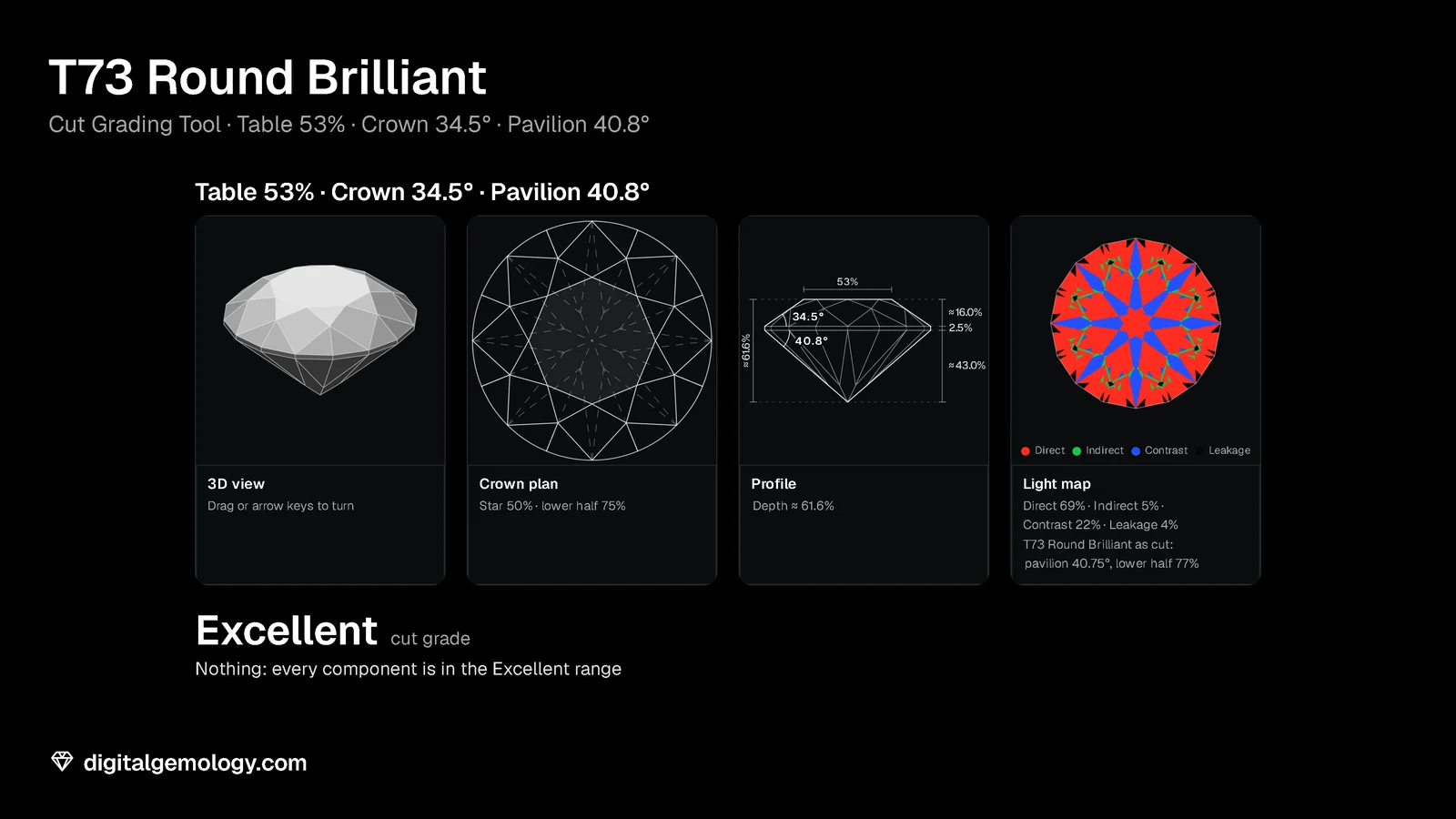
His 1919 numbers: pavilion 40° 45′, crown 34° 30′, table 53%.
His model was a 2D slice, with light from straight above and at most two reflections.
Then he measured well-cut stones of his day. They were strikingly close to his numbers.
Five hundred years of trial and error
Every cut before 1919 came from trying: a better wheel, a new facet plan, a machine that rounds. Nobody had calculated what shape a diamond should be. In 1919, Marcel Tolkowsky, an engineer from a family of diamond cutters, opened his book Diamond Design with that point. The art, he wrote, had progressed entirely by trial and error. His aim was to calculate the best shape.
The technology: the saw, and mathematics
The saw. Around 1900, inventors patented motorized rotary saws for diamond (1901 and 1902). Until then a cutter could only split a rough along its cleavage planes or grind it away. A saw could cut a stone wherever the cutter chose, even across the grain. So two stones could come out of one octahedron, with less waste. The saw and good lathes for bruting made it practical to cut every stone to the same round plan. So the crystal did not have to decide the shape.
Mathematics. Tolkowsky's tools were geometry, trigonometry and one number: diamond's refractive index, 2.417. From it he calculated diamond's critical angle, 24° 26′ (24.4°). When light strikes the inside of a facet at more than that angle from the perpendicular, the facet reflects all of it. At less, the light leaks out.
How he worked it out
He split the problem in two.
- The pavilion: keep the light in. A ray that comes straight down through the table must reflect completely off one pavilion facet, then off the opposite one. Then it must go back up through the front. His calculation for this gave a pavilion angle of 40.75°.
- The crown: share the light out as fire. Steeper crown facets spread the colors further apart but let less light through. Flatter ones do the reverse. Tolkowsky set the crown where the product of the two is largest, a balance of brilliance and fire: 34.5°, with a table of 53%.
He then measured well-cut stones of his day and found them strikingly close to his numbers. He also noted the price: even a perfectly cut brilliant loses at least 52% of its rough.
What he left out
Tolkowsky worked on a two-dimensional slice through the stone, with light coming straight from above. He followed each ray for at most two reflections. Real light enters from every direction, and real rays bounce many times. His answer was a very good start, not the last word. Today a computer can do each of these: see Past the 1919 ceiling: DG-Miliano and the modern brilliant.
Our model: the T57
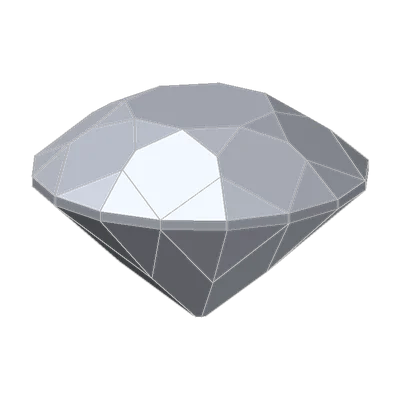
Our T57 is Tolkowsky's plan as he drew it: 57 facets (table, 32 crown, 24 pavilion), no culet, and a knife-edge girdle, with no girdle facets at all. Crown 34.5°, pavilion 40.8°, 59.2% deep. The T73, our benchmark on the Wheel, has the same angles plus 16 girdle facets: 73.
Try it yourself
- Open Cut Performance Wheel with
?cut=t57-round-brilliant&stone=diamond. Set the comparison cut to the old European. Read brilliance, fire and scintillation. - Set the comparison cut to the T73. The angles are the same; only the girdle is different. Which score moves?
- Open 3D Gemstone Simulator with
?cut=t57-round-brilliant&stone=diamond, Turn on Slow, lighting Sunny day. Then load the old European. Look at the center of each stone.
What the Wheel and the simulator show
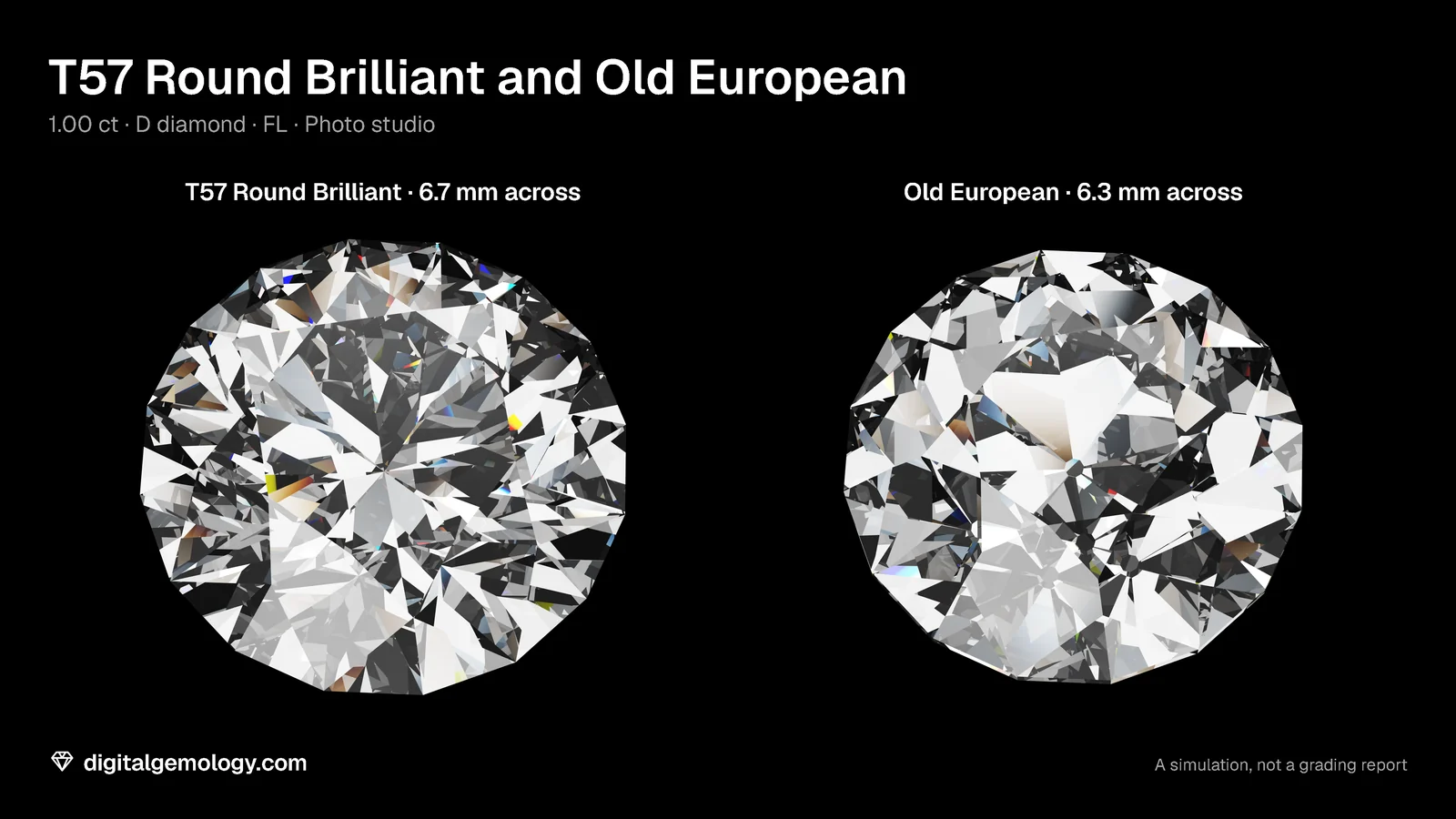
Against the old European. The T57 scores 92 for brilliance against 90, and 79 for fire against 74. The calculation pays off most in fire. Scintillation is 72 against 81, which looks like a step back. It isn't one, as the next comparison shows.
Against the T73. Same crown, same pavilion, same table. Brilliance 92 vs 93, fire 79 vs 78: practically identical. Scintillation 72 vs 80. The difference is the girdle. The T73 has 16 girdle facets (and a girdle band, so it's a little deeper, 61.7% against 59.2%). The Wheel counts scintillation from the facets that reach the surface: 57 facets give 72, 73 give 80. So the knife-edge girdle, not the angles, gives the T57 its lower number. Our old European model has 16 girdle facets, so it gets the higher count. On a plain girdle, its 58 facets would score 72 too (faceted girdles are a recent habit: see the Peruzzi).
Where the light comes back. In the simulator, compare the centers. The old European's table is much smaller (45% against 53%), so you see more crown facets face-up. The T57 shows you a wide, open table with the pavilion's reflections behind it.
What Tolkowsky changed. Not a facet, not a tool on the bench, but the method. From 1919, you could design a cut on paper from the properties of the material, before you touched a stone. Every modern round is built on his numbers.
Key points
- Motorized diamond saws (patented 1901 and 1902) and good lathes let cutters cut every stone to the same plan, with less waste.
- Tolkowsky calculated his cut from diamond's refractive index (2.417) and critical angle (24° 26′):
- pavilion 40.75° to keep light in
- crown 34.5° to balance light and fire
- table 53%.
- His model was a 2D slice, with light straight from above and at most two reflections.
- On our Wheel, the T57 beats the old European in brilliance (92 vs 90) and fire (79 vs 74).
- The T57 and T73 share the same angles. The T73's 16 girdle facets raise scintillation from 72 to 80.
Go further: the T57 round brilliant page has the 1919 plan with its knife-edge girdle, and the T73 page the version with girdle facets.
Try it free
- Cut Performance Wheel: Compare brilliance, fire and scintillation of two cuts, or one cut in two stones.
- Brightness & Tilt Analysis: Face-up brightness under four standard lights, and how it holds as the stone tilts.
- 3D Gemstone Simulator: Turn a cut in seven gemstones and set its carat, color, clarity and cut grade.
Free, in your browser, no account.
Quick quiz
Five questions on this lesson, a couple of minutes. Pick an answer and see at once if you got it, and why.
Cuts in this lesson
We sell the files of these cuts: 3D models and cutting files, with a personal-use license.
Keep exploring
- Next lesson: Hearts and arrows diamonds: precision you can see
- Try another topic · Diamond anatomy and proportions: Crown angle and crown height in a round diamond
Previous lesson · Historic diamond cuts: the history of the brilliant: all lessons · All topics