Transcript
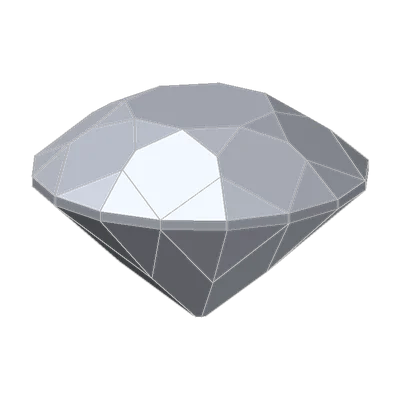
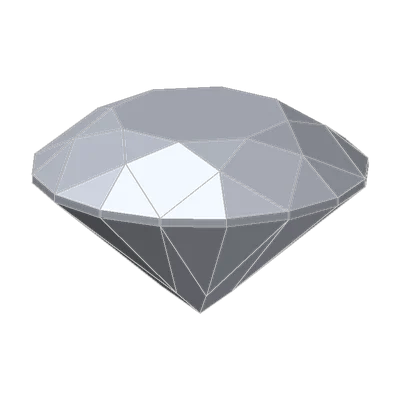
This 10-second clip has no sound. What you see:
The old mine and the old European turning side by side at the same carat weight and true size, the old European brighter in the center.
Two hundred years of cushions
Since the Mazarin, every brilliant had been a cushion. Not by choice. To round a diamond, you grind its outline against another diamond. This is called bruting, and by hand nobody could do it accurately. Careful handwork had already made the old mine cut rounder and neater, and it got darker.
In the 1870s, a machine finished the job.
The technology: the bruting machine
Two things arrived together in the second half of the 1800s.
A machine. In Boston, the jeweler Henry Morse opened a diamond-cutting workshop around 1860. His foreman, Charles Field, built a mechanical bruting machine to replace rounding by hand. The two also brought dimensional gauges into the trade, so a cutter could measure a stone and not judge it by eye. Tolkowsky thought mechanical bruting more likely started in Amsterdam or Antwerp, where nearly all diamonds were cut. Either way, by the 1870s a cutter could make a diamond truly round.
More rough. In 1866 the first diamond was found in South Africa. Within a few years the Kimberley mines produced diamonds on a scale the world had never seen. With plenty of rough, cutters could afford to give up weight for beauty. Morse is remembered for exactly that bet: a smaller stone that looks better sells better.
Why round matters
On a cushion, the facets at the corners and those along the sides can't sit at the same angle, as the Peruzzi shows. On a circle, they can. The cutter can give every pavilion main one angle. Once that angle is right everywhere, the stone no longer needs to be thick. Tolkowsky describes it this way: as the corners shrank in, the stones could be cut less thick, with more fire and life.
That's the old European cut:
- the same 58 facets as the Peruzzi and the old mine: nothing added (our model again adds 16 girdle facets, for 74);
- a round outline;
- a thinner stone (64.7% deep in our model, against the old mine's 65.6% and the Peruzzi's 69.1%), with a small table (45%), a crown of 35.0° and a pavilion of 41.5°.
It became the standard round and stayed on the market until about 1930. Most antique round diamonds you'll find are old Europeans.
Try it yourself
- Open Cut Performance Wheel with
?cut=old-european&stone=diamond. Set the comparison cut to the old mine. Read brilliance, fire and scintillation. - Set the comparison cut to the T73, our modern benchmark. Read the Global row too.
- Open 3D Gemstone Simulator with
?cut=old-european&stone=diamond, lighting Sunny day. Then change to the old mine. Where did the dark areas go?
What the Wheel shows
The biggest jump on our scoreboard. Brilliance goes from 59 to 90: 31 points, with the same facets. Leakage drops from 32% to 5%. Against the Peruzzi, the 58-facet cut it comes from, leakage falls from 19% to 5%.
Fire and sparkle hold. Fire rises a little, 72 → 74. Scintillation stays at 81: same facets, same count.
Close to modern. Against the T73, the old European is 90 / 74 / 81 against 93 / 78 / 80. On the Wheel's Global score, it's 88 against 90: within two points of the modern benchmark.
What about "more fire than a modern round"? You'll often read that old Europeans have more fire than modern brilliants. Our model doesn't show it: 74 against the T73's 78. The small table does make large, slow flashes, and people may mean those. But measured as a share of returned light, the modern round comes out ahead. Try it in the simulator under Club lighting and judge for yourself.
The main point. No new facets. No new plan. A machine made the outline round, and with it came a single, correct pavilion angle all the way around. Technology, not decoration, closed the gap.
Key points
- Mechanical bruting (1870s) made diamonds truly round for the first time. Dimensional gauges arrived with it.
- South Africa's mines (from 1866) gave plenty of rough, so cutters could trade weight for beauty.
- On a round outline, every pavilion main can share one angle, so the cutter can make the stone thinner.
- The old European keeps the same 58 facets. Against the old mine, brilliance goes 59 → 90 and leakage 32% → 5%: the biggest jump on our scoreboard of eight cuts.
- It ends within two points of the T73 on the Wheel's Global score (88 vs 90). Its fire (74) is below the T73's (78) in our model.
Go further: the old European cut page has the diagram, the 3D model and the cutting file for antique-style work.
Try it free
- Cut Performance Wheel: Compare brilliance, fire and scintillation of two cuts, or one cut in two stones.
- 3D Gemstone Simulator: Turn a cut in seven gemstones and set its carat, color, clarity and cut grade.
Free, in your browser, no account.
Quick quiz
Five questions on this lesson, a couple of minutes. Pick an answer and see at once if you got it, and why.
Cuts in this lesson
We sell the files of these cuts: 3D models and cutting files, with a personal-use license.


Keep exploring
- Next lesson: Tolkowsky's 1919 ideal cut: the brilliant that was calculated
- Try another topic · The bow-tie effect: Fixing a bow-tie: the steep belly of DG-Bowtie
Previous lesson · Historic diamond cuts: the history of the brilliant: all lessons · All topics