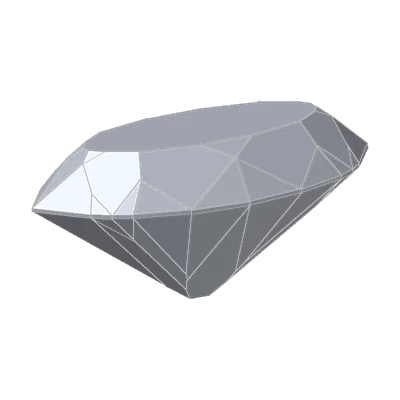
Transcript
DG-Bowtie: 87 facets, 93.8% deep, and a black band across the belly.
Take a slice across the belly. Follow the light that comes straight down.
The belly facets of DG-Bowtie are cut at 52.0° to 53.5°. Here: 52.3°.
The light meets the facet at 52.3°. That is far above 24.4°, the critical angle.
So the facet works as a mirror. It sends the light across to the opposite facet.
There it arrives at 180° − 3 × 52.3° = 23.1°. That is less than 24.4°.
The gray cone holds every angle below 24.4°. Light inside it gets out.
So the light goes out through the back of the stone. That facet goes dark.
Now change the belly facet angle. Watch the angle at the opposite facet.
The light flips at (180° − 24.4°) ÷ 3 = 51.9°. Steeper than that, it leaks.
DG-Bowtie's belly tiers: 52.0°, 52.3° and 53.5°. All three are past the limit.
The next tiers toward the points, 49.0° and 49.3°, are below it. The band stops there.
The Marquise keeps the outline and all 87 facets. Every tier is 9.5° to 11° lower.
Its belly facets sit at 41.0° to 42.5°. The light meets the opposite facet at about 56°.
That is far past 24.4°. So the light reflects again and comes back up to you.
Lower angles make a shallower stone: 93.8% deep before, 62.0% after.
Real light comes from every angle. The light map shows the full picture.
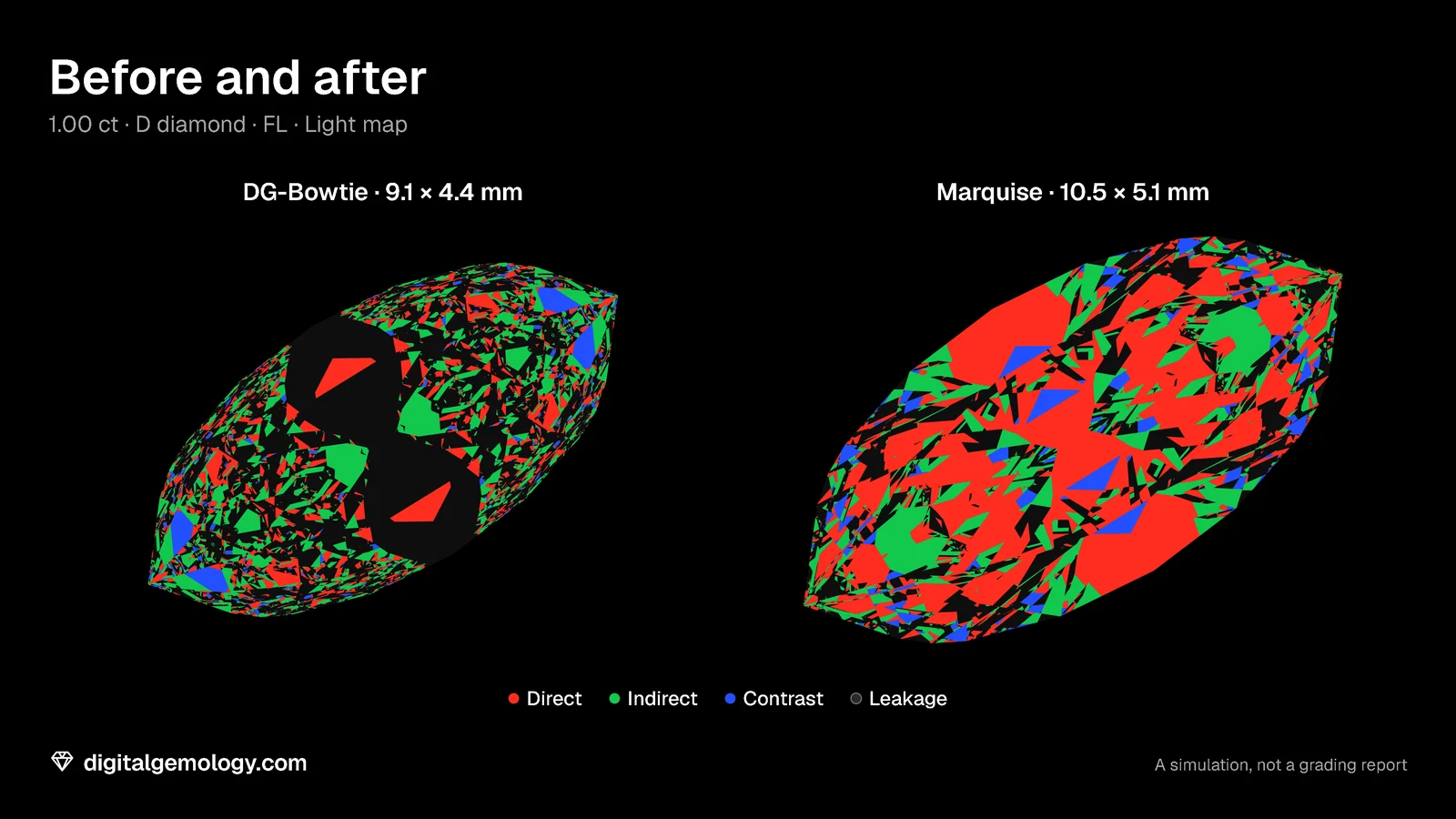
Leakage falls from 59% to 25%. No organized band across the belly.
The cost: at the same face-up size, the Marquise weighs about a third less.
The starting point: DG-Bowtie
A deep belly gets cut because it keeps carats. And the marquise is the hardest shape to cut well. So this is the real test: take the hardest shape, with a bow-tie in it, and fix it.
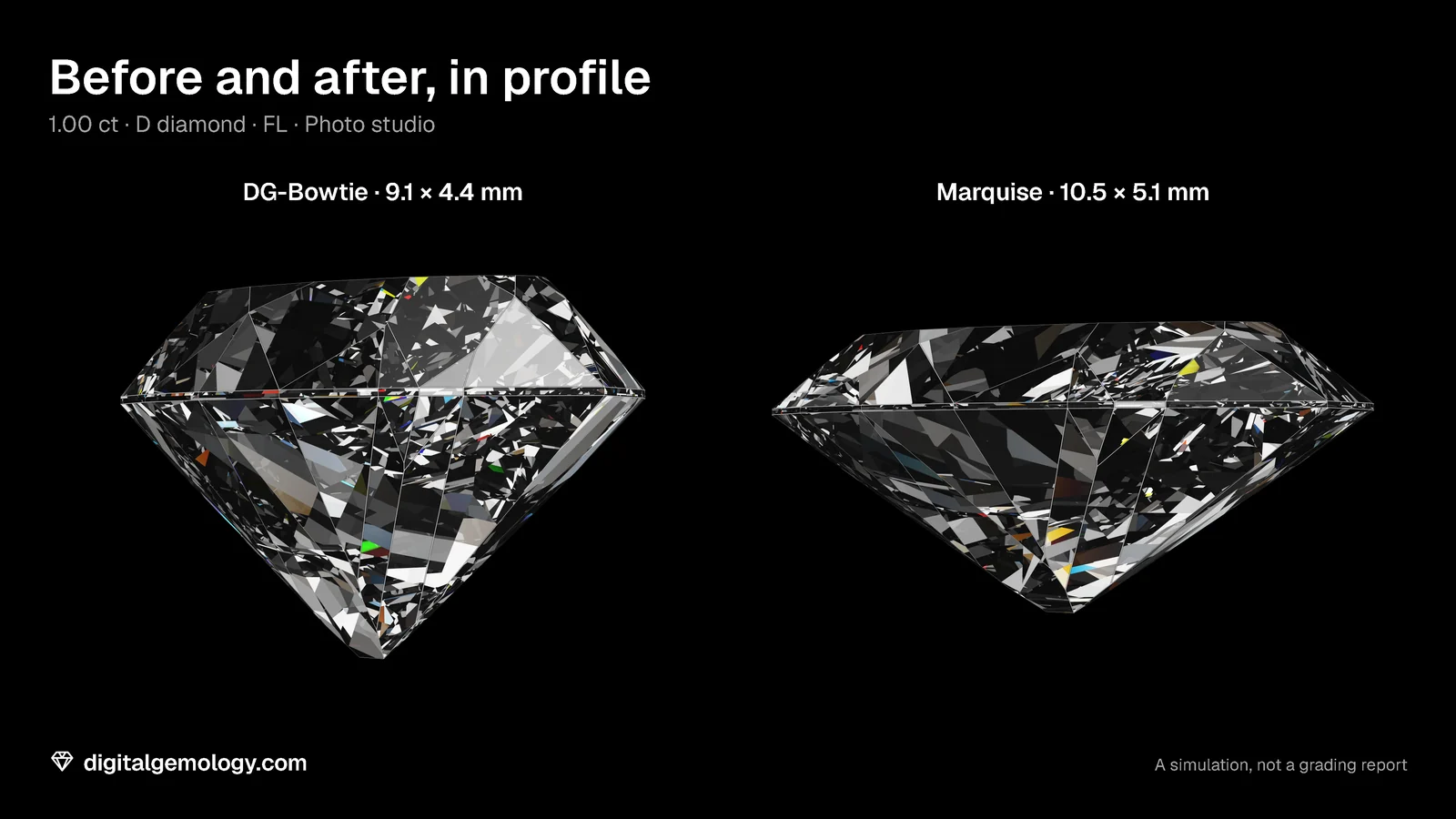
Here's where we start. DG-Bowtie, the first marquise in our library: 87 facets, 2.06 to 1, 93.8% deep, and a black band across the belly. Light Return: 15% direct, 21% indirect, 5% contrast, 59% leakage.
The diagnosis
GIA's marquise guide notes that bow-ties are especially common in diamonds with "either shallow or very deep pavilions". DG-Bowtie is the very deep kind. Here's exactly what that does.
Take a slice across the belly. Follow the light that comes straight down through the table.
- It meets a belly pavilion facet. DG-Bowtie's belly facets are cut at 52.0° to 53.5°. That's far above diamond's critical angle, 24.4°. So the facet acts as a perfect mirror and sends the light across to the opposite facet.
- It meets the opposite belly facet. Geometry fixes the angle: it arrives 180° − 3 × 52.3° = 23.1° from straight-on. That's less than 24.4°, so this time the facet doesn't reflect. The light goes straight out through the back of the stone.
The limit is easy to work out: (180° − 24.4°) ÷ 3 = 51.9°. In diamond, a pair of belly facets steeper than about 51.9° lets head-on light out of the back on its second bounce. All three of DG-Bowtie's belly tiers are past it (52.0°, 52.3° and 53.5°). The next tiers toward the points, at 49.0° and 49.3°, are below it. That's why the band stops at the shoulders.
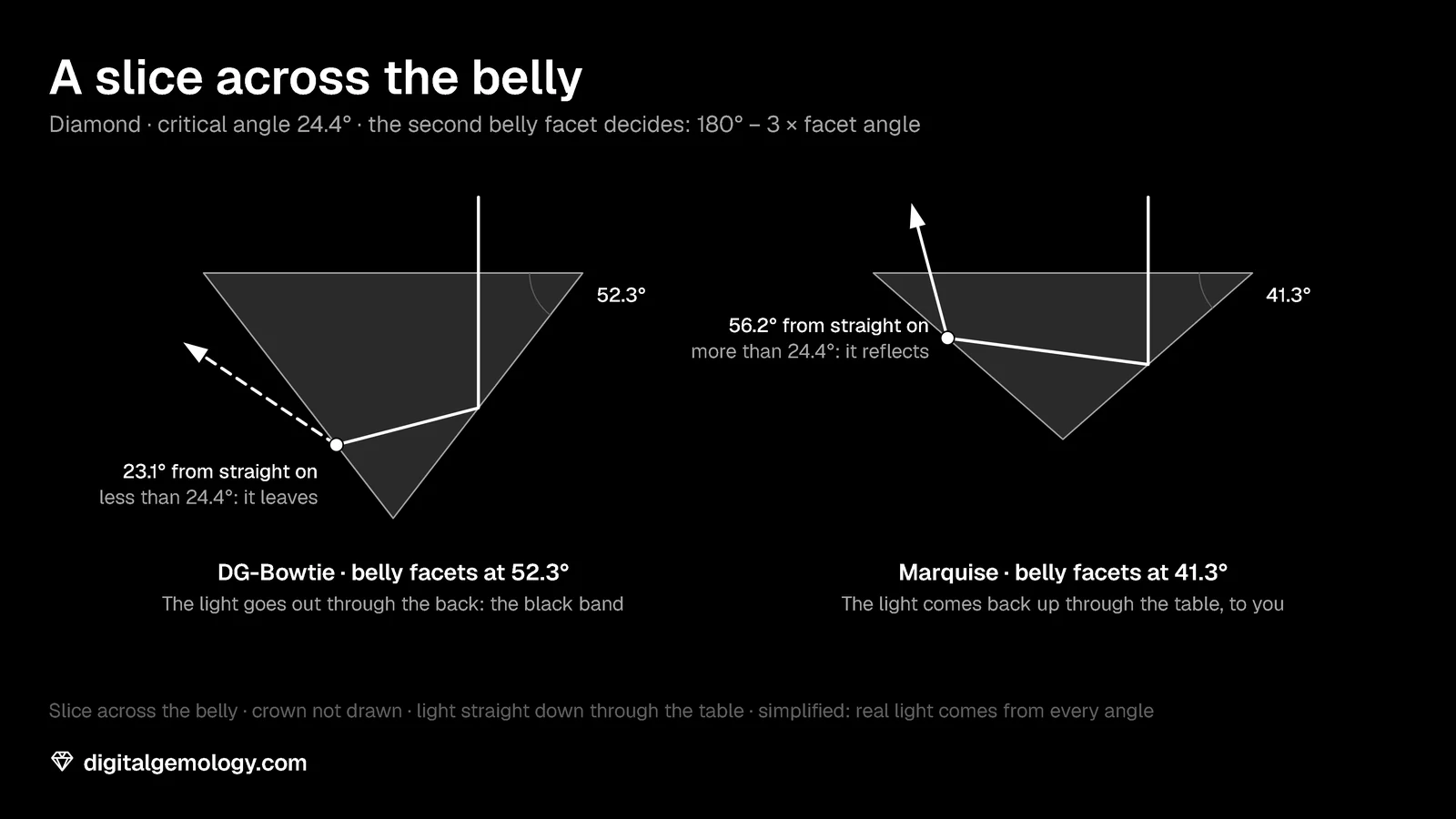
(This is a simplified slice. Real light arrives from every angle, so we read the full picture from the light map. But the slice shows the heart of it.)
The animation at the top of this page shows the same slice.
What we changed
We kept everything a buyer would recognize: the outline (2.06 to 1), all 87 facets, each one in the same position around the stone. And we lowered every crown and pavilion tier, by about 9.5° to 11°.
| DG-Bowtie | Marquise | |
|---|---|---|
| Belly pavilion facets | 52.0°–53.5° | 41.0°–42.5° |
| Pavilion facets at the points | 41.0° | 30.5° |
| Steepest crown facets | 54.5° | 43.6° |
| Total depth | 93.8% | 62.0% |
| Facets, outline | 87, 2.06 to 1 | 87, 2.06 to 1 |
The belly facets now sit at 41.0° to 42.5°, close to the T73's 40.75° and far below the 51.9° limit. Light that comes down through the table meets the opposite facet at about 56°, well past the critical angle. So it reflects again and comes back up to you. The points went shallower, to 30.5°. In diamond, that angle still reflects head-on light: the Marquise cut page measures 100% of its pavilion holding head-on light in diamond.
The result
| 1.00 ct diamond | DG-Bowtie | Marquise |
|---|---|---|
| Light Return (direct, indirect, contrast, leakage) | 15, 21, 5, 59% | 47, 22, 6, 25% |
| Brilliance (Cut Performance Wheel) | 27 | 64 |
| Fire | 82 | 89 |
| Scintillation | 86 | 86 |
| Brightness & Tilt ISO, head shadow 20° | 24.6% | 57.1% |
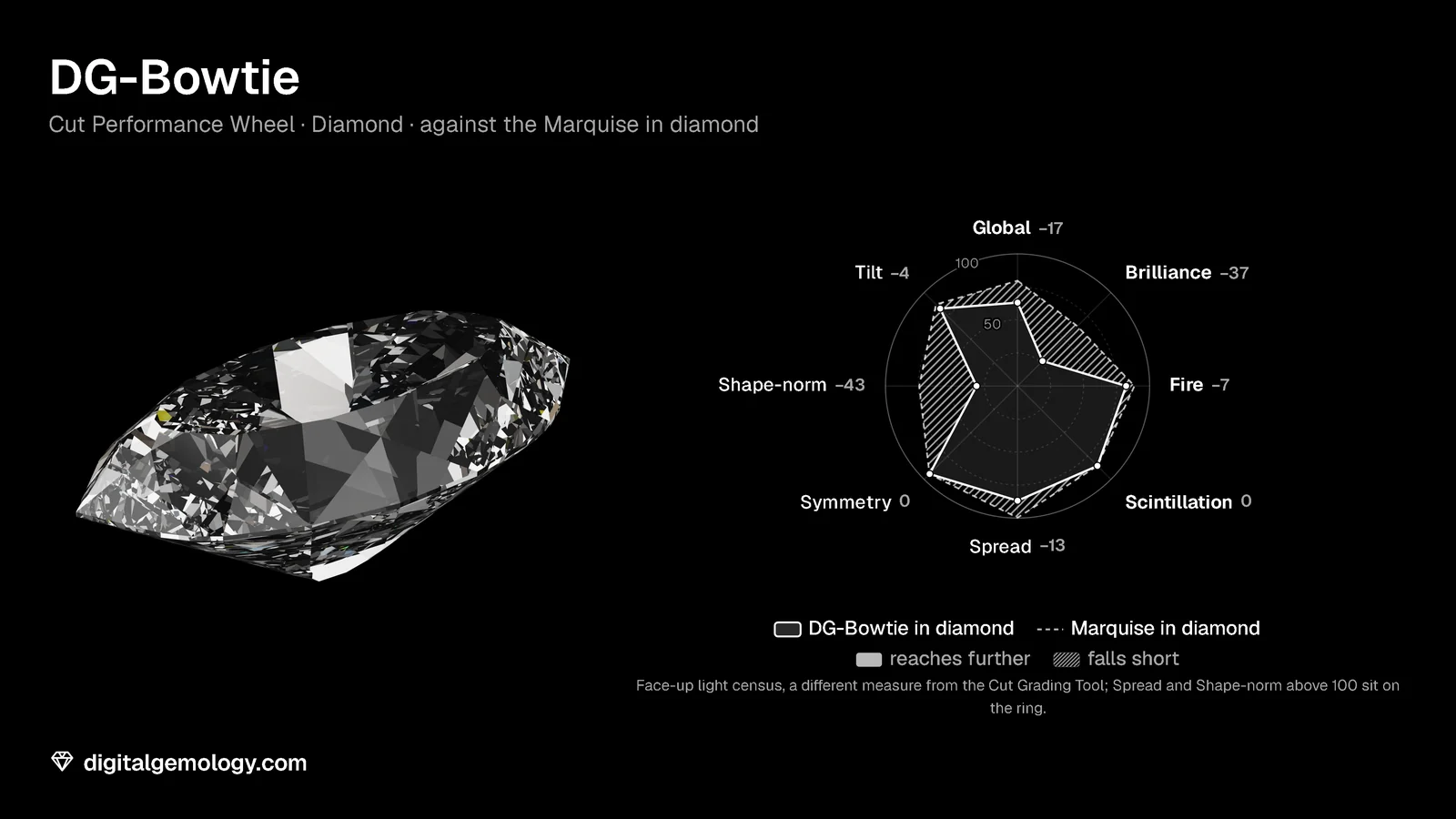
Scintillation didn't move. The Wheel reads it from the pattern of facets, and the pattern is the same. Everything that depends on the angles moved together.
The stress test
A fix that only works in a good room isn't a fix. So:
- Every room. In all eight lightings bright enough to judge, the Marquise shows no band. DG-Bowtie's band shows in every one, white or dark. (Club and UV lamp are too dark for either stone.)
- Your head. At the largest head shadow, the Marquise keeps 47.2% under ISO against DG-Bowtie's 23.2%.
- Tilt. With a 20° head shadow and a tilt from −30° to +30°, the tool's tilt chart keeps the Marquise between 50.8% and 58.6% under ISO. DG-Bowtie stays between 25.0% and 37.9%. (The chart uses a coarser grid than the face-up table above, so face-up figures differ by a few tenths.)
What it cost
A rebuild presented as free would be a sales pitch. Here's the bill.
- Weight. At the same face-up size, the Marquise weighs a third less: about 0.66 ct where DG-Bowtie weighs 1.00 ct. That's the "compromise elsewhere" the Natural Diamond Council warns about, and it's real.
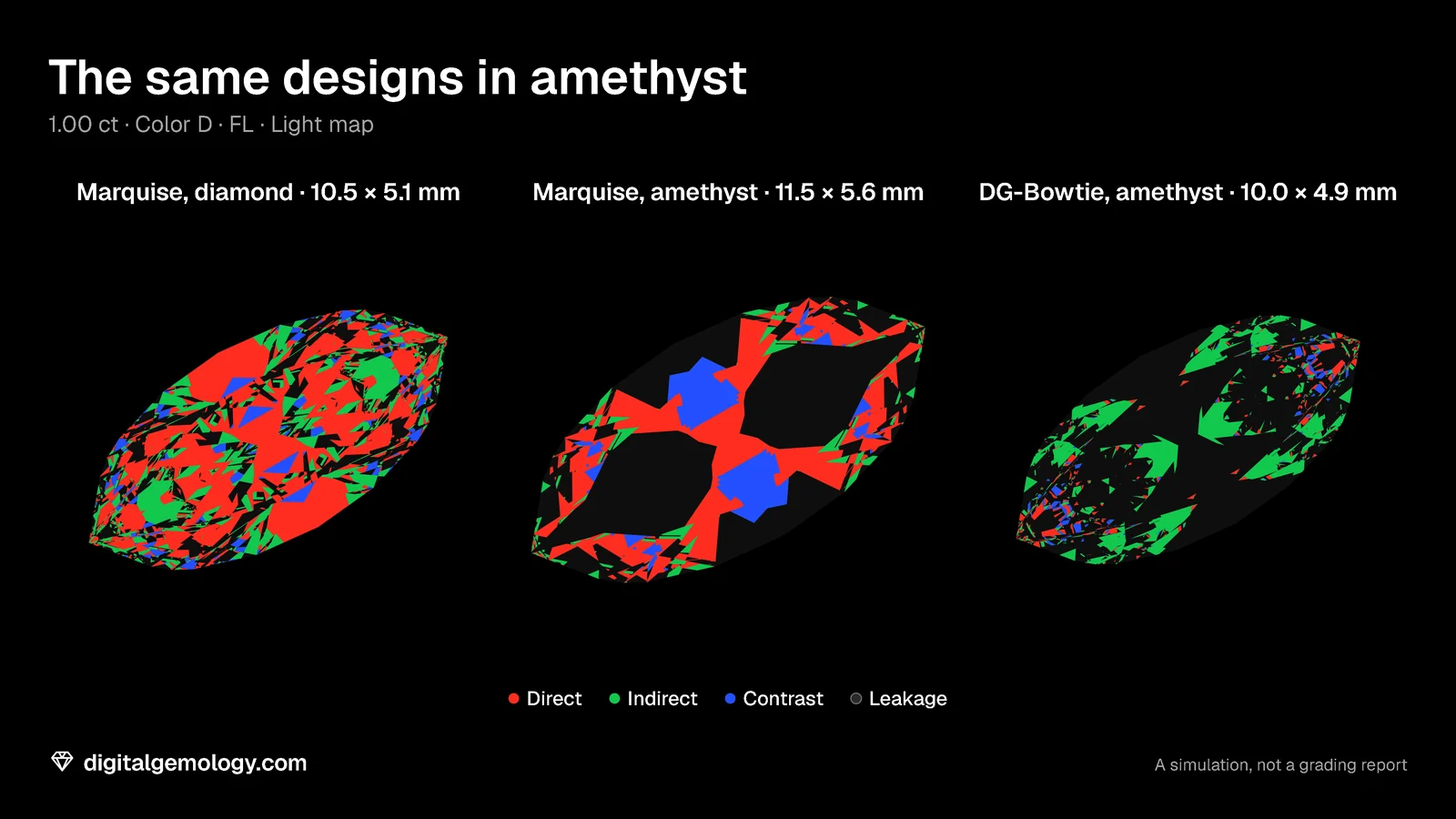
- It's a diamond fix. The Marquise's lower angles are matched to diamond. Amethyst has a critical angle of 40.4°. In amethyst, the shallower facets toward the points let head-on light straight out on the first bounce. Large windows open at both ends (Light Return 28/5/10/57). Its belly facets, at 41.0°–42.5°, still just hold. Its cut page advises a steeper pavilion for ruby, sapphire, emerald and amethyst. (DG-Bowtie in amethyst is worse still: 75% leakage.)
- Scatter remains. The Marquise still leaks 25%, in scattered facets and toward the points. So we say no organized band across the belly, never "no dark at all".
- The points are as sharp as before. Same outline, same points, so they still need protection in a setting, usually with V-prongs.
The short version
The bow-tie is always in the stone. It is only sometimes on your finger.
The room decides when you see it. The angles decide whether it's there. So we changed the angles.
Try it yourself
- Open 3D Gemstone Simulator with DG-Bowtie, Light map on, then the Marquise. Read both Light Return bars.
- Open Cut Performance Wheel with DG-Bowtie against the Marquise. Which axis didn't move?
- Open Brightness & Tilt Analysis with DG-Bowtie against the Marquise, Head shadow 20°. Drag Tilt from −30° to +30°.
- Back in the simulator, set the Marquise to Amethyst, light map on. What came back?
- The cutter's challenge: work out the deep limit for belly facets in moissanite (critical angle 22.2°) and in cubic zirconia (27.7°), using (180° − critical angle) ÷ 3.
What the tools show
DG-Bowtie's belly facets, at 52.0° to 53.5°, are just past diamond's 51.9° limit. So head-on light leaves through the opposite facet: the black band. The Marquise keeps the outline and all 87 facets. It lowers every tier by about 9.5° to 11° and puts the belly at 41.0° to 42.5°. Leakage falls from 59% to 25%, brilliance rises from 27 to 64, and fire from 82 to 89. The band of leakage is gone in every room bright enough to judge, under every head shadow and at every tilt.
The cost: a third less weight at the same face-up size, a cut matched to diamond only, and scatter that remains. In the challenge: about 52.6° in moissanite and 50.8° in cubic zirconia.
Key points
- DG-Bowtie's belly facets sit at 52.0°–53.5°. In diamond, when they pass about 51.9°, head-on light leaves through the opposite facet: that's the band.
- The fix kept the outline, the 87 facets and their positions. It lowered every tier by about 9.5° to 11°. Belly facets now sit at 41.0°–42.5°.
- Leakage 59% → 25%, brilliance 27 → 64, fire 82 → 89, scintillation unchanged.
- No band of leakage in any of the eight lightings bright enough to judge, at any head shadow or tilt.
- The costs: a third less weight at the same size, a diamond-only fix (windows open at the ends in amethyst), and scatter that remains. A bow-tie is a decision, and it can be decided differently.
Sources
- GIA 4Cs, marquise diamond guide, 29 November 2016: bow-ties especially common with shallow or very deep pavilions.
- Grant Mobley, "The Bow Tie Effect in Diamonds: What It Is and Why It Shouldn't Scare You", Only Natural Diamonds (Natural Diamond Council), 31 March 2026: removing it entirely "can lead to compromises elsewhere in the stone".
Go further: both stones' cutting files and 3D models are on the Marquise and DG-Bowtie cut pages.
Try it free
- Brightness & Tilt Analysis: Face-up brightness under four standard lights, and how it holds as the stone tilts.
- Cut Performance Wheel: Compare brilliance, fire and scintillation of two cuts, or one cut in two stones.
- 3D Gemstone Simulator: Turn a cut in seven gemstones and set its carat, color, clarity and cut grade.
Free, in your browser, no account.
Quick quiz
Why does light leave through the back of DG-Bowtie's belly?
- The facets are badly polished
- After one reflection it meets the opposite belly facet at less than the critical angle
- The table is too large
Show the answer
b: 180° − 3 × 52.3° = 23.1°, less than 24.4°.
What is diamond's deep limit for a pair of belly facets, for light coming straight down?
- About 40.75°
- About 51.9°
- About 60°
Show the answer
b: (180° − 24.4°) ÷ 3.
What did the rebuild keep, and what did it change?
Show the answer
It kept the outline, the 87 facets and their positions; it lowered every crown and pavilion tier by about 9.5° to 11°.
Why didn't scintillation change on the Wheel?
Show the answer
It's read from the pattern of facets, and the pattern is the same.
Name two costs of the fix, with a number for each.
Show the answer
Any two: about 0.66 ct instead of 1.00 ct at the same face-up size; in amethyst, windows open at the ends (57% leakage); 25% scatter remains.
Cuts in this lesson
We sell the files of these cuts: 3D models and cutting files, with a personal-use license.
Keep exploring
- Next lesson: How to check a stone for a bow-tie: a bench routine
- Try another topic · Historic diamond cuts: the history of the brilliant: Tolkowsky's 1919 ideal cut: the brilliant that was calculated
Previous lesson · The bow-tie effect: all lessons · All topics