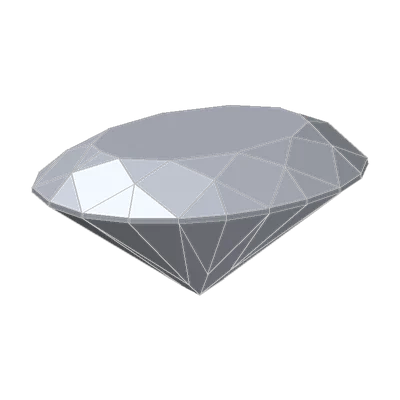
Four lists
DG-Bowtie, a marquise, has a dark band across its belly. The next question everyone asks is: which other shapes get one?
Four well-known sources answer it, each from long experience with real stones:
| Shape | GIA's shape guides | Natural Diamond Council | Estate Diamond Jewelry | Ritani |
|---|---|---|---|---|
| Oval | "always present", in some degree | listed | among the most common | "will exhibit" it |
| Pear | "many" show one | listed | among the most common | "can also" show one |
| Marquise | "typically" some degree | listed | among the most common | "can also" show one |
| Heart | (no guide read) | listed | among the most common | "sometimes even" |
| Radiant | (no guide read) | not listed | "possible" in its table | "sometimes even" |
| Cushion | (no guide read) | not listed | prose: no; table: possible; FAQ: can | not prone |
| Princess | (no guide read) | not listed | table: no; FAQ: cannot | not prone |
| Round | not listed | not listed | no | not prone |
They agree on the core: ovals, pears and marquises, and never the round. After that, the lists differ. Estate Diamond Jewelry gives the cushion three different answers in three parts of one guide. That isn't carelessness. "Cushion" is a name for an outline, and two cushions can have completely different facet designs inside it.
Two of the sources also give a reason. Ritani says round, cushion and princess are spared for two reasons: light is evenly distributed in them, and they're "symmetrically shaped". Estate Diamond Jewelry says the effect typically occurs in elongated cuts that follow the brilliant faceting pattern. Let's test both reasons.
Symmetry, or distance?
Our Oval and our Marquise are perfectly symmetric: each half mirrors the other, lengthwise and across (the cut pages say "2-fold mirror-image symmetry"). So symmetry alone can't separate a round from an oval.
What separates them is distance. Measure from the center of the stone out to the girdle:
- In a round, it's the same in every direction.
- In an elongated stone, it's short across the belly and long toward the ends. In our Marquise, the distance to a point is 2.06 times the distance to the side.
Now look at the pavilion. All its facets slope down from the girdle to the bottom of the stone. The bottom sits at one depth: a point in a round, a short line (the keel) in a marquise. A facet that starts close to the center, across the belly, must slope steeply to reach that depth. A facet that starts far out, toward a point, slopes gently.
So a round can use one main pavilion angle all the way round. The T73 uses 40.75°, the angle Marcel Tolkowsky worked out for diamond in 1919. An elongated stone can't. It needs a spread of pavilion angles, and only some of its facets can sit near that ideal. Our cutting files show the spread:
| Cut | Length to width | Pavilion angles | Spread |
|---|---|---|---|
| T73 | 1.00 | 40.75° | one main angle |
| Oval | 1.33 | 35.7° to 43.3° | 7.6° |
| Marquise | 2.06 | 30.5° to 42.5° | 12.0° |
| Pear | 1.50 | 33.2° to 47.0° | 13.8° |
The pear isn't the longest, but it's the most lopsided: a round end on one side and a point on the other. Its angles vary the most.
That's the criterion behind every list: how much the distance from the center changes around the girdle, and how sharp the ends are. GIA's pear guide puts it in one line: a bow-tie gets darker as the difference between length and width increases and "pavilion angle variations become more extreme". Estate Diamond Jewelry's word "elongated" was the right one. A cushion or a princess can sit anywhere on that scale: its design decides where. That is why the lists can't agree on them.
Try it yourself
- Open 3D Gemstone Simulator. Turn on Light map and load the T73. Read its leakage on the Light Return bar.
- The ranking game. Before you load them, rank the Oval, the Pear and the Marquise by how much they leak, from least to most. Write your guess down.
- Load each one and read its leakage. Where does the black sit: a band across the belly, the ends, or scattered?
- Open Cut Performance Wheel with the Marquise in diamond. Compare it with the Oval.
What the light maps show
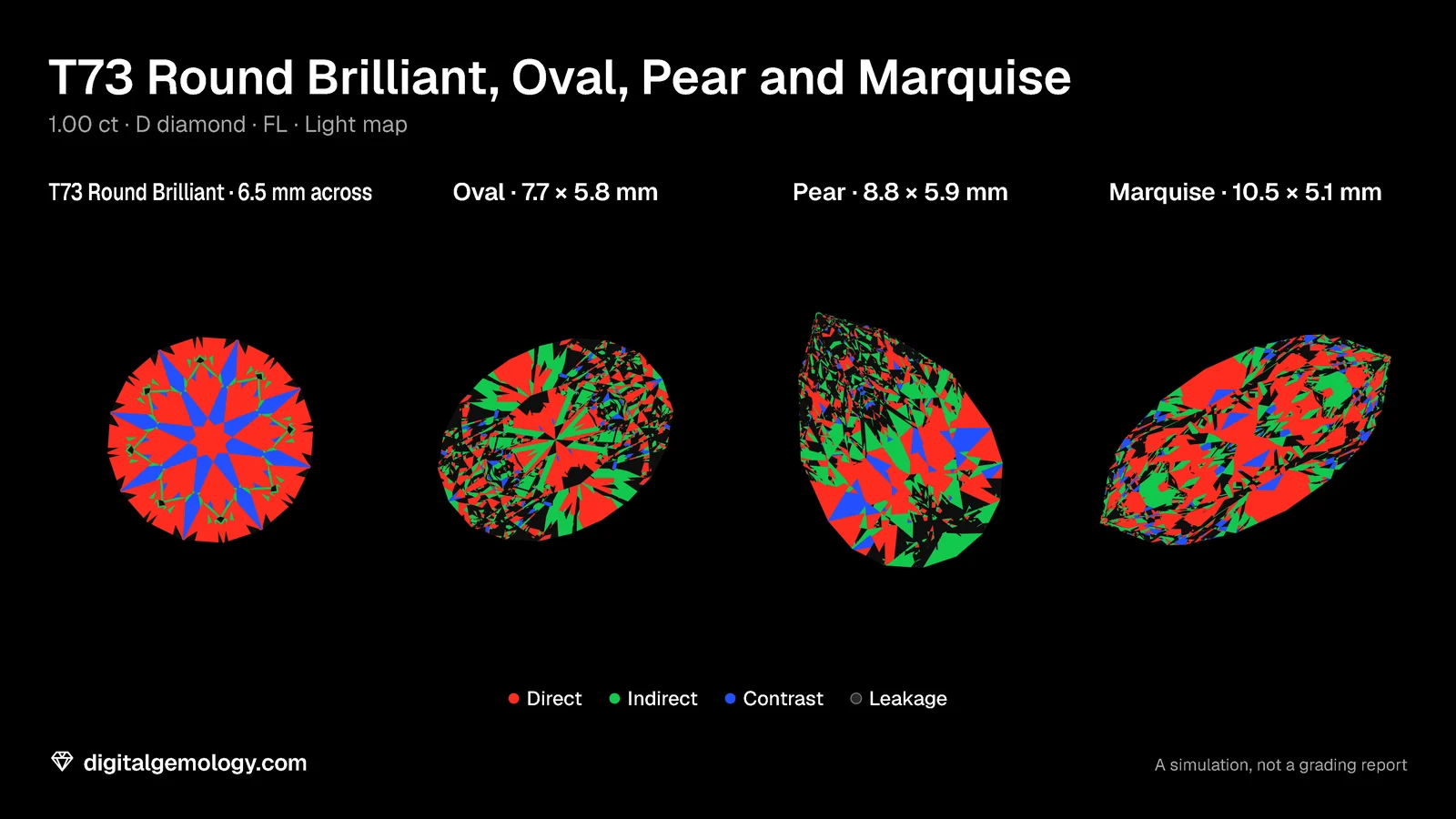
| 1.00 ct diamond | Direct | Indirect | Contrast | Leakage |
|---|---|---|---|---|
| T73 | 69% | 5% | 22% | 4% |
| Marquise | 47% | 22% | 6% | 25% |
| Pear | 35% | 26% | 8% | 31% |
| Oval | 33% | 27% | 3% | 38% |
Most people guess the Marquise leaks most: it's the longest and the pointiest. It leaks least of the three. Its belly is solid red. The Pear's black is scattered toward its point. The Oval's black sits in two patches at its ends, not across its belly.
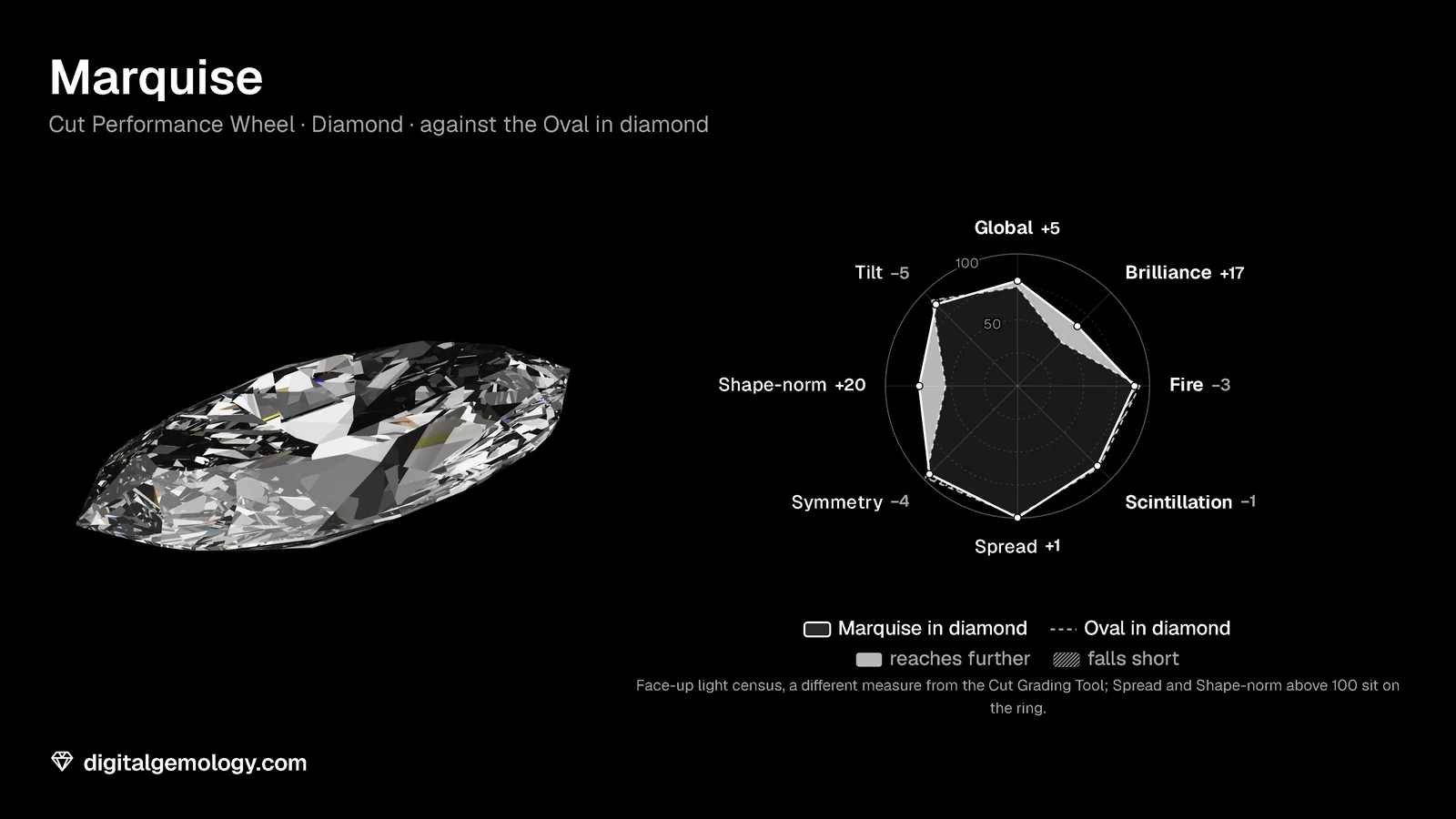
The Wheel says the same thing: brilliance 64 for the Marquise against 47 for the Oval. Fire (89 and 92) and scintillation (86 and 87) are close.
So the marquise is the hardest outline to cut well. It is the most stretched of the common shapes and pointed at both ends, with a 12° spread of pavilion angles to manage. Hardest isn't condemned. The angles decide, and DG-Bowtie has the very same outline as our best-scoring elongated stone. Fixing a bow-tie shows where its angles went instead.
One side note on facet counts. GIA's oval guide says most ovals have 57 or 58 facets. Our Oval's cutting design has 93. More tiers give a cutter more angles to tune around the outline. But they don't fix a bow-tie by themselves: DG-Bowtie and the Marquise both have 87.
Key points
- The published lists agree on ovals, pears and marquises, and never the round. They differ on cushions, princesses, hearts and radiants, because each of those names covers many facet designs.
- Symmetry doesn't separate a round from an oval: both are symmetric. Distance from the center does.
- A round can use one main pavilion angle. An elongated stone needs a spread: 7.6° in our Oval, 12.0° in the Marquise and 13.8° in the Pear.
- The marquise is the hardest case, but our Marquise leaks less (25%) than our Pear (31%) and Oval (38%).
- The facet count doesn't decide it: DG-Bowtie and the Marquise both have 87 facets.
Sources
- GIA 4Cs, Oval Cut Diamond Guide, 23 September 2025: bow-tie always present in some degree; 57 or 58 facets.
- GIA 4Cs, marquise diamond guide, 29 November 2016, and pear diamond guide, 13 March 2018: bow-ties typical in marquises and shown by many pears.
- Grant Mobley, "The Bow Tie Effect in Diamonds: What It Is and Why It Shouldn't Scare You", Only Natural Diamonds (Natural Diamond Council), 31 March 2026: ovals, pears, marquises and hearts.
- Benjamin Khordipour, diamond bow-tie effect guide, Estate Diamond Jewelry, updated 15 April 2026: shapes table, cushion and princess answers, "elongated cuts".
- Kristin P, "What is a bow tie in an oval diamond", Ritani, 13 October 2025: shapes, "symmetrically shaped".
Go further: the Marquise cut page has its specifications and its scores in seven gemstones.
Try it free
- 3D Gemstone Simulator: Turn a cut in seven gemstones and set its carat, color, clarity and cut grade.
- Cut Performance Wheel: Compare brilliance, fire and scintillation of two cuts, or one cut in two stones.
Free, in your browser, no account.
Quick quiz
Which shapes do all four sources link to bow-ties?
- Round, cushion and princess
- Oval, pear and marquise
- Heart and radiant only
Show the answer
b: They differ on the others.
Why can a round brilliant use one main pavilion angle all the way round?
- It has more facets
- Its girdle is the same distance from the center in every direction
- It's more symmetric than an oval
Show the answer
b: The same distance everywhere means the same slope down to the culet everywhere.
In an elongated stone, which pavilion facets slope most steeply?
- The ones across the belly
- The ones at the points
- They all slope the same
Show the answer
a: They start closest to the center, so they must slope most steeply to reach the same depth.
A friend says the marquise is the worst shape for bow-ties, so every marquise has one. What does our Marquise show?
Show the answer
Hardest isn't condemned: our Marquise has a solid red belly and leaks only 25%, less than our Pear or Oval.
In the simulator, rank the T73, Oval, Pear and Marquise by leakage. Which surprised you?
Show the answer
T73 4%, Marquise 25%, Pear 31%, Oval 38%. Most people expect the Marquise to be last.
Cuts in this lesson
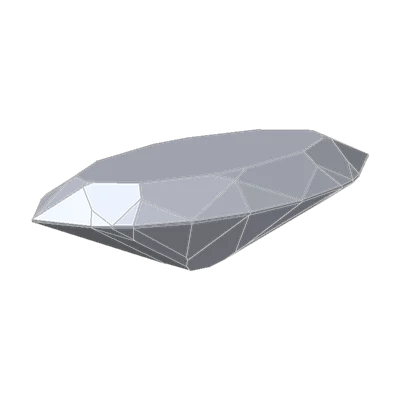
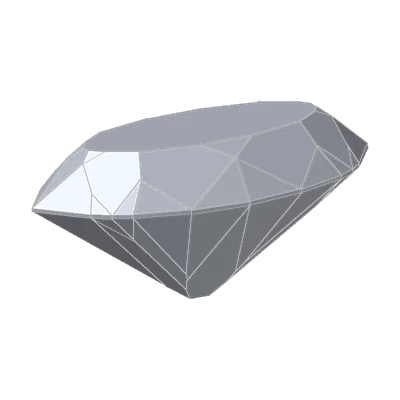
We sell the files of these cuts: 3D models and cutting files, with a personal-use license.
Keep exploring
- Next lesson: Bow-tie in the stone, sometimes on your finger: tilt and head shadow
- Try another topic · How to read a diamond grading report: The grades on a diamond report: color, clarity and cut
Previous lesson · The bow-tie effect: all lessons · All topics