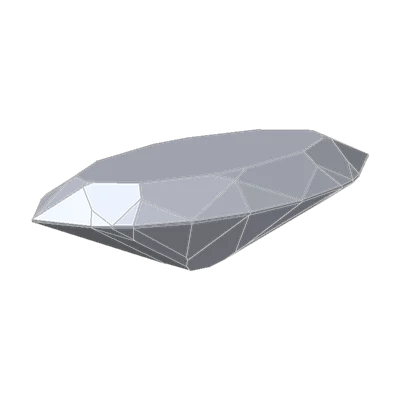
A fair question
A bow-tie across the belly can be avoided, even in a marquise. And the paperwork rarely catches one. So why are so many long stones still cut with one?
For the deep kind, like the band in our DG-Bowtie marquise, the answer is weight.
Same weight, different size
Put DG-Bowtie beside our Marquise, which has the same outline and facets but no band. Set both to the same weight, 1.00 ct each, in the Shopping center light.
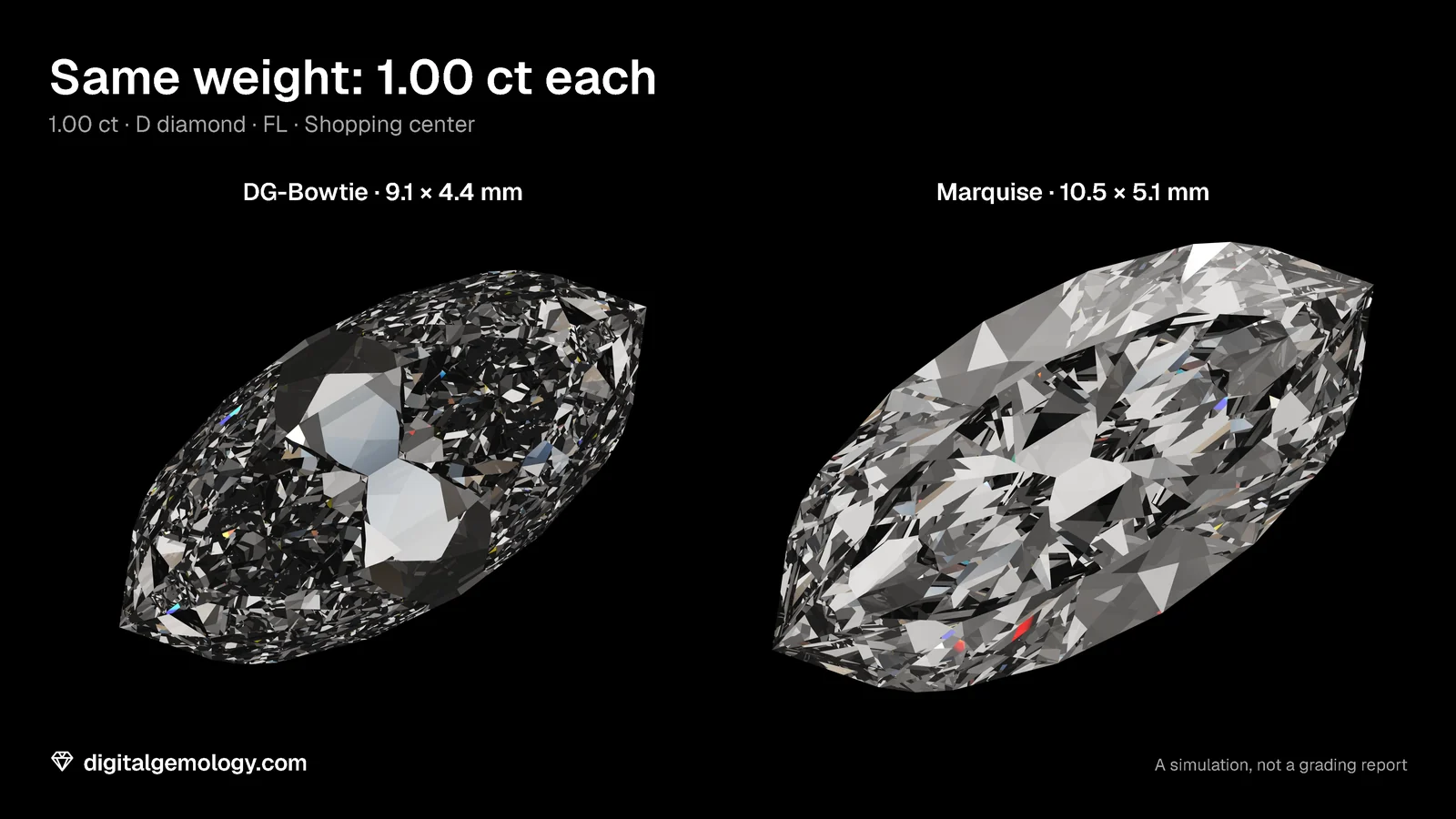
| 1.00 ct diamond | Length × width × depth |
|---|---|
| DG-Bowtie | 9.13 × 4.43 × 4.16 mm |
| Marquise | 10.47 × 5.08 × 3.15 mm |
The Marquise is 15% longer and has 31% more face-up area, for the same carats. DG-Bowtie hides its weight underneath, in a pavilion so deep that the stone is 93.8% as deep as it is wide. (Notice its belly in this shop light: pale and glassy, not dark. The room explains why.)
Same size, different weight
Now turn it around. Set DG-Bowtie to 1.50 ct and leave the Marquise at 1.00 ct.
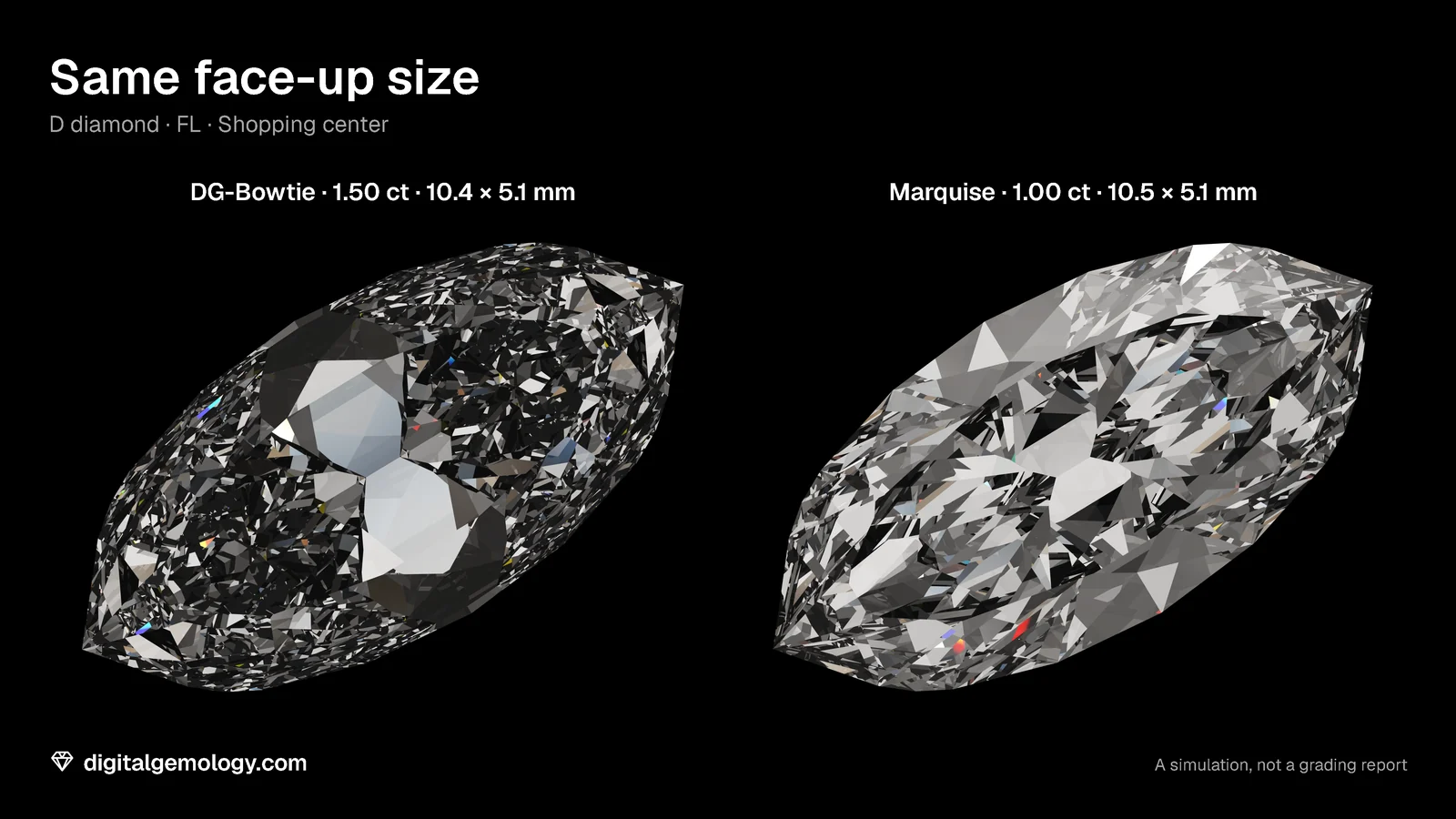
| Diamond | Carat | Length × width |
|---|---|---|
| DG-Bowtie | 1.50 ct | 10.45 × 5.07 mm |
| Marquise | 1.00 ct | 10.47 × 5.08 mm |
Face up, they're the same stone, to a few hundredths of a millimeter. One weighs half as much again as the other.
Weight follows the cube of size, so you can work out the other direction too. A Marquise with the face-up size of a 1.00 ct DG-Bowtie weighs (9.13 ÷ 10.47)³ × 1.00 ≈ 0.66 ct. The deep cut reaches the one-carat line. The light cut doesn't.
Why that decides so much
Diamonds are sold by weight. GIA's retailer training notes two things about how that works. Prices rise faster than weight, because larger diamonds are rarer. And round weights (a half, three quarters, one carat) carry a price step that the eye can't see.
So picture a cutter with a piece of rough. A deeper pavilion keeps more of the crystal as weight, and it can carry the stone over the one-carat line. A lighter, brighter cut gives up that weight to put angles where the light needs them.
The rough shapes the design in other ways too. GIA's oval guide notes that ovals longer than 1.50 to 1 are rarely seen because they're impractical to cut from diamond crystals.
None of this is hidden or dishonest. A buyer who wants the most carats for the money gets them in a deep stone. A buyer who wants the brightest stone for its weight wants the other one. When a bow-tie comes from a deep belly, as DG-Bowtie's does, it comes with the weight. It's a trade-off made at the wheel, not a law of optics.
(Not every bow-tie is a weight choice. GIA's marquise guide notes they're common in shallow pavilions too, and a shallow stone carries less weight, not more.)
And removing it does cost something. The Natural Diamond Council's article says that trying to eliminate a bow-tie entirely "can lead to compromises elsewhere in the stone". That's fair, and our rebuild names exactly what it cost our Marquise.
Try it yourself
- Open 3D Gemstone Simulator with DG-Bowtie at 1.00 ct, view Face up, lighting Shopping center. Note its measurements in the report.
- Switch to the Marquise at 1.00 ct. Which looks bigger? By how much?
- Set DG-Bowtie to 1.5 ct. Compare its measurements with the Marquise at 1.00 ct.
- The price-tag challenge: give both stones the same price per carat (any figure you like). What does each cost? Which would you rather wear, and which would a seller rather sell?
What the simulator shows
At 1.00 ct each, the Marquise is 10.47 × 5.08 mm and DG-Bowtie 9.13 × 4.43 mm: 31% more face-up area for the same weight. To look as big as the 1.00 ct Marquise, DG-Bowtie must weigh 1.50 ct. A Marquise as big as a 1.00 ct DG-Bowtie weighs only 0.66 ct, below the one-carat line. Give both the same price per carat. Of the two stones that look identical in size, the deep one costs 1.5 times as much. The extra money buys the band.
DG-Bowtie is an extreme case: 93.8% deep. Real stones sit anywhere between the two. The trade-off points the same way: a steeper belly keeps more weight.
Key points
- At the same weight, the Marquise has 31% more face-up area than DG-Bowtie.
- At the same face-up size, DG-Bowtie weighs 1.5 times as much (1.50 ct against 1.00 ct).
- Weight follows the cube of size: a Marquise the size of a 1.00 ct DG-Bowtie weighs about 0.66 ct.
- Diamonds are sold by weight. Prices rise faster than weight, and round weights carry a price step. A deep belly keeps carats.
- A bow-tie from a deep belly is a trade-off made at the wheel, not a law of optics.
Sources
- GIA, Retailer Training Modules, module 2 (2023): larger diamonds are rarer, so prices rise more steeply; round "magic" weights.
- GIA 4Cs, Oval Cut Diamond Guide, 23 September 2025: ovals above 1.50 to 1 are rarely seen, being impractical to cut from diamond crystals.
- Grant Mobley, "The Bow Tie Effect in Diamonds: What It Is and Why It Shouldn't Scare You", Only Natural Diamonds (Natural Diamond Council), 31 March 2026: trying to eliminate a bow-tie entirely "can lead to compromises elsewhere in the stone".
Go further: Carat weight vs size explains carat weight, size and the magic weights.
Try it free
- 3D Gemstone Simulator: Turn a cut in seven gemstones and set its carat, color, clarity and cut grade.
Free, in your browser, no account.
Quick quiz
At 1.00 ct each, which marquise looks bigger face up?
- DG-Bowtie
- The Marquise
- They look the same
Show the answer
b: 31% more face-up area for the same weight.
To look as big as the 1.00 ct Marquise, what must DG-Bowtie weigh?
- 1.00 ct
- 1.25 ct
- 1.50 ct
Show the answer
c: 1.50 ct gives 10.45 × 5.07 mm, the Marquise's size at 1.00 ct.
Why would a cutter keep a deep belly?
- It always looks brighter
- It keeps more of the rough as weight, which is what diamonds are sold by
- Labs require it
Show the answer
b: Weight is what's paid for, and a deep pavilion keeps it.
A Marquise is cut to the face-up size of a 1.00 ct DG-Bowtie. Roughly what does it weigh, and why does that matter at the counter?
Show the answer
About 0.66 ct, below the one-carat line, where round weights carry a price step.
In the price-tag challenge, what did your two stones cost at the same price per carat?
Show the answer
Open answer: the same-looking DG-Bowtie costs 1.5 times as much.
Cuts in this lesson
We sell the files of these cuts: 3D models and cutting files, with a personal-use license.
Keep exploring
- Next lesson: Fixing a bow-tie: the steep belly of DG-Bowtie
- Try another topic · The four Cs of diamonds: Diamond cut grade: Excellent vs Poor, side by side
Previous lesson · The bow-tie effect: all lessons · All topics