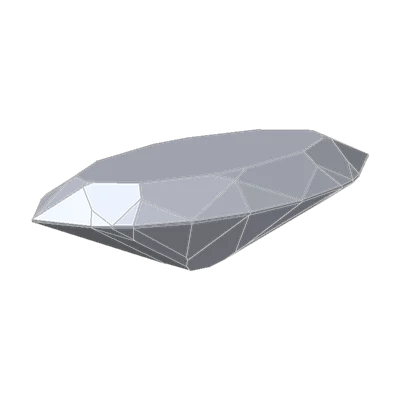
The biggest claim
DG-Bowtie is a marquise with a dark band across its belly, and we tested what that band is made of. Now the claim that matters most to anyone buying a long stone: can a bow-tie be avoided at all?
Our sources answer with different strengths:
- GIA's oval guide: a well-cut oval will "minimize the bow tie", but because of the shape and faceting pattern, "some degree of bow tie is always present".
- GIA's marquise guide: marquises "typically will have some degree of a bow-tie", and stones without one "usually lack brightness".
- The Natural Diamond Council: some degree "is almost inevitable in elongated cuts".
- Estate Diamond Jewelry: every brilliant-cut diamond "aside from perfectly round diamonds" has "some tiny degree of bow tie".
Two of them, GIA's oval guide and Estate Diamond Jewelry, say it's always there. GIA's marquise guide calls it typical, and the NDC calls it almost inevitable. These are careful statements, and they come from looking at a great many real stones. But "always" is a special word. To test a claim about every stone, you need to find one stone it doesn't fit.
One more thing to settle first: what kind of bow-tie? GIA's marquise guide describes the bow-tie as "a dark contrast where your head and shoulders are reflected". DG-Bowtie's band is a different thing: leakage, light leaving through the back. We'll test both.
First, two things GIA says that are simply true. GIA gives an overall cut grade only to round brilliants. So a marquise or oval report won't grade its cut. And GIA notes that bow-tie visibility can vary between stones with the same length-to-width ratio. That is a quiet hint that the cut decides, not the shape.
The counterexample: our Marquise
It has the same outline as DG-Bowtie, the same 87 facets and different angles.
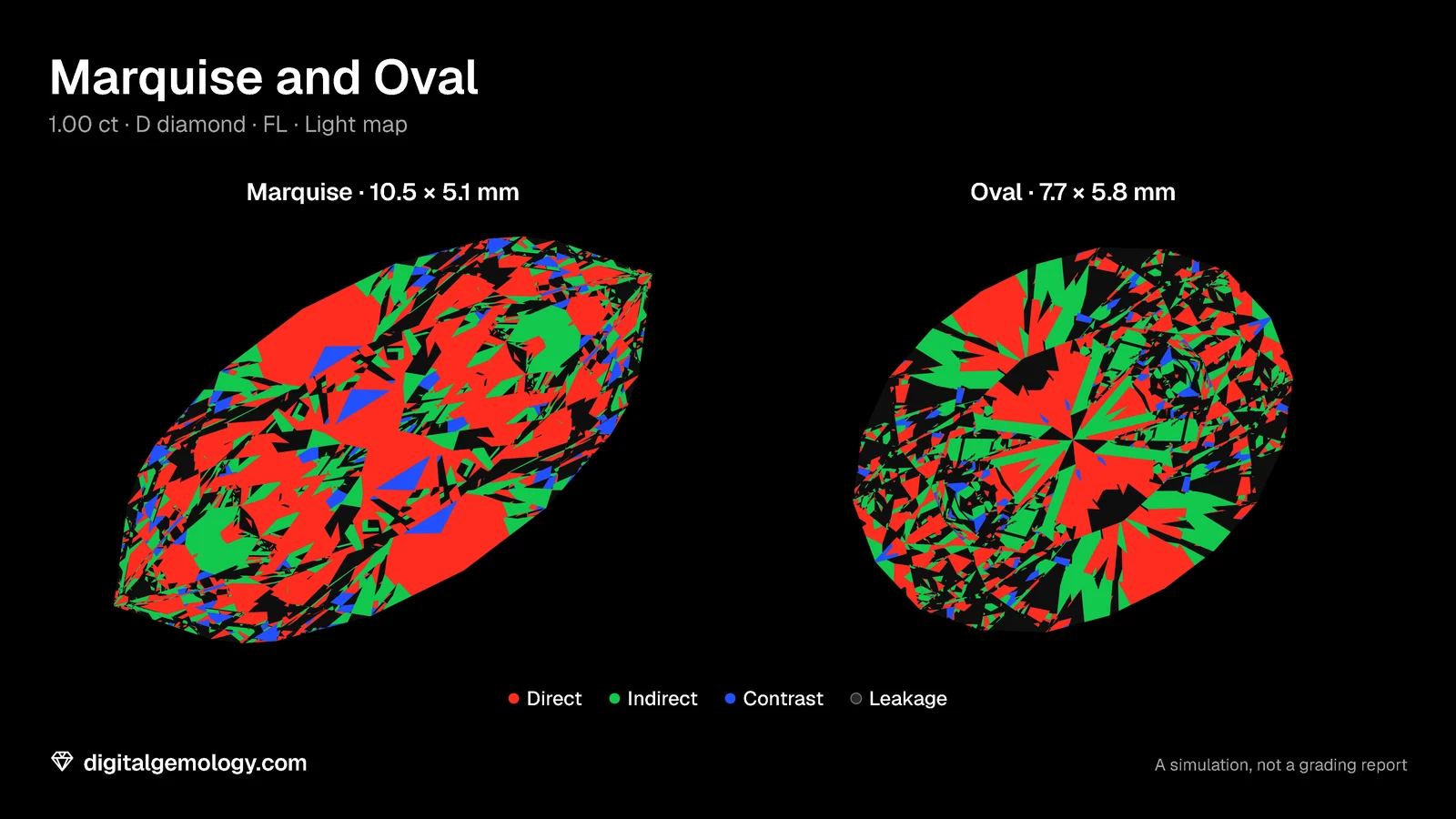
Its light map: 47% direct, 22% indirect, 6% contrast, 25% leakage. The belly, where the band is supposed to be, is the reddest part of the stone. There's black scattered through it, as in every stone, but no band runs across it.
And GIA's marquise guide expects a marquise without a bow-tie to lack brightness. Ours is the bright one: brilliance 64 on the Cut Performance Wheel, against DG-Bowtie's 27.
And an oval, for GIA's oval claim
GIA's "always present" is about ovals, so let's test an oval too. Our Oval's belly is red and green, with no band across it. It isn't perfect. It leaks 38%, more than the Marquise, and its black collects in two patches at its ends. At Home those ends look dark.
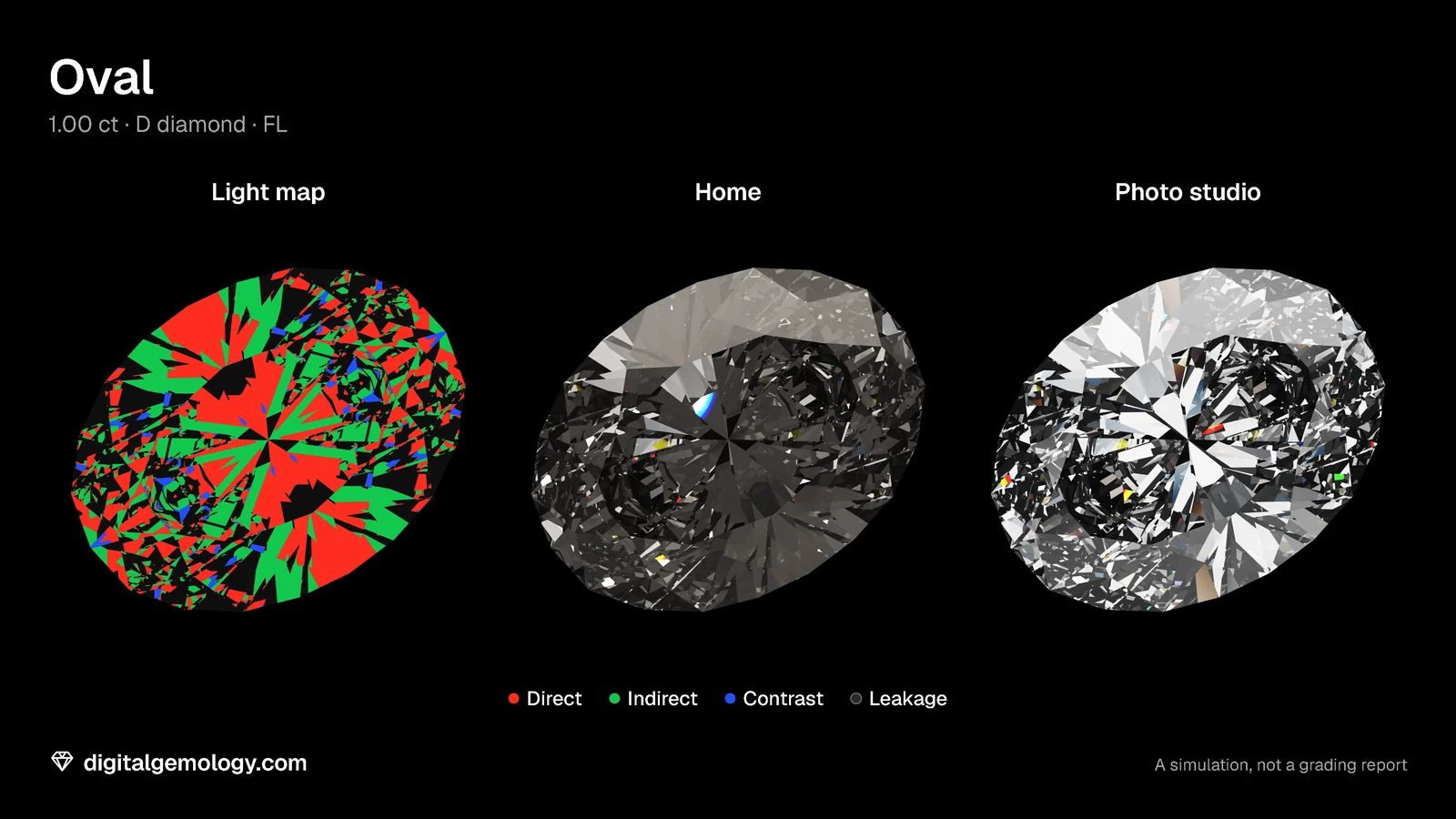
That's a different pattern, and an honest trade-off: the darkness went to the ends instead of the middle. So say exactly this and no more: no organized band across the belly. Not "no dark anywhere".
The stress test
One good picture could be luck: the right room, the right angle. So we push the Marquise as hard as our tools allow.
Ten rooms. Photo studio, Shopping center, Home and Cloudy day below, and the other six too. No band in any of the eight that are bright enough to judge. At Home and in the Restaurant, the whole stone is darker because the room is darker. But the middle stays with the rest. (Club and UV lamp are too dark for either stone.)
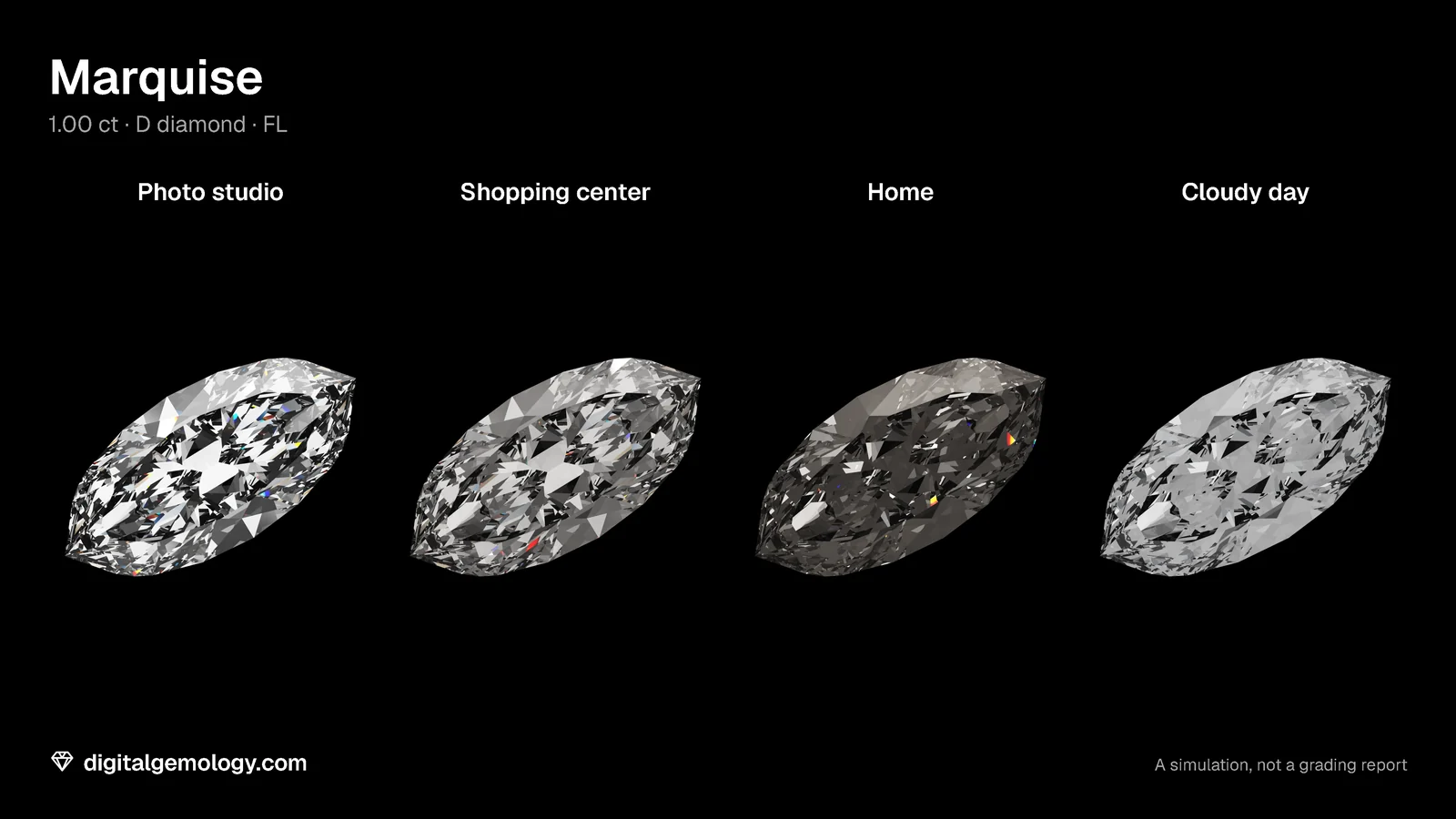
Your head. In Brightness & Tilt, with the head shadow at its largest (30°), the Marquise drops to 47.2% under ISO, still twice DG-Bowtie's 23.2%. And here GIA's head and shoulders do show up: a dark cross of separate facets appears in the Marquise's middle. That's your head reflected, the blue of its light map, and it fades as the head gets smaller (57.1% at 20°, 70.6% at 0°). By GIA's own description, that's a bow-tie of the head-and-shoulders kind. Under a head this big, every stone shows some. It's a pattern, not a band of leakage: the Marquise's Brightness & Tilt leakage stays at 22.1%.
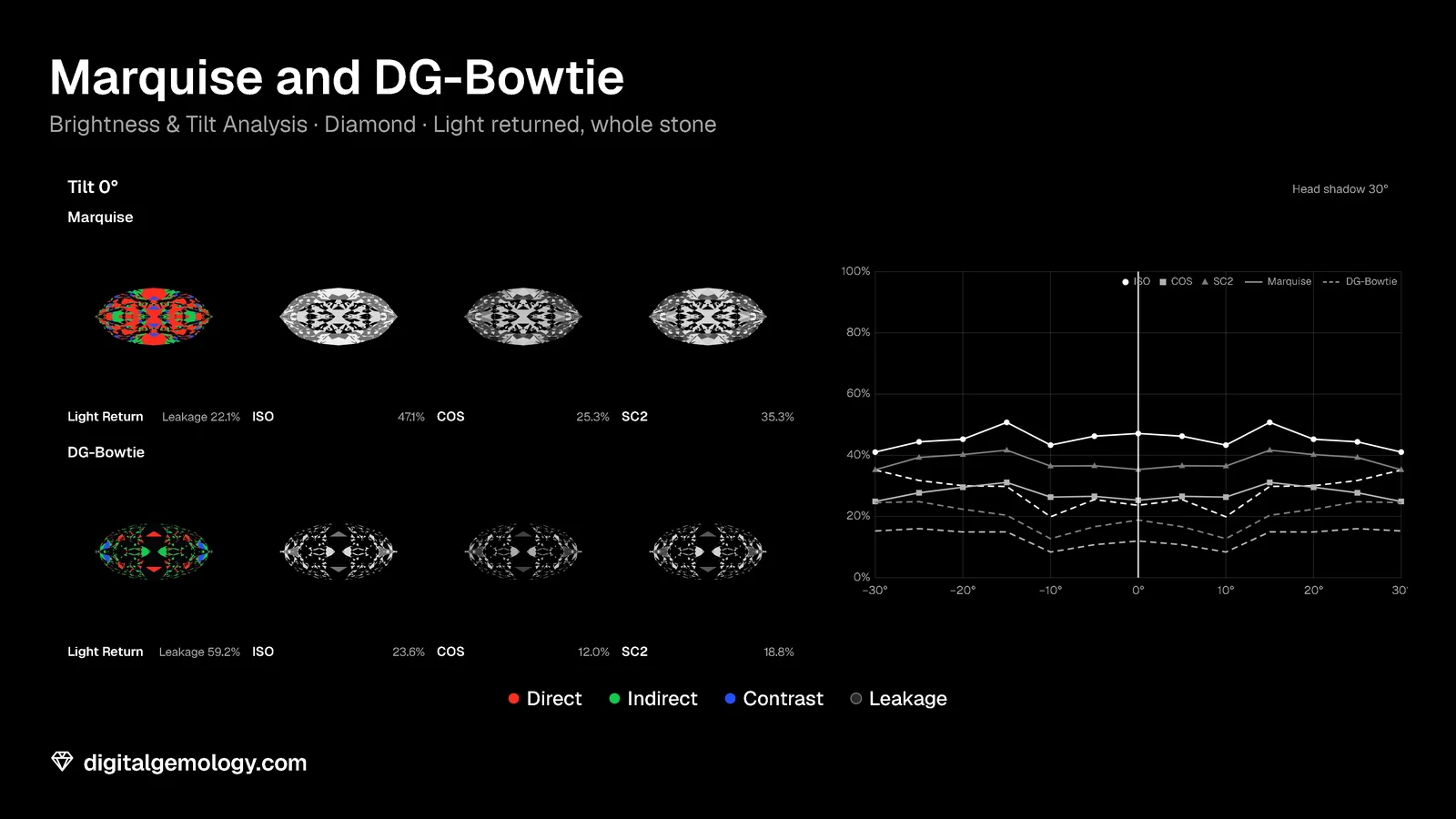
Tilt, under the biggest head. Keep the 30° head shadow and tip both stones from −30° to +30°. Under ISO, the Marquise stays between 41.0% and 50.7% at every tilt. DG-Bowtie stays between 19.9% and 35.2%. The dark cross moves as the Marquise tips, and it breaks up at other angles. It's the head's reflection, not something fixed in the stone. And no band of leakage opens across its belly at any tilt.
The video at the top of our tilt and head-shadow page shows this sweep.
Try it yourself
- Open 3D Gemstone Simulator with the Marquise, view Face up, Light map on. Find the belly. What color is it?
- Switch to the Oval. Where does its black sit?
- Turn the light map off and take the Marquise through all ten lightings.
- Open Brightness & Tilt Analysis with the Marquise against DG-Bowtie. Set Head shadow to 30°, then drag Tilt from −30° to +30°.
- The break-it challenge: find any setting, in either tool, that puts an organized band of black across the Marquise's belly.
What the stress test shows
The Marquise has no band across its belly. Its belly is the reddest part of its map, and it out-shines DG-Bowtie (brilliance 64 against 27). The Oval has no band across its belly either. Its darkness sits at the ends. In every room we tried, under every head shadow and at every tilt, the Marquise stays well above DG-Bowtie. The head never changes its leakage.
The largest head shadow paints a cross of contrast into the Marquise's middle: the head-and-shoulders reflection GIA describes. It moves and breaks up as the stone tilts. So here's what held and what didn't. Your head's reflection is real, and it shows in every stone under a big enough head. But a band of leakage across the belly, the dark bar DG-Bowtie carries in every room, isn't "always" there. It's avoidable, even in the hardest shape.
Key points
- GIA's oval guide and Estate Diamond Jewelry say some degree of bow-tie is always present. GIA's marquise guide calls it typical, and the NDC calls it almost inevitable.
- One stone that doesn't fit is enough to test a claim about every stone. Our Marquise and our Oval have no organized band across the belly.
- The Marquise is brighter than DG-Bowtie, not duller: brilliance 64 against 27.
- Under a very large head shadow, your head shows as a contrast pattern in the middle. That is the kind of bow-tie GIA's marquise guide describes. It moves as the stone tilts, and it isn't a band of leakage.
- Say "no organized band of leakage across the belly", never "no dark anywhere".
Sources
- GIA 4Cs, Oval Cut Diamond Guide, 23 September 2025: minimize, "always present"; no overall cut grade except for round brilliants; visibility varies within the same ratio.
- GIA 4Cs, marquise diamond guide, 29 November 2016: "typically" some degree; without one, "usually lack brightness"; the bow-tie as a reflection of your head and shoulders.
- Grant Mobley, "The Bow Tie Effect in Diamonds: What It Is and Why It Shouldn't Scare You", Only Natural Diamonds (Natural Diamond Council), 31 March 2026: "almost inevitable in elongated cuts".
- Benjamin Khordipour, diamond bow-tie effect guide, Estate Diamond Jewelry, updated 15 April 2026: every brilliant except the round.
Go further: the Oval cut page has its specifications and scores, for comparing with the Marquise.
Try it free
- Brightness & Tilt Analysis: Face-up brightness under four standard lights, and how it holds as the stone tilts.
- Cut Performance Wheel: Compare brilliance, fire and scintillation of two cuts, or one cut in two stones.
- 3D Gemstone Simulator: Turn a cut in seven gemstones and set its carat, color, clarity and cut grade.
Free, in your browser, no account.
Quick quiz
Why is one stone enough to test the claim "some degree is always present"?
- Because one stone is a big sample
- Because a claim about every stone fails if one stone doesn't fit
- It isn't enough
Show the answer
b: "always" fails on one counterexample.
Where does our Oval's darkness collect?
- Across the belly
- At its two ends
- Nowhere
Show the answer
b: Two patches at the ends; the belly is clean.
Under a 30° head shadow, a dark cross appears in the Marquise's middle. What is it?
- Leakage
- A bow-tie of black
- Your head, reflected as contrast
Show the answer
c: Contrast, the blue of the light map: the head-and-shoulders kind GIA describes; its Brightness & Tilt leakage stays 22.1%.
GIA's marquise guide says marquises without a bow-tie usually lack brightness. What do the Wheel's brilliance figures say for our pair?
Show the answer
The Marquise, without a band, has 64; DG-Bowtie, with one, has 27.
Did you find a setting that puts a band across the Marquise's belly? Describe what you tried.
Show the answer
Open answer.
Cuts in this lesson
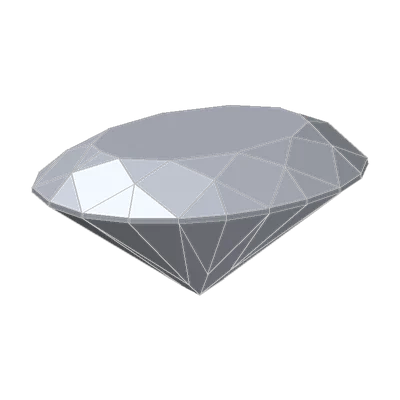
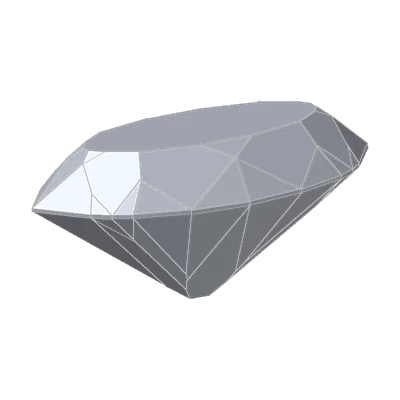
We sell the files of these cuts: 3D models and cutting files, with a personal-use license.
Keep exploring
- Next lesson: Bow-ties and grading reports: what the numbers can't tell you
- Try another topic · Historic diamond cuts: the history of the brilliant: Old mine cut diamonds: tidier, not brighter
Previous lesson · The bow-tie effect: all lessons · All topics