
Transcript
This 10-second clip has no sound. What you see:
The old mine against the T73 across the tilt, in the Brightness & Tilt Analysis.
A new source of rough
For centuries, almost every diamond came from India. In the 1720s that changed: large deposits were found in Brazil. (Tolkowsky gives 1728, other sources 1725.) More rough reached Europe's cutting centers.
The trade now calls the antique stones from this period old mine cuts. The name comes from the old mines of India and Brazil.
The technology: refinement by hand
There was still no machine to round a diamond. What improved over the 1700s and 1800s was handwork. In Tolkowsky's words, cutters modified the old-cut brilliants: they made the size and angle of the facets more uniform. That produced "a somewhat rounder stone".
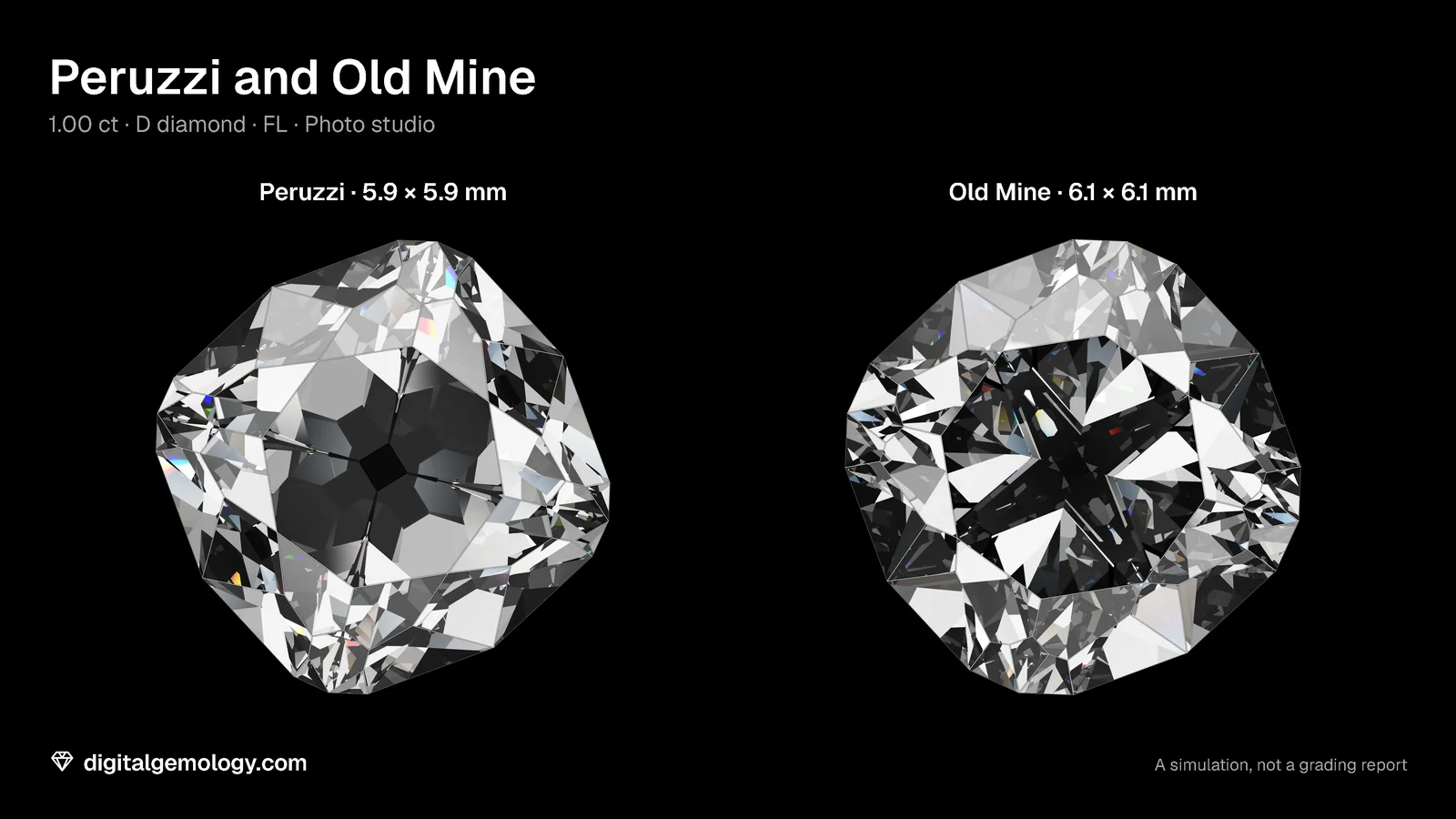
So the old mine cut is the Peruzzi tidied up:
- the same 58 facets, in the same plan (our model again adds 16 girdle facets, for 74);
- facets more even in size and angle;
- a rounder cushion, with a wider table (60.3% of the width in our model) and a shallower stone (65.6% deep, against the Peruzzi's 69.1%).
On paper, every one of those changes sounds like progress.
Try it yourself
- Open Cut Performance Wheel with
?cut=old-mine&stone=diamond. Set the comparison cut to the Peruzzi. Read brilliance, fire, scintillation and symmetry for both. - Before you look: which one do you expect to be brighter?
- Open 3D Gemstone Simulator with
?cut=old-mine&stone=diamondand open the Light Return view. Then change to the Peruzzi. Where are the dark areas in each?
What the Wheel shows
Neater. Symmetry goes up from 85 to 90: the more uniform facets show.
Darker. Brilliance drops from 75 to 59. That is the lowest of all eight cuts in the history of the brilliant, and our old mine cut page agrees: the least light face-up of the antique cuts. In our ray census, 32% of the light leaks out. That is the most of any historic diamond cut we measure, against the Peruzzi's 19% and the T73's 2%.
The rest barely moves. Fire goes from 68 to 72. Scintillation stays at 81, because the facet count stays at 74.
Why would a tidier stone be darker? Because nobody was aiming at light. Cutters wanted a neat, even stone that kept as much weight as possible. The angles followed the rough and the habit of the workshop. Our model's steep pavilion (44.4°) and wide table are one plausible version of that. Tidy facets and a rounder outline are craftsmanship. Whether light comes back is optics, and in the 1700s nobody had worked out the optics.
And yet people love them. Old mine stones have a soft, chunky, candlelit look, with big flashes and dark areas between them. That's partly what the numbers measure: less light that comes straight back to your eye. Whether it's a fault is taste. Our Wheel measures light, not charm.
Key points
- Brazil's deposits, found in the 1720s, ended India's near-monopoly on diamond.
- The old mine cut is the Peruzzi made more uniform and rounder, by hand: same 58 facets, wider table, shallower stone.
- On our Wheel, symmetry improves (85 → 90) but brilliance falls (75 → 59), the lowest of all the historic cuts.
- It leaks 32% of the light, the most of any historic diamond cut we measure.
- Neatness and weight were the goals. Nobody calculated the angles yet.
Go further: the old mine cut page has the 3D model and cutting file, if you want an antique-style stone for a reproduction piece.
Try it free
- Cut Performance Wheel: Compare brilliance, fire and scintillation of two cuts, or one cut in two stones.
- Brightness & Tilt Analysis: Face-up brightness under four standard lights, and how it holds as the stone tilts.
- 3D Gemstone Simulator: Turn a cut in seven gemstones and set its carat, color, clarity and cut grade.
Free, in your browser, no account.
Quick quiz
Five questions on this lesson, a couple of minutes. Pick an answer and see at once if you got it, and why.
Cuts in this lesson
We sell the files of these cuts: 3D models and cutting files, with a personal-use license.

Keep exploring
- Next lesson: Old European cut diamonds: when the outline went round
- Try another topic · The bow-tie effect: Fixing a bow-tie: the steep belly of DG-Bowtie
Previous lesson · Historic diamond cuts: the history of the brilliant: all lessons · All topics