
Doubling again
The Mazarin gave cutters a crown of 16 facets. Toward the end of the 1600s, a Venetian polisher, Vincent Peruzzi, doubled it again. The cut is called the Peruzzi, or the triple cut. With it, the modern facet plan arrives.
The technology: the same tools, more skill
Nothing new on the bench. Diamond powder, a polishing wheel, a stone held by hand, and an outline that still couldn't be made round. What changed was ambition. Cutters now laid out 32 small facets on the crown and made them meet. That is a feat of hand and eye, with no machine to set the angles.
The modern crown, three hundred years early
Look at the crown of any round brilliant today. You'll find:
- 8 bezels, the large kite-shaped facets around the table;
- 8 stars, the small triangles touching the table;
- 16 upper girdle halves, the triangles along the girdle.
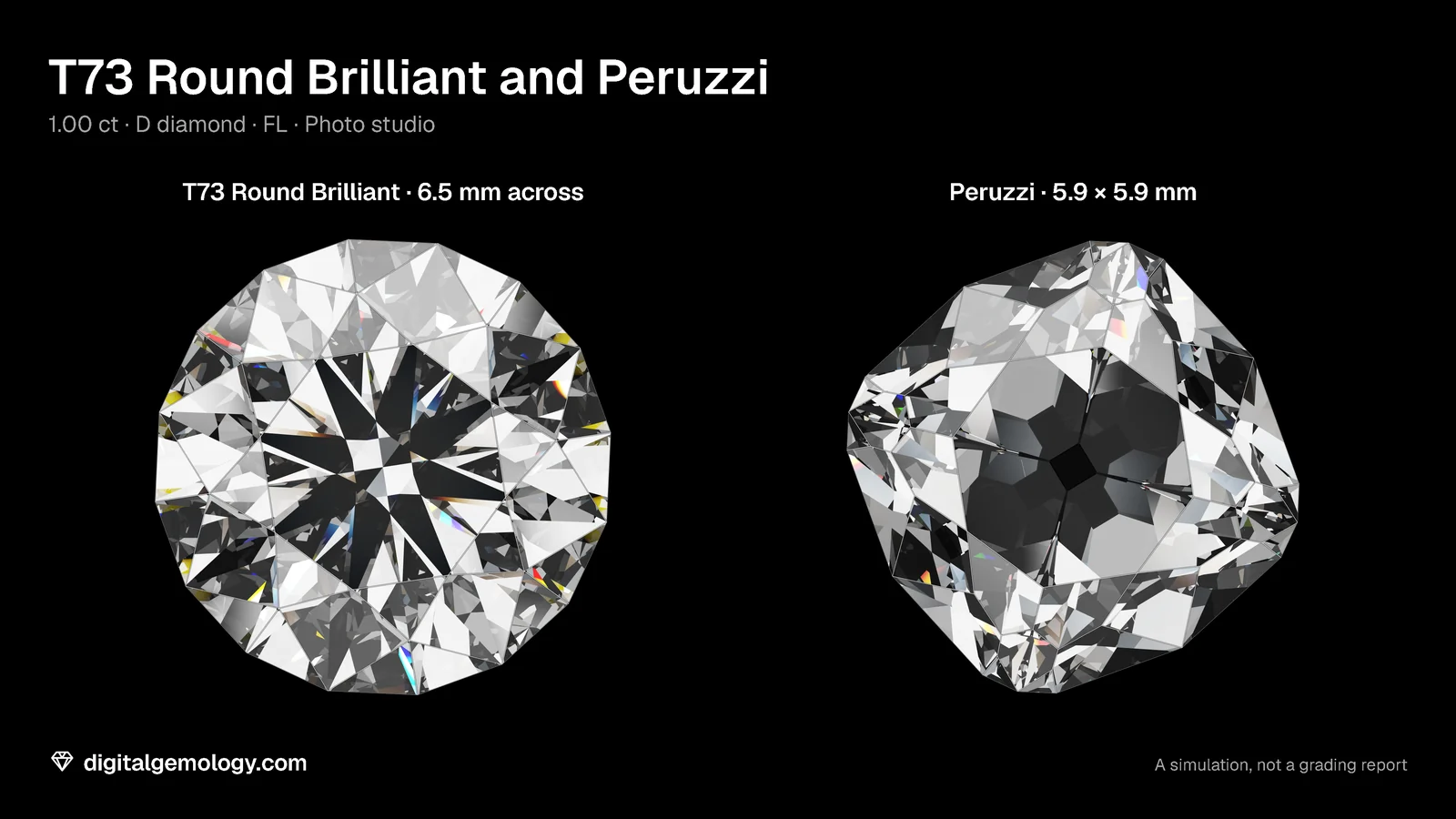
That's 32 facets above the girdle, the Peruzzi's crown. Add the table, a pavilion of 24 facets and a culet, and you get 58 facets in all. Our model adds 16 small girdle facets, for 74.
What the Peruzzi doesn't have is a modern shape. It is a cushion, cut deep. Our model is 69.1% as deep as it is wide, with a steep pavilion of 46.2°.
Try it yourself
- Open Cut Performance Wheel with
?cut=peruzzi&stone=diamond. Set the comparison cut to the Mazarin. Read brilliance, fire and scintillation for both. - Set the comparison cut to the T73, our modern benchmark. Now read the Symmetry row as well.
- Open 3D Gemstone Simulator with
?cut=peruzzi&stone=diamond, lighting Sunny day, Turn on Slow. Watch the corners of the cushion, then the straight sides. Do they flash at the same moments?
What the Wheel and the simulator show
A step up on all three. Against the Mazarin, the Peruzzi gains on every score: brilliance 65 → 75, fire 63 → 68, scintillation 61 → 81. Tolkowsky agreed: the triple cut raised fire and brilliance a great deal.
Scintillation level with today, with a catch. The Peruzzi scores 81, one point above the T73's 80. That's the facet count again: our Peruzzi has 74 facets and the T73 has 73. The catch is the girdle. A faceted girdle is a modern habit. A girdle can be frosted, polished smooth or faceted, and most have been faceted only in recent decades. Our model carries 16 girdle facets anyway. On a plain girdle, its 58 facets would score 72 by the Wheel's own formula, level with Tolkowsky's T57. So the modern crown plan was there in the 1690s. The extra twinkle of a faceted girdle came much later.
But still dull. Brilliance 75 is well behind the T73's 93, and 19% of the light leaks out, against 2%. Tolkowsky gave two reasons, and you can see both:
- Too thick. In a deep stone with a steep pavilion, light finds its way out of the back.
- Corners and sides at different angles. On a cushion, the facets at the corners and the facets along the sides can't all sit at the same angle. Even if one set is right, the other is too steep. The Wheel shows this as a Symmetry score of 85 against 100, and lists it as "a less regular pavilion". It's also why, in the simulator, the corners and the sides don't light up together as the stone turns.
Seen today, Tolkowsky wrote, these stones look exceedingly dull next to modern ones. The facet plan was right. The shape wasn't, and the technology set that limit.
Key points
- The Peruzzi, or triple cut (late 1600s), doubles the crown to 32 facets: 8 bezels, 8 stars, 16 upper halves. This is the crown of every modern round.
- 58 facets in all, still on a deep cushion, still cut entirely by hand.
- On our Wheel it improves on the Mazarin in brilliance, fire and scintillation (75 / 68 / 81).
- Our model's scintillation matches the T73's because it carries as many facets. That includes 16 girdle facets that a stone of the 1690s wouldn't have had. On a plain girdle it would score 72.
- It stays dull for two reasons: it is thick, and a cushion forces different angles at the corners and sides (symmetry 85). 19% of the light leaks.
Go further: the Peruzzi cut page has the facet diagram to compare with the T73's.
Try it free
- Cut Performance Wheel: Compare brilliance, fire and scintillation of two cuts, or one cut in two stones.
- 3D Gemstone Simulator: Turn a cut in seven gemstones and set its carat, color, clarity and cut grade.
Free, in your browser, no account.
Quick quiz
Five questions on this lesson, a couple of minutes. Pick an answer and see at once if you got it, and why.
Cuts in this lesson
We sell the files of these cuts: 3D models and cutting files, with a personal-use license.

Keep exploring
- Next lesson: Old mine cut diamonds: tidier, not brighter
- Try another topic · Diamond anatomy and proportions: The diamond culet: none, pointed or large
Previous lesson · Historic diamond cuts: the history of the brilliant: all lessons · All topics