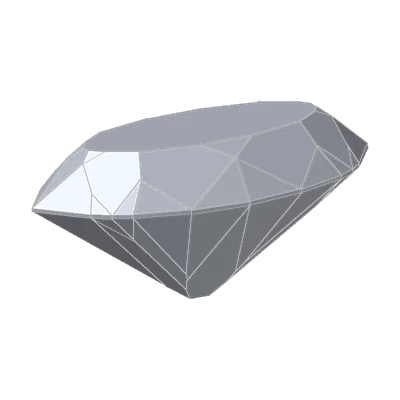
Three shortcuts
A marquise without a bow-tie exists: our Marquise is one, while DG-Bowtie, with the same outline, has a band. So how would a buyer find one without our tools? Guides usually offer three shortcuts: the finish grades, the report and the numbers. Let's test all three.
Shortcut 1: Excellent polish and symmetry
Two of our sources recommend the finish grades:
- Estate Diamond Jewelry, on reading the report: if polish and symmetry are both "excellent", "you should have nothing to worry about".
- Ritani: "Always choose an oval cut with Excellent symmetry and polish grades." Just before that, the same guide notes that grading labs don't give fancy shapes a cut grade. It also says a report "won't specify whether or not it has a bow tie".
What do the two grades measure? In the simulator's own words:
- Polish: how smooth the facets are. Rougher facets scatter light and look hazy.
- Symmetry: how exactly the facets are placed and aligned. Misaligned facets break up the pattern.
Both are about finish and precision. Neither says where the facets point. So let's put the worst finish on the good stone and the best finish on the banded one.
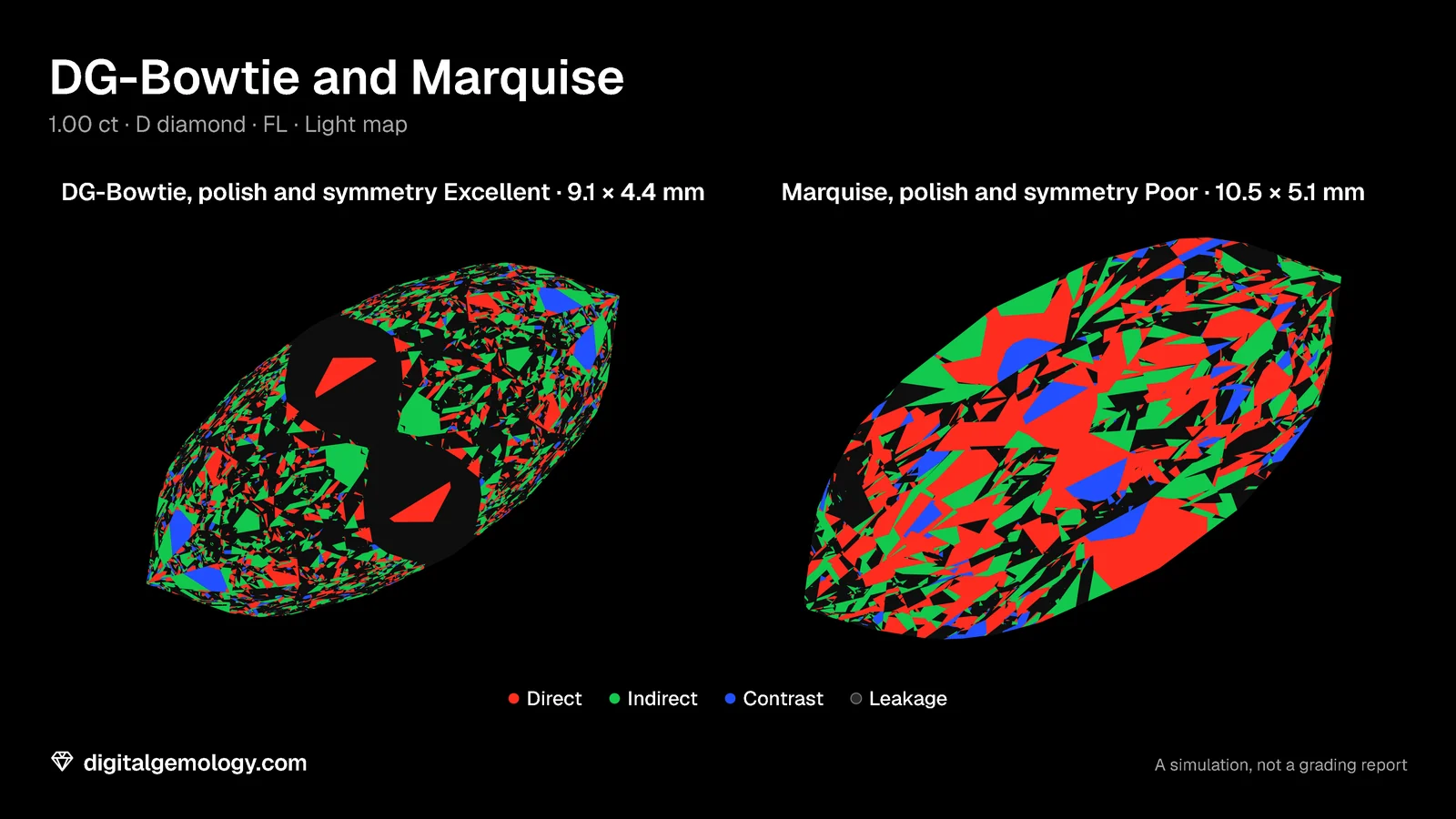
DG-Bowtie, Excellent and Excellent: the band is there, 59% leakage. The Marquise, Poor and Poor: its pattern is scrambled, and leakage rises a little, from 25% to 29%. But there's still no band across the belly. That small rise comes from symmetry's tilted facets. Polish doesn't change the light map at all: in the simulator, poor polish is a loss of contrast laid over the picture. Symmetry nudges the light. The angles decide it.
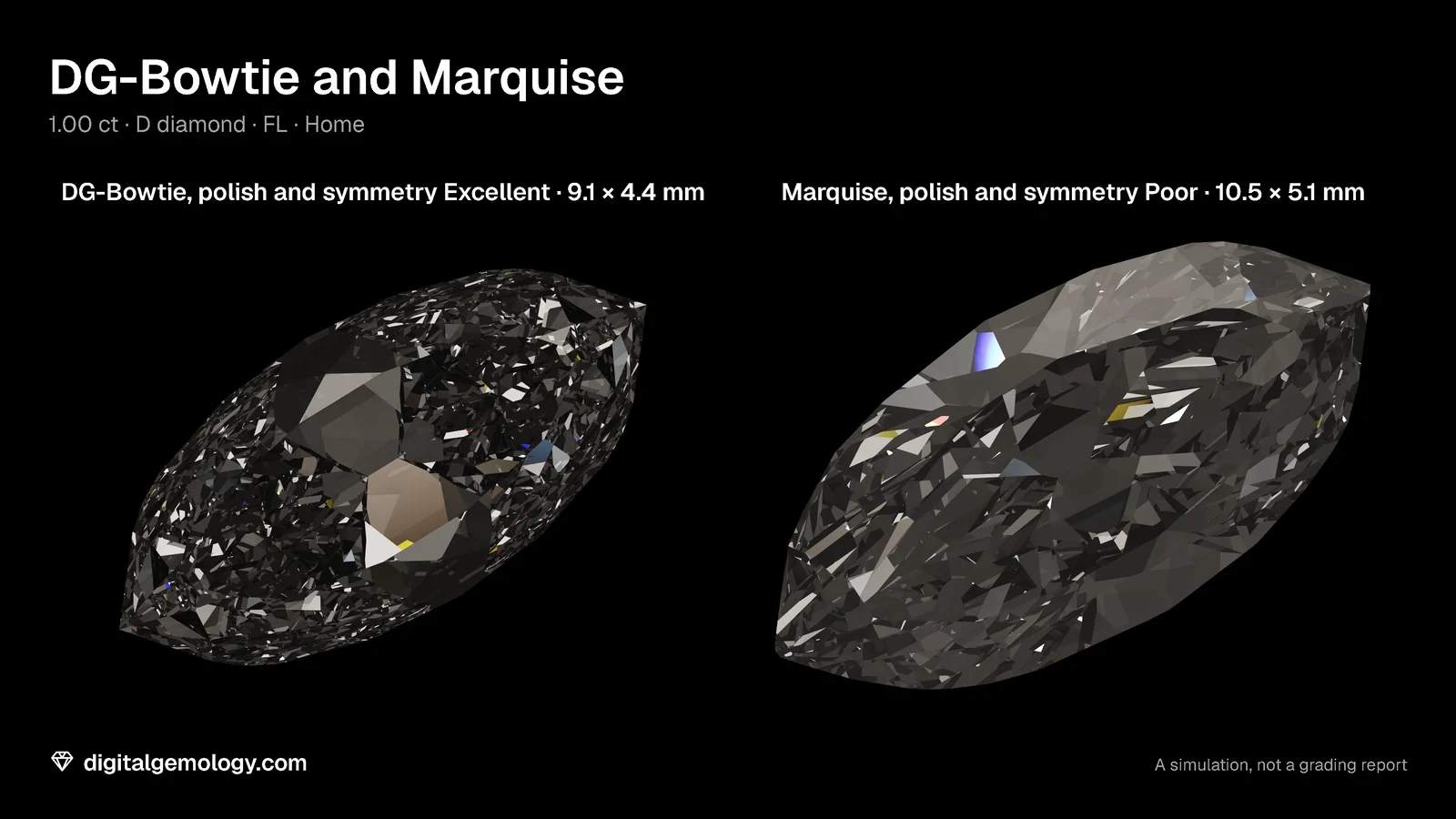
That doesn't make good finish grades worthless. They're part of the entry ticket for the documents below. IGI's fancy-shape cut grade first requires Very Good or better, and the AGS Ideal Report requires Excellent. But they can't see a bow-tie.
Shortcut 2: the report
GIA gives an overall cut grade only to standard round brilliants. On a GIA report for a marquise, pear or oval, there's no cut grade and no word about a bow-tie. Our sources agree on that.
But that isn't the whole story. Two other documents do look:
- IGI's fancy-shape cut grade, an option. To earn Excellent, a fancy shape must pass four steps in turn. The third step is a set of "shape specific requirements designed to analyze bow-ties" and other features.
- The AGS Ideal Report by GIA, a light performance supplement to a GIA report, with an ASET map. The ASET map is the same kind of four-color picture as our light map. GIA offers the report only for some facet arrangements of the oval, cushion, emerald, radiant, princess and fancy round. The stone needs Excellent polish and symmetry, and it must reach the top light performance grade, AGS Ideal 0. The report comes with or without the map, so ask for the map. Marquises and pears aren't on the list.
So for an oval, you can ask whether it has an AGS Ideal Report with the map. If that report exists, it is already a good sign, because a stone with a strong band wouldn't qualify. For a marquise or a pear, ask whether the stone has an IGI fancy-shape cut grade. Or judge it with your own eyes, with our bench routine.
Shortcut 3: the numbers
The ratio. GIA's oval guide says many people prefer 1.30 to 1.50. Its own example of a noticeable bow-tie is 1.48 to 1, inside that range. GIA also notes that bow-tie visibility varies between stones with the same ratio. Our pair shows the point as plainly as possible: DG-Bowtie and the Marquise are both 2.06 to 1. Same ratio, one band.
The depth. Ritani gives an ideal oval depth of 58–62% and a table of 53–63%. Depth is the height from table to culet, as a percentage of the width. It adds three things together: the crown's height, the girdle and the pavilion's depth. Two stones with the same total depth can share it differently between crown and pavilion. Then their belly angles differ.
Depth does flag DG-Bowtie: at 93.8% it's far from any range. But a range can't see the belly. Our Oval sits at 64.0%, outside Ritani's 58–62%, and has a clean belly. The range is a fair first filter, not a verdict.
The pavilion angle. DG-Bowtie's cut page lists its "Pavilion angle (main)" as 42.0°. That looks like a round's: the T73 uses 40.75°. But an elongated stone has a whole spread of pavilion angles, and the main tier is only one of them. DG-Bowtie's belly facets sit at 52.0° to 53.5°. One number hides the one that matters.
| DG-Bowtie | Marquise | |
|---|---|---|
| Length to width | 2.06 | 2.06 |
| Total depth | 93.8% | 62.0% |
| Pavilion angle (main), cut page | 42.0° | 31.4° |
| Belly pavilion facets, cutting file | 52.0°–53.5° | 41.0°–42.5° |
| Band across the belly | yes | no |
If you read the third row alone, you'd pick the wrong stone: 42.0° looks ideal and 31.4° looks shallow. The fourth row decides, and it lives in the cutting file, not in a report.
Try it yourself
- Open 3D Gemstone Simulator with DG-Bowtie, Light map on. Leave Polish and Symmetry at Ex.
- Switch to the Marquise and set Polish and Symmetry to P. What happens to the band? What happens to the leakage figure?
- Open the DG-Bowtie cut page and the Marquise cut page. Compare their specifications line by line.
- The spot-the-band challenge: using only the cut pages' specifications, without the pictures, which line would you trust to predict the band? Which lines would fool you?
What the simulator and the cut pages show
DG-Bowtie with Excellent polish and symmetry has the band. The Marquise with Poor polish and symmetry doesn't (leakage 25% → 29%, the pattern scrambled, the belly clean). The finish grades can't see a bow-tie.
GIA's report doesn't grade a fancy shape's cut. But IGI's optional fancy-shape cut grade checks bow-ties, and the AGS Ideal supplement shows an ASET map for some ovals. Both stones are 2.06 to 1. Depth flags DG-Bowtie's extreme 93.8%, but a range can't see the belly. The single "main" pavilion angle points the wrong way. The belly angles in the cutting file point the right way.
Key points
- Polish grades smoothness. Symmetry grades placement. Neither says where the facets point, so neither predicts a bow-tie.
- GIA's report gives no cut grade to fancy shapes and doesn't mention bow-tie. IGI's optional fancy-shape cut grade checks for bow-ties. The AGS Ideal Report by GIA adds an ASET map for some ovals.
- The ratio can't tell two stones apart: both of ours are 2.06 to 1, and GIA's own noticeable example is 1.48 to 1.
- Depth adds three heights into one number. It catches extremes but can't see the belly angle.
- A single "pavilion angle" hides the spread. The belly angles decide, and they're in the cutting file.
Sources
- Benjamin Khordipour, diamond bow-tie effect guide, Estate Diamond Jewelry, updated 15 April 2026: both Excellent, "nothing to worry about".
- Kristin P, "What is a bow tie in an oval diamond", Ritani, 13 October 2025: "Always choose" Excellent symmetry and polish; no cut grade for fancy shapes; ideal table and depth.
- GIA 4Cs, Oval Cut Diamond Guide, 23 September 2025: overall cut grade only for round brilliants; 1.30 to 1.50; the 1.48 example; visibility varies within the same ratio.
- IGI, Diamond Cut Grading (igi.org): the four steps of the fancy-shape cut grade.
- GIA, Introducing the AGS Ideal Report by GIA, and the GIA training module AGS Ideal Report, 2024: eligible shapes, ASET map.
Go further: How to read a diamond grading report, start to finish explains every line of a report, including what's printed for fancy shapes.
Try it free
- 3D Gemstone Simulator: Turn a cut in seven gemstones and set its carat, color, clarity and cut grade.
Free, in your browser, no account.
Quick quiz
What does a symmetry grade measure?
- How much light the stone returns
- How exactly the facets are placed and aligned
- Where the facets point
Show the answer
b: Placement and alignment, not direction.
DG-Bowtie has Excellent polish and symmetry. Does it have a bow-tie?
- No, Excellent finish rules it out
- Yes: the finish grades don't see where the facets point
- Only in dim light
Show the answer
b: The band is set by the angles.
Which document checks for bow-ties as part of a grade?
- GIA's diamond grading report
- IGI's optional fancy-shape cut grade
- None at all
Show the answer
b: Step 3 includes requirements designed to analyze bow-ties. (The AGS Ideal supplement shows an ASET map for some ovals.)
Two marquises are both 2.06 to 1. One has a bow-tie. What does that tell you about the ratio?
Show the answer
The ratio can't predict it: same ratio, different bellies.
DG-Bowtie's cut page lists a main pavilion angle of 42.0°. Why doesn't that number warn you about its band?
Show the answer
It's one tier out of a spread. The belly facets, at 52.0°–53.5°, decide, and they're only in the cutting file.
Cuts in this lesson
We sell the files of these cuts: 3D models and cutting files, with a personal-use license.
Keep exploring
- Next lesson: Why bow-ties are still cut: weight, outline and cost
- Try another topic · Historic diamond cuts: the history of the brilliant: Old European cut diamonds: when the outline went round
Previous lesson · The bow-tie effect: all lessons · All topics