Transcript
The 2.00 ct weighs twice as much. How much wider is it?
A carat is a weight, not a size. One carat is 200 mg.
Weight is volume times density. So weight grows with volume.
Make the cube twice as wide, twice as long and twice as deep.
It holds 8 cubes: 8 times the volume, 8 times the weight.
Now turn it around. Start from twice the weight.
Make it into a cube again. Each edge is only 1.26 times as long.
1.26 is the cube root of 2. Twice the weight is only 26% wider.
Face up, you see area. Area grows with the square of the width.
So twice the weight shows about 59% more face. Not twice as much.
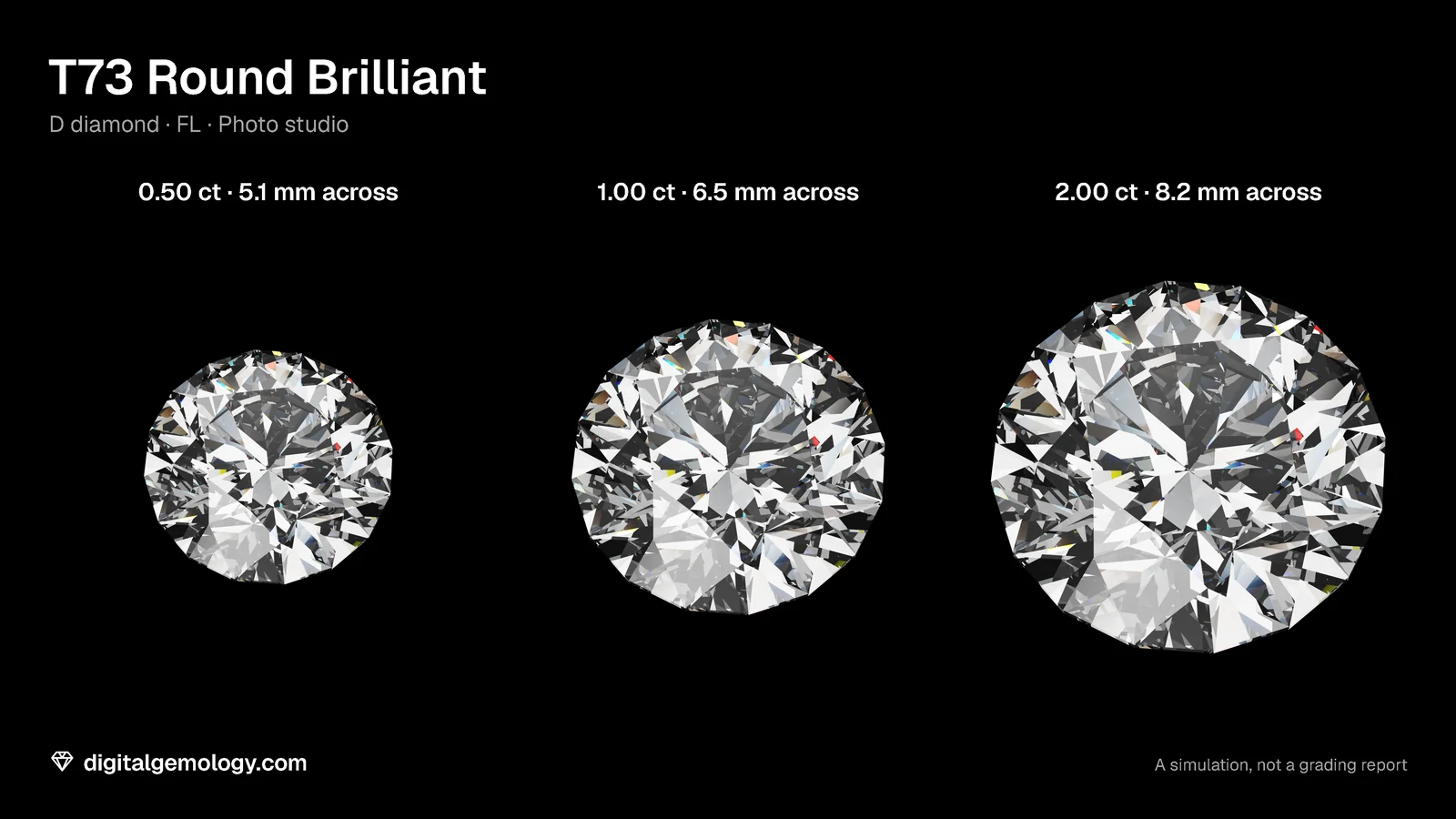
Now the T73 in diamond, all three at the same scale.
The 3D Gemstone Simulator gives the width of each one.
From 1.00 ct to 2.00 ct: 6.48 mm to 8.16 mm. That is 26% wider.
Now make a T73 twice as wide as the 1.00 ct.
It must weigh 8 carats: 2 × 2 × 2 times the weight.
Weight grows with the cube of size. Double the weight is 26% wider.
A quick guess
Picture a 1-carat round diamond. Now picture a 2-carat one beside it. How much wider is the 2-carat?
Most people say "twice as wide", or at least "a lot". The answer is 26%. A 1.00 ct T73 is 6.48 mm across; a 2.00 ct T73 is 8.16 mm. Double the weight buys you less than two millimeters.
Here is why.
A carat is a weight
Carat measures weight, not size. One carat is 200 milligrams, a fifth of a gram. For smaller stones, the carat has 100 points. So a 0.75 ct diamond is a "75-pointer", and a half carat is 50 points.
A lab weighs every stone on an electronic microbalance. GIA's microbalance reads to the fifth decimal place, a hundred-thousandth of a carat. The report gives the weight rounded to two decimals. Carat is the only one of the four Cs that the lab measures directly. Nobody's eye is involved.
And diamond is rare by nature. GIA says that miners dig about a ton of rock to get less than half a carat of rough diamond.
Weight grows with the cube
Weight is volume times density. Our 3D models give the volume of every cut, and the density of diamond does the rest. For a cut of a given shape, volume grows with the cube of its size. Make a stone twice as wide, twice as long and twice as deep, and it holds eight times as much diamond.
Now turn that around. When you double the weight, you multiply every dimension by the cube root of 2, which is 1.26. That's the 26%.
The face-up area grows with the square of the width. So the 2 ct shows about 59% more surface than the 1 ct. That's a real step up, and you can see it. It just isn't double.
Try it yourself
- Open 3D Gemstone Simulator with the T73 Round Brilliant in diamond.
- In the report, find Carat weight. Click through every step from 0.25 to 5.
- Watch the stone on screen. Then watch the scale bar under it, and read Measurements in the report at each step.
- Before you click 5, write down your guess for its width.
- The challenge: which carat step shows about twice the face-up area of the 0.50 ct? Use the measurements to find it, not your eye.
What the simulator shows
The stone didn't grow on screen. The simulator always makes the stone fill the view, so you can study its pattern at any weight. The scale bar and the measurements show the size. As the carat goes up, each millimeter takes up less of the picture, so the bar gets shorter. From time to time it jumps to a rounder length (0.5, 1 or 2 mm). Read the number on it.
The measurements follow the cube root. Here's the T73 in diamond:
| Carat | Diameter | Depth |
|---|---|---|
| 0.25 | 4.08 mm | 2.52 mm |
| 0.50 | 5.14 mm | 3.17 mm |
| 0.75 | 5.89 mm | 3.63 mm |
| 1.00 | 6.48 mm | 4.00 mm |
| 1.50 | 7.42 mm | 4.58 mm |
| 2.00 | 8.16 mm | 5.04 mm |
| 3.00 | 9.34 mm | 5.77 mm |
| 5.00 | 11.08 mm | 6.84 mm |
The 5 ct has five times the weight of the 1 ct, but it is only 71% wider. To be twice as wide as the 1 ct, a T73 must weigh 8 carats.
The challenge. The area grows with the weight to the power two-thirds. So twice the area of the 0.50 ct needs 2.83 times its weight: about 1.41 ct. The nearest step is 1.50 ct: 7.42 mm against 5.14 mm, so 2.08 times the area. Three times the weight, twice the face.
Same carat, different size. Carat sets only the weight. The cut and the material decide how that weight spreads out. In moissanite, the same 1.00 ct T73 is 6.67 mm across, because moissanite is less dense than diamond. And a badly cut diamond hides weight in a deep pavilion and a thick girdle. Diamond cut grade: Excellent vs Poor shows this side by side.
Magic sizes
Some weights sell better than others: half a carat, three-quarters, one carat. Demand makes these round numbers special, not looks. A 0.99 ct T73 is 0.02 mm narrower than a 1.00 ct, and nobody can see that difference. But it is below the 1-carat line, so its price is usually much lower.
Price doesn't go up in a straight line either. Larger diamonds are rarer and people want them more. So a 2-carat stone costs more than two 1-carats when the other three Cs are equal.
Key points
- One carat is 200 mg, and it has 100 points. Labs weigh to five decimals and report two.
- Weight grows with the cube of size. So double the weight is only 26% wider, with 59% more face-up area.
- The simulator keeps the stone the same size on screen. Read the scale bar and the measurements for its true size.
- The same carat can face up larger or smaller. The material and the cut decide.
- Round "magic" weights have a price step that the eye cannot see: 0.99 ct is 0.02 mm narrower than 1.00 ct.
Go further: the T73 Round Brilliant cut page lists its weight and measurements from the 3D model.
Try it free
- 3D Gemstone Simulator: Turn a cut in seven gemstones and set its carat, color, clarity and cut grade.
Free, in your browser, no account.
Quick quiz
Five questions on this lesson, a couple of minutes. Pick an answer and see at once if you got it, and why.
Cuts in this lesson
We sell the files of these cuts: 3D models and cutting files, with a personal-use license.
Keep exploring
- Next lesson: The diamond color scale, D to Z: where you first see a tint
- Try another topic · Diamond anatomy and proportions: Diamond table percentage: what table size does to the light
Previous lesson · The four Cs of diamonds: all lessons · All topics