Four stones, one question
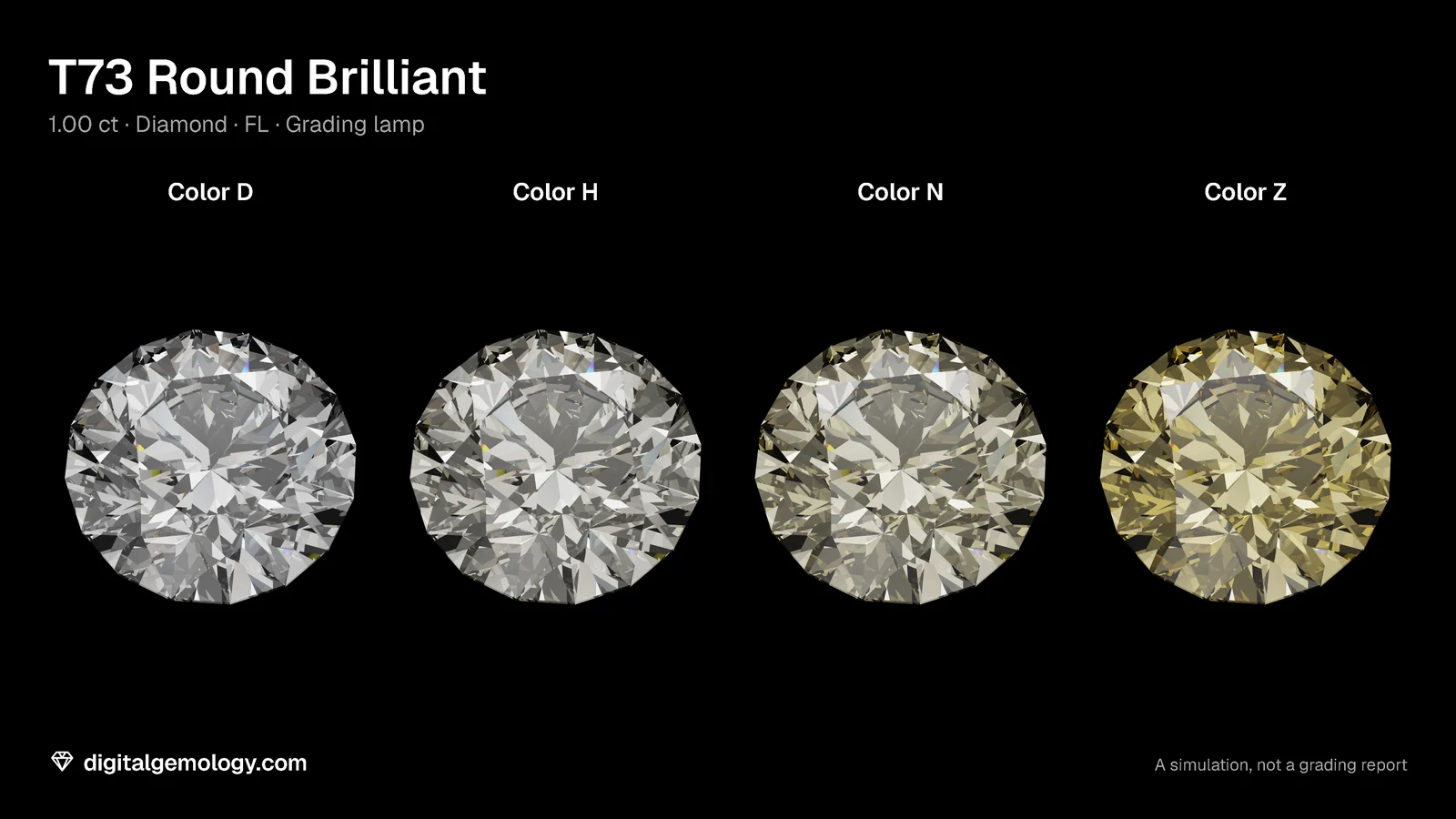
Four diamonds sit in a row under the same lamp. Same cut, same carat, same clarity. One is a D, one an H, one an N and one a Z. Which is which?
The Z gives itself away. The N is plainly warm. But the D and the H? Most people hesitate. They are four letters apart on the scale, and on paper that's a big step.
That hesitation is the whole point. Color grades are real, and they matter for value. But how much you see depends on where you are on the scale, and on the light.
What the scale measures
The D-to-Z scale measures how much yellow or brown tint a near-colorless diamond has. D is colorless. Z is light yellow or brown. Truly colorless diamonds are rare: most diamonds in jewelry have a slight tint.
A letter isn't one exact shade. Each letter covers a band of tint, and the tint goes from barely there to plainly visible as you go down the scale. Our simulator puts the 23 letters into five ranges, with the same names as GIA's scale:
- D–F, Colorless. The rarest. Even a trained grader can tell them apart only beside master stones.
- G–J, Near colorless. Looks white face up. A slight tint shows beside a better grade.
- K–M, Faint. You can see a faint warm tint face up, most of all in a larger stone.
- N–R, Very light. A yellow or brown tint that is easy to see.
- S–Z, Light. Plainly yellow or brown.
A Z isn't a bad diamond. It's a diamond with a visible tint, and some people choose exactly that warmth.
How a lab grades it
Light and background change how a diamond looks. So a lab never grades color by eye in a showroom. GIA compares each stone with a set of master diamonds of known grade, in a standard viewing environment. At least two graders give their grades independently. More graders can join, depending on how well the first graders agree and on the weight and quality of the stone. The grade stands only when they agree.
The scale starts at D for a reason that we give in the four Cs explained: GIA wanted a clean break from the vague A, B and C of the past.
Try it yourself
- Open 3D Gemstone Simulator with the T73 in diamond, lighting Grading lamp.
- In the report, under Color grade, pick the range G–J and then H. Switch back and forth between D and H. Then try N and Z.
- Find your threshold. Start at D and go down one letter at a time. Do not go back. Write down the first letter where you say "that's warm" with no D to compare.
- Change the light. Set the stone to H, then try Photo studio, Home and Restaurant. Can you still tell H from D?
- Set it to Z and go through the same lights.
What the simulator shows
Where the tint lives. The simulator colors the light as it travels through the stone. A longer path inside gives more yellow. Light that bounces around the pavilion several times before it gets to you carries the most color. That's why the tint seems to sit inside the stone, not on its surface.
Your threshold. The note in the simulator puts the first tint that you can see face up in the K–M range. Where was yours? In our model, each letter adds a little more absorption than the letter before it. So the steps near D are tiny, and the steps near Z are bigger.
The light. The Grading lamp is a neutral daylight lamp. Under it, H looks different from D if you look for it. Warm Home light makes the gap smaller. In the dim, warm Restaurant scene, D and H look the same. The warm light tints every stone, so the faint tint of the stone itself drowns in it. A Z still shows, because its color is stronger than the color of the light. That's why labs grade color under controlled light and against master stones. It is also why you shouldn't judge a G against an H by candlelight.
One simplification to know: in a real diamond, a larger stone shows its color more easily, because the light travels further inside. Our simulator keeps the color depth the same at every carat. So you can compare grades without the size getting in the way.
Key points
- The D-to-Z scale measures how much yellow or brown tint a near-colorless diamond has. D is colorless, and Z is light yellow or brown.
- Each letter is a range. The scale has five ranges: colorless, near colorless, faint, very light and light.
- Labs grade color against master diamonds in standard light, with at least two independent graders.
- Color comes from absorption along the path of the light inside the stone. So it collects where the light travels furthest.
- Warm, dim light hides the difference between nearby grades. Neutral light shows it.
Go further: to compare grades, use the Photo studio and the Grading lamp in the 3D Gemstone Simulator. Try your threshold test in both.
Try it free
- 3D Gemstone Simulator: Turn a cut in seven gemstones and set its carat, color, clarity and cut grade.
Free, in your browser, no account.
Quick quiz
Five questions on this lesson, a couple of minutes. Pick an answer and see at once if you got it, and why.
Cuts in this lesson
We sell the files of these cuts: 3D models and cutting files, with a personal-use license.
Keep exploring
- Next lesson: Fancy color diamonds and fluorescence: beyond the Z grade
- Try another topic · Historic diamond cuts: the history of the brilliant: Hearts and arrows diamonds: precision you can see
Previous lesson · The four Cs of diamonds: all lessons · All topics