What does "blue white" mean?
Until the middle of the twentieth century, nobody could tell you. People described diamond color with loose letters like A, B and C, with numbers or with Roman numerals. They also used phrases like "gem blue" and "blue white". Two jewelers could use the same word for different stones.
The four Cs fixed that. They turned the quality of a diamond into four scales that mean the same thing everywhere.
Four scales, one language
Robert M. Shipley, a former retail jeweler, founded GIA. He put diamond quality into four groups and gave them a name that is easy to remember: color, clarity, cut and carat weight. In the 1950s GIA made them into a grading system. Today the whole world uses it.
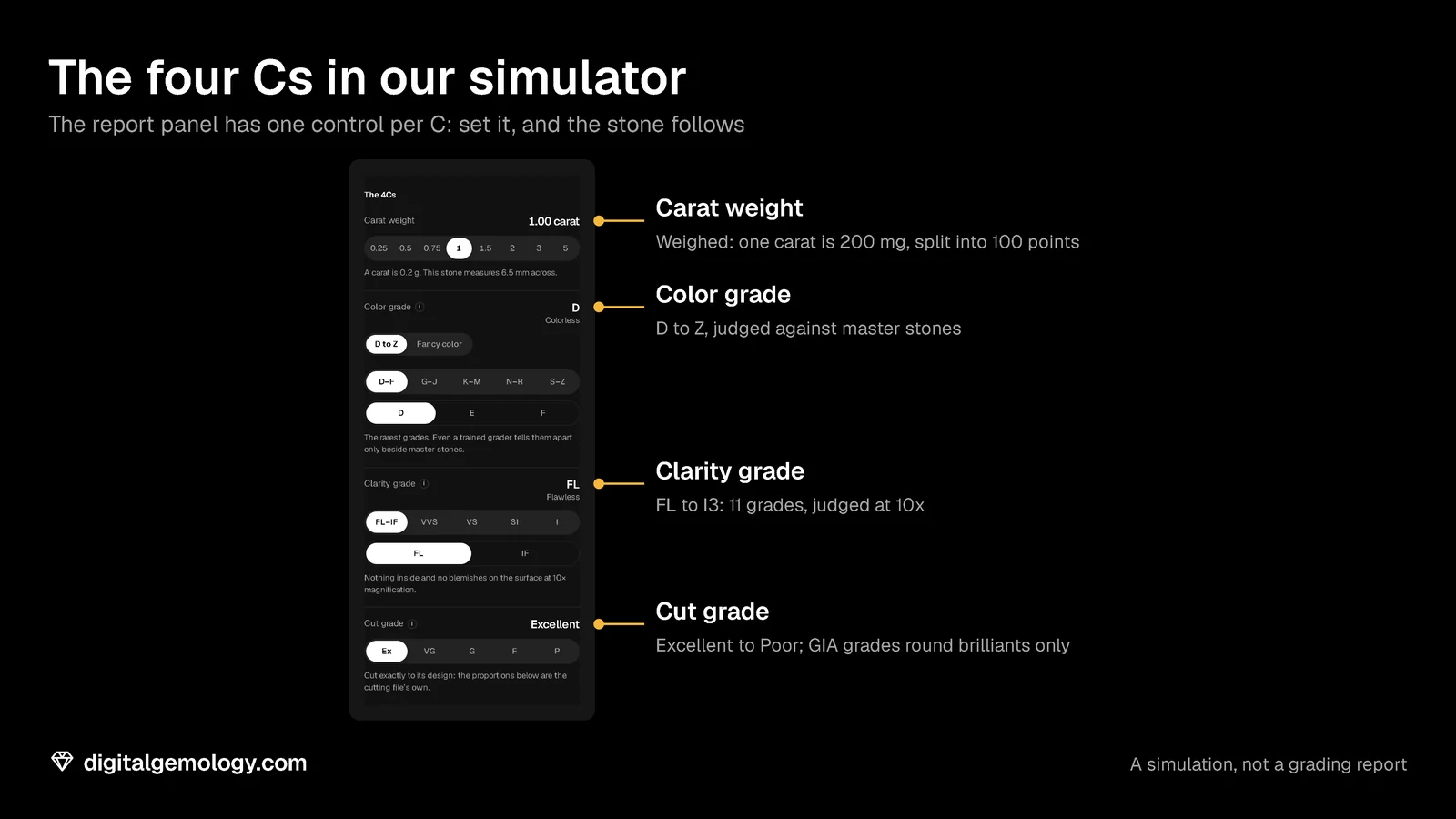
- Color goes from D, colorless, to Z, light yellow or brown. The scale starts at D on purpose, so that nobody could confuse it with the old A, B and C.
- Clarity has 11 grades, from Flawless (FL) to I3. A grader judges it at 10x magnification.
- Cut goes from Excellent to Poor. GIA gives a cut grade to standard round brilliants only.
- Carat weight is the weight of the stone. One carat is 200 milligrams, and it has 100 points.
Trained eyes judge three of the four Cs against fixed standards:
- Color: the grader compares the stone with a set of master diamonds under controlled light.
- Clarity: the grader examines the stone at 10x. For color and for clarity, at least two graders work independently.
- Cut: the grade combines measured proportions with a visual check of the finish.
Carat weight is different. The lab simply weighs the stone.
No single C sets the value of a diamond. All four do, together.
Try it yourself
- Open 3D Gemstone Simulator with the round brilliant in diamond. It starts at the top of every scale: 1 carat, D, FL, Excellent.
- Set Color grade to Z. Look at the stone, then set it back to D.
- Set Clarity grade to I3. Look, then set it back to FL.
- Set Cut grade to Poor. Look, then set it back to Excellent.
- Change Carat weight from 1 to 2. What changes, and what stays the same?
What the simulator shows
Each C changes the stone in its own way.
Color tints the light as the light travels through the stone. A longer path inside gives more color. So the tint shows most where the light bounces the furthest.
Clarity puts crystals, pinpoints and feathers inside the stone. Each one blocks or reflects some light at one spot. The rest of the stone does not change.
Cut changes the angles and the size of the table (the flat top) and the pavilion (the cone underneath). At Poor, more light leaks out of the bottom and does not come back to you. The whole face changes.
Carat changes only the size. The pattern stays exactly the same.
That is why we say that cut is the C that decides how a stone looks. Each C has its own page: carat weight, color, clarity and cut.
Key points
- The four Cs are color, clarity, cut and carat weight. They are four scales that replaced vague trade words with a shared language.
- Color goes from D to Z, and clarity from FL to I3 (11 grades). Cut goes from Excellent to Poor (round brilliants only). Carat weight is 200 mg per carat.
- At least two graders grade color and clarity by eye against fixed standards. The lab weighs the carat weight.
- Each C changes a stone differently. Cut is the C that changes the whole face.
Go further: carat weight vs size: why a 2 ct stone isn't twice as wide as a 1 ct.
Try it free
- 3D Gemstone Simulator: Turn a cut in seven gemstones and set its carat, color, clarity and cut grade.
Free, in your browser, no account.
Quick quiz
Five questions on this lesson, a couple of minutes. Pick an answer and see at once if you got it, and why.