Spot the SI2
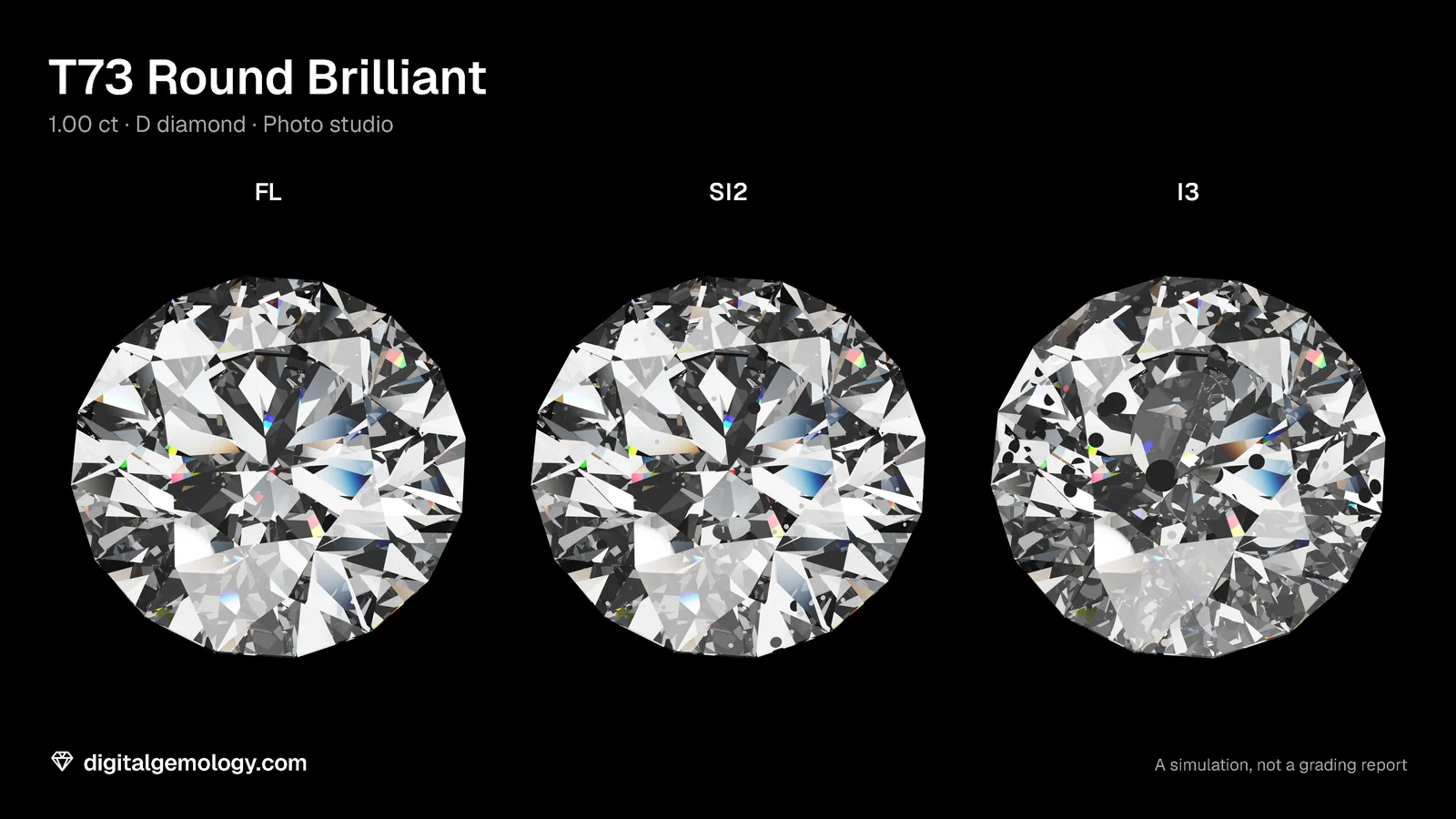
Three diamonds, side by side. One is Flawless. One is SI2, "slightly included", the last grade before the included range. One is I3, the bottom of the scale. Which is which?
The I3 is easy: dark specks all through it. But the other two? At this distance, most people can't pick the SI2. It looks as clean as the Flawless stone.
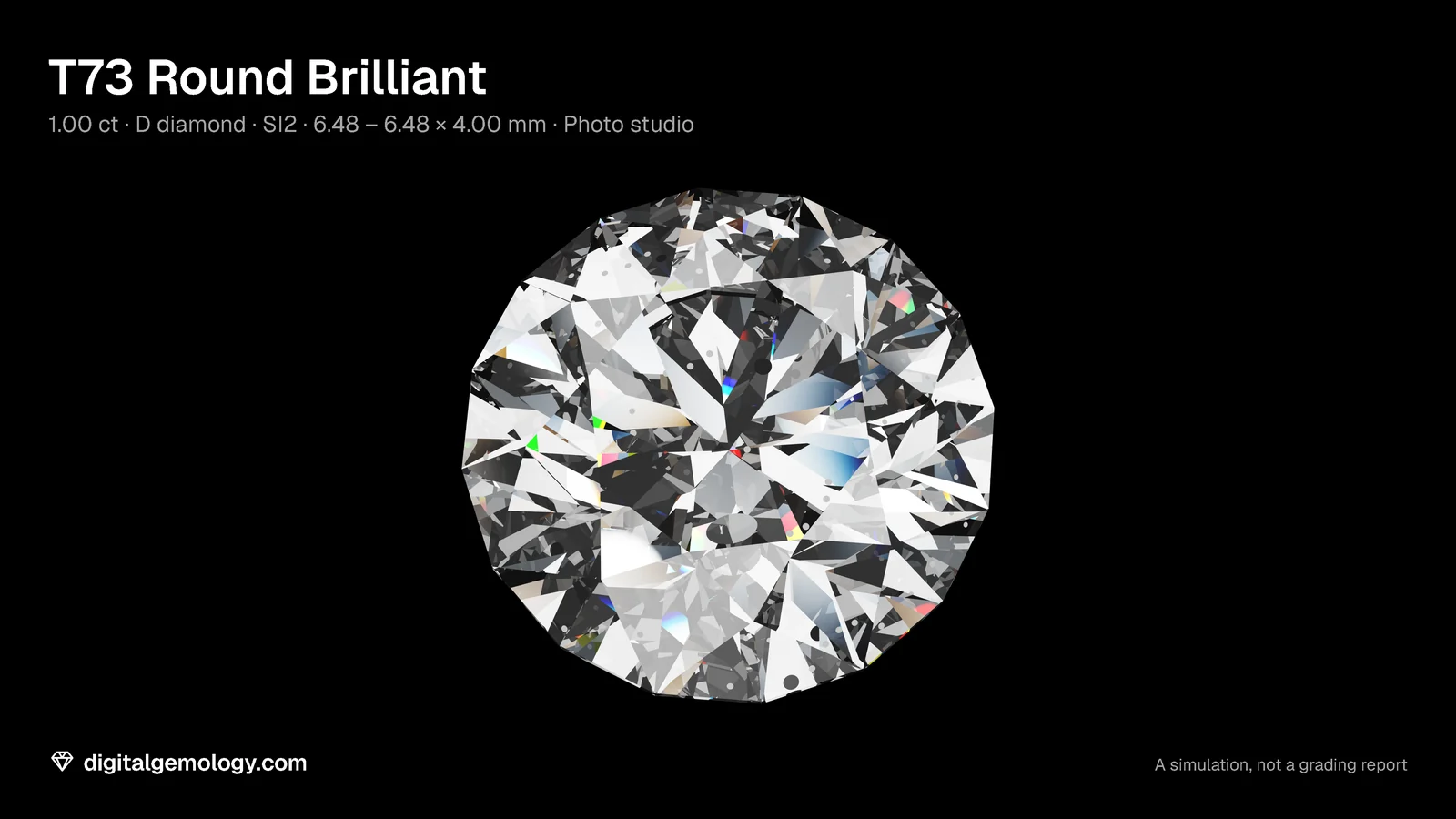
Now fill the screen with the SI2 alone, and there they are: small crystals and pinpoints, all through the stone. Graders judge clarity at that scale, under magnification, not at arm's length. Keep those two distances apart. That is the key to this whole C.
What clarity measures
Clarity is about the absence of two kinds of characteristics:
- inclusions, which are inside the stone
- blemishes, which are on its surface.
Diamonds form under very high heat and pressure. As a diamond grows, small crystals can get trapped inside it. The crystal structure of the diamond itself can also grow irregularly. A diamond with no characteristics at all is extremely rare.
GIA's scale has 11 grades in six categories. A skilled grader judges all of them at 10x magnification:
- Flawless (FL): a grader finds nothing at all, inside or on the surface.
- Internally Flawless (IF): clean inside; the only marks are on the surface.
- Very, Very Slightly Included (VVS1, VVS2): inclusions so small that even a trained eye at 10x has difficulty finding them.
- Very Slightly Included (VS1, VS2): small inclusions that take some searching at 10x.
- Slightly Included (SI1, SI2): inclusions that you see quickly at 10x.
- Included (I1, I2, I3): inclusions that are easy to see at 10x. They can make the stone cloudy or reduce its brilliance.
Flawless is strict. A diamond with a few very small polish marks can still get an Excellent polish grade. But those same marks stop it from being Flawless.
How a lab grades it
The grader examines the diamond under standard conditions at 10x and finds every clarity characteristic. The grader also looks for clarity treatments, for example fracture filling or laser drilling. At least two graders grade the stone independently. Then they plot the characteristics on a diagram of the shape and facets of the stone. This diagram is a map of that diamond.
The grade isn't a count. It depends on five things:
- the size of the characteristics
- their number
- their position
- how noticeable they are in the stone as a whole
- how dark or light they look.
One dark crystal under the table can matter more than three faint pinpoints near the girdle.
And those characteristics are useful. Like birthmarks, they identify one particular stone. They also help gemologists tell natural diamonds from synthetics and simulants.
Try it yourself
- Open 3D Gemstone Simulator with the T73 in diamond, lighting Photo studio. Make the stone fill most of your screen.
- Hide and seek. In the report, under Clarity grade, step from FL toward I3, one grade at a time. Write down the first grade where you can see something at normal viewing distance. Do not zoom in.
- At each grade, scroll down the report to Clarity characteristics. The diagram plots each characteristic on the crown (left) and the pavilion (right). Read the Comments line too.
- The puzzle. Compare VVS2 and VS1. Both plot two characteristics. Why is VS1 the lower grade?
- Turn the stone slowly at SI2. Do the characteristics stay equally visible from every angle?
What the simulator shows
The diagram. At FL, the diagram plots nothing. At IF, the report notes "internally flawless". Then the map fills up:
- one characteristic at VVS1
- two at VVS2 and VS1
- three at VS2
- one more at each grade below that, up to eight at I3.
In VVS they are pinpoints only. A crystal joins at VS1, and a feather at VS2.
The puzzle. VVS2 and VS1 have the same count. The difference is the type and the size. VS1 adds a crystal, and the simulator sets the size of every characteristic by grade. Size and type matter, not only the number. A real grader thinks like that too.
What they do to light. In the simulator, a crystal or a pinpoint stops any light path that hits it. So it shows as a dark spot. A feather is a small break inside the stone. It reflects part of the light, so it can flash bright as the stone turns. When you turned the SI2, characteristics came into view and went out of view as the facets lined up. Visibility depends on the angle and the light. So one look from one side never tells the whole story.
Your threshold. The simulator's notes describe VS inclusions as "seen at 10×, rarely by eye" and SI as "noticeable at 10×, and sometimes to the eye". Where did you first see something? Only a skilled grader at 10x can find many of the inclusions in SI stones. SI is one of the most popular categories: it costs less and is still beautiful.
Key points
- Clarity grades the absence of inclusions (inside) and blemishes (on the surface). Graders judge it at 10x magnification.
- GIA's scale has 11 grades in six categories, from Flawless to I3.
- The grade depends on size, number, position, visibility and darkness, not on a simple count.
- At least two graders grade independently. They plot the characteristics on a diagram that is a map of that particular stone.
- Many inclusions that graders find at 10x are not visible to the unaided eye. How visible they are depends on the angle and the light.
Go further: in the 3D Gemstone Simulator, step through the clarity grades with Facet mesh on. Then you can see which facet each characteristic sits under.
Try it free
- 3D Gemstone Simulator: Turn a cut in seven gemstones and set its carat, color, clarity and cut grade.
Free, in your browser, no account.
Quick quiz
Five questions on this lesson, a couple of minutes. Pick an answer and see at once if you got it, and why.
Cuts in this lesson
We sell the files of these cuts: 3D models and cutting files, with a personal-use license.
Keep exploring
- Next lesson: Diamond cut grade: Excellent vs Poor, side by side
- Try another topic · Diamond anatomy and proportions: Crown angle and crown height in a round diamond
Previous lesson · The four Cs of diamonds: all lessons · All topics