Transcript
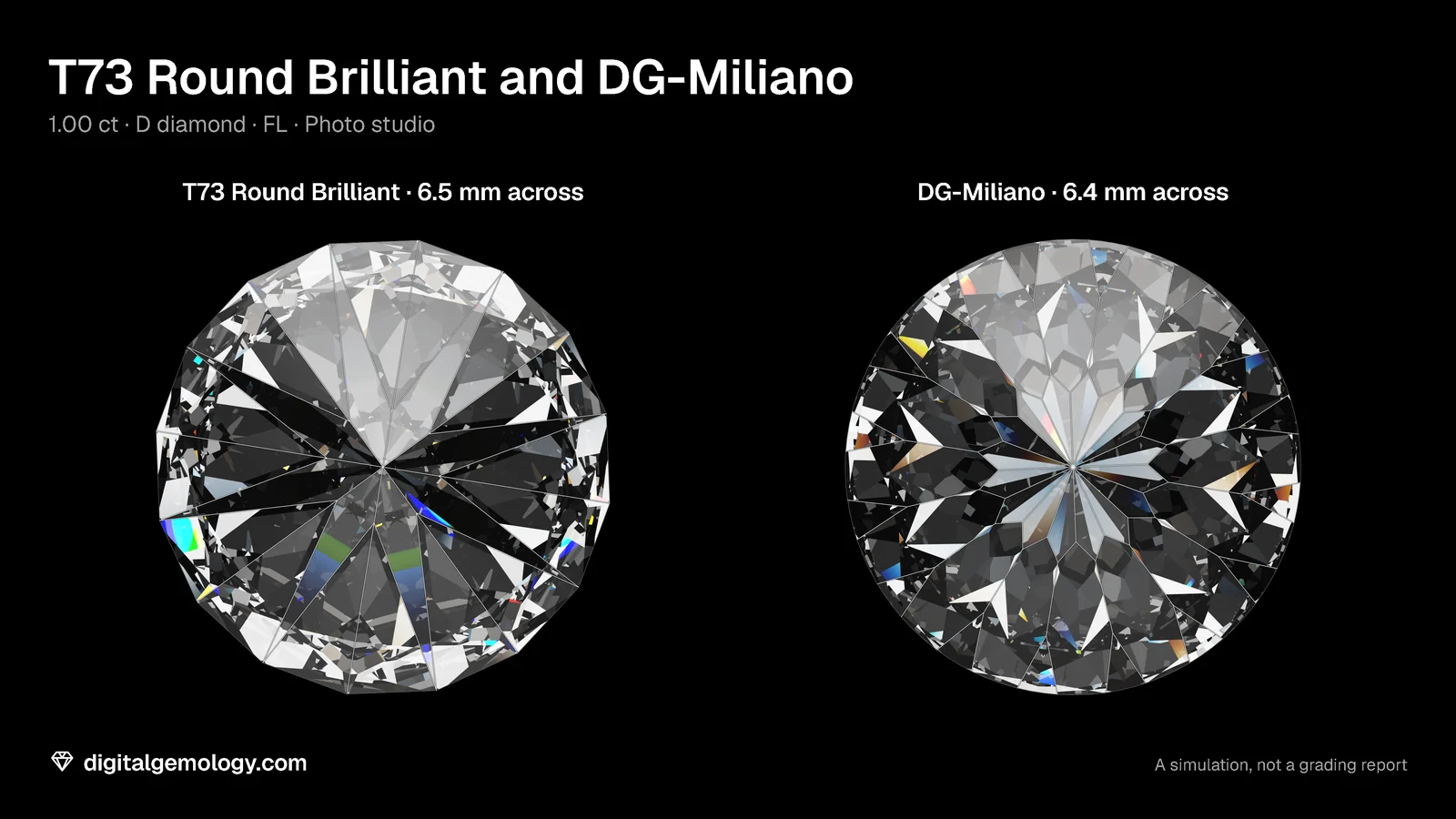
This 10-second clip has no sound. What you see:
The T73 beside DG-Miliano, turning at true size.
107 years on the same numbers
Tolkowsky's proportions became the foundation of the modern round. A century later, the benchmark on our own Wheel, the T73, still uses his 40.75° and 34.5°. His numbers became a ceiling as much as a foundation. They were hard to argue with, as long as nobody could trace the light well enough to do better. In our models, even the hearts and arrows round runs on his angles.
Tolkowsky's model had three limits: a flat slice, light only from straight above, no more than two reflections. Today a computer does each of those routinely.
The technology: ray tracing, CAD and the cutting file
Ray tracing in 3D. Our Cut Performance Wheel fires 3,200 rays into a full 3D model of the stone, from near-vertical directions. It follows each ray for up to 12 reflections, through every facet. Then it tilts the stone by 20° and does it again with 2,200 more. That is the measurement Tolkowsky couldn't make, and it runs in a browser.
Design on screen. Today a designer draws a cut in CAD, scores it, changes it and scores it again, many times before a stone exists. That loop is how we make our house cuts.
The cutting file. The finished design becomes a faceting diagram on a standard 96-tooth index wheel. A cutter with an ordinary faceting machine can then reproduce it.
What DG-Miliano changes
DG-Miliano is one of our house cuts. We drew it for moissanite, but like every cut in the table below we measure it here in diamond. It keeps the modern round's crown plan (8 stars, 8 crown mains, 16 upper girdle facets) and changes three things:
- A shallower crown: 32.0° instead of 34.5°.
- A multi-angle pavilion: three tiers of 16 facets instead of one set of mains and halves. The mains sit at 38.3°, below Tolkowsky's 40.75°.
- A faceted girdle of 96 facets.
That's 177 facets in all (81 on crown and pavilion, plus 96 on the girdle), against the T73's 73. The stone is 60.3% deep.
Try it yourself
- Open Cut Performance Wheel with
?cut=dg-miliano&stone=diamond. The comparison cut is the T73. Read all eight rows, not just the top three. - Open 3D Gemstone Simulator with
?cut=dg-miliano&stone=diamond, Turn on Slow, lighting Sunny day. Then load the T73 and the old single, the oldest cut in the table below. - Go back to the Wheel. Load each of the eight cuts in the table below in diamond and write down brilliance, fire and scintillation.
What the Wheel shows
Ahead on all three. DG-Miliano scores 95 for brilliance, 82 for fire and 98 for scintillation, against the T73's 93, 78 and 80. On the Wheel's Global score it's 93 against 90. On our diamond page it ranks first of the top-ten brilliants.
Read it honestly. Most of the gap is scintillation: +18 points. The Wheel counts scintillation from the facets, and DG-Miliano has 177 against 73. That's a real design choice, but it's a count, not a traced result. The traced gains are smaller: +2 in brilliance and +4 in fire. And not every row goes up. On Tilt, how well brightness holds when the stone is tipped 20°, it scores 90 against the T73's 92. These are simulation results for an ideal model: "a simulation, not a grading report", as our method page says. A few points is a small margin.
What is new. Not the facets alone. Tolkowsky's method had no way to test the shallower crown and the lower, three-tier pavilion. Their effect only shows when you follow the light in 3D, from many directions, through many bounces. That is the new step. The gains are small, far smaller than the bruting machine's. But they come from a new way of designing: trace the light first, then choose the angles.
The whole story in one table
| Cut | Era | Facets | Technology it depended on | Brilliance | Fire | Scintillation |
|---|---|---|---|---|---|---|
| Old single | 1400s | 18 | Polishing wheel and diamond powder | 72 | 84 | 44 |
| Mazarin | 1650s | 34 | Same; skill | 65 | 63 | 61 |
| Peruzzi | 1690s | 58 | Same; skill | 75 | 68 | 81 |
| Old mine | 1700s | 58 | Hand refinement; Brazil rough | 59 | 72 | 81 |
| Old European | 1870s | 58 | Bruting machine, gauges; South African rough | 90 | 74 | 81 |
| T57 (Tolkowsky) | 1919 | 57 | Saw, lathe, mathematics | 92 | 79 | 72 |
| Hearts and arrows (our T73) | 1985–1990s | 57 | Reflector viewers; cutting to optical symmetry | 93 | 78 | 80 |
| DG-Miliano | 2026 | 177 | 3D ray tracing, CAD, cutting files | 95 | 82 | 98 |
Scores are our Wheel's, in diamond, for our models. Facet counts in the table are table, crown, pavilion and culet. We count girdle facets only for DG-Miliano, because its girdle is part of the design. Our historic models also carry girdle facets:
- 8 on the old single and Mazarin
- 16 on the Peruzzi, old mine, old European and T73.
That's why their scintillation is higher than this column suggests: scintillation counts every facet. Faceted girdles are a recent habit (see the Peruzzi). On plain girdles, the Wheel's own formula would give the old single 33, the Mazarin 53, and the Peruzzi, old mine and old European 72, level with the T57.
Key points
- Tolkowsky's 1919 proportions were a foundation and, for a century, a ceiling.
- Today's tools follow light in 3D, from many directions, through up to 12 reflections. A designer can draw and score a cut on screen before anyone cuts it.
- DG-Miliano: a shallower crown (32.0°), a three-tier pavilion with mains at 38.3°, a 96-facet girdle, 177 facets.
- In diamond it scores 95 / 82 / 98 against the T73's 93 / 78 / 80, and ranks first of our top-ten brilliants.
- Most of the lead is scintillation, which is a facet count. The traced gains in brilliance and fire are 2 and 4 points, and tilt is 2 points lower.
Go further: the DG-Miliano cut page has the full diagram, and its 3D model and cutting file if you want to cut or render it yourself.
Try it free
- Cut Performance Wheel: Compare brilliance, fire and scintillation of two cuts, or one cut in two stones.
- 3D Gemstone Simulator: Turn a cut in seven gemstones and set its carat, color, clarity and cut grade.
Free, in your browser, no account.
Quick quiz
Five questions on this lesson, a couple of minutes. Pick an answer and see at once if you got it, and why.
Cuts in this lesson
We sell the files of these cuts: 3D models and cutting files, with a personal-use license.
Keep exploring
Previous lesson · Historic diamond cuts: the history of the brilliant: all lessons · All topics