
Transcript
This 10-second clip has no sound. What you see:
The old single beside the T73 in direct sun, at true size: big, separate flashes against many small ones.
A crystal that was already a gem
For most of history, a diamond in jewelry was a crystal as it came out of the ground. That crystal is an octahedron: two four-sided pyramids joined at their bases. People prized it for its hardness and its mirror-like luster, not for colored flashes. In paintings of the period, table-cut diamonds look almost black.
Our history of the brilliant follows that crystal for six hundred years, one cut at a time. For each cut we ask two questions: what technology made it possible, and what did it change in the light?
The technology: a wheel and diamond dust
Only diamond scratches diamond. So the only way to shape one was to grind it with its own powder. The first firm record is a guild of diamond polishers in Nuremberg in 1375, with an apprenticeship of five to six years. Around 1476, Lodewyk van Berquem, a polisher in Bruges, became famous for something new: facets laid out with strict symmetry. His family later claimed he invented polishing with diamond powder. Tolkowsky, writing in 1919, points out that polishing was a century older. What Van Berquem may have added is a better iron wheel, one that held the powder well.
Demand pushed the craft forward. From about 1450, it became fashionable at the French court for women to wear diamonds as jewels. The fashion spread across Europe. More orders meant more cutters, and more ideas.
Still, every cut of this era was a compromise with the crystal. The French traveler Tavernier described Indian cutters in 1665. They mostly polished over the natural faces, covered flaws with many small facets, and kept as much weight as possible. European cutters went further, but only so far.
The old single cut
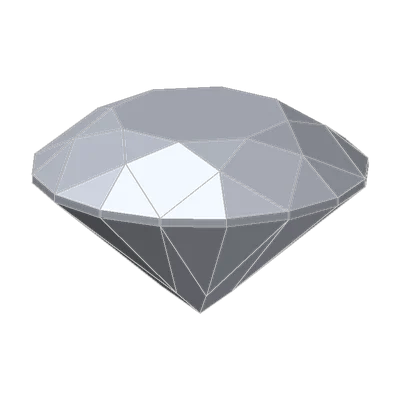
The single cut, or eight cut, does three things to the octahedron:
- The cutter grinds away the top point to make a flat table.
- The cutter bevels the corners into a regular octagon.
- Every crown facet matches every other, and every pavilion facet matches every other.
That gives 8 facets above the girdle, 18 in all (table, 8 crown facets, 8 pavilion facets and a culet). Our model adds 8 small facets at the girdle, for 26. The plan never quite disappeared: cutters still use it today for very small melee stones.
Try it yourself
- Open Cut Performance Wheel with
?cut=old-single&stone=diamond. The comparison cut is the T73 by default, our benchmark, built on Tolkowsky's 1919 cut. Read brilliance, fire and scintillation for both. - Open 3D Gemstone Simulator with
?cut=old-single&stone=diamond. Set Turn to Slow and lighting to Club. Count the facets that you can see flash. - Change the cut to the T73 round brilliant, with the same lighting. What changes: the size of the flashes, or the number?
What the Wheel and the simulator show
The scoreboard. The old single scores 72 for brilliance, 84 for fire and 44 for scintillation. The T73 scores 93, 78 and 80. This old cut beats the modern benchmark on fire, and loses badly on the other two.
Why so much fire? Our fire score is a share of the light that comes back to you, not of all the light that goes in. A stone with eight big crown facets sends that light out in a few large beams. Each beam has room to spread into separate colors. So when the old single does return light, a lot of it arrives as color. That's why the simulator shows a few big, slow, colored flashes under Club lighting.
Why so little sparkle? Scintillation is the on-and-off twinkle when you move the stone. The Wheel counts it from the number of facets that reach the surface: 26 facets give 44, and the T73's 73 give 80. Few facets, few sparkles.
Where the light goes. In our ray census, 19% of the light leaks out through the pavilion, against 2% in the T73. Much of the missing brilliance goes there.
One caution. These are scores for our model: a regular single cut at fixed angles (pavilion 48.5°, depth 67.5%). A real stone from the 1400s followed its crystal and was rarely this regular. The written sources say these early cuts showed little fire, and in paintings of the period table-cut diamonds look almost black. Our model shows what the plan could do, cut perfectly.
Key points
- In the 1400s, the only way to shape diamond was to grind it with diamond powder on a wheel. Polishers in Nuremberg formed a guild by 1375.
- Around 1476, Van Berquem in Bruges made strict symmetry the standard and may have improved the wheel.
- The old single cut flattens the octahedron into a table and bevels it to an octagon: 8 facets above the girdle, 18 in all.
- On our Wheel it has the most fire (84) and the least scintillation (44) of the eight cuts in the history of the brilliant. 19% of its light leaks out.
- Fire is a share of the light that returns. Scintillation is a count of facets.
Go further: the old single cut page has the full diagram and proportions.
Try it free
- Cut Performance Wheel: Compare brilliance, fire and scintillation of two cuts, or one cut in two stones.
- 3D Gemstone Simulator: Turn a cut in seven gemstones and set its carat, color, clarity and cut grade.
Free, in your browser, no account.
Quick quiz
Five questions on this lesson, a couple of minutes. Pick an answer and see at once if you got it, and why.
Cuts in this lesson
We sell the files of these cuts: 3D models and cutting files, with a personal-use license.
Keep exploring
- Next lesson: The Mazarin cut: the first brilliant
- Try another topic · The bow-tie effect: Fixing a bow-tie: the steep belly of DG-Bowtie
Historic diamond cuts: the history of the brilliant: all lessons · All topics