Transcript
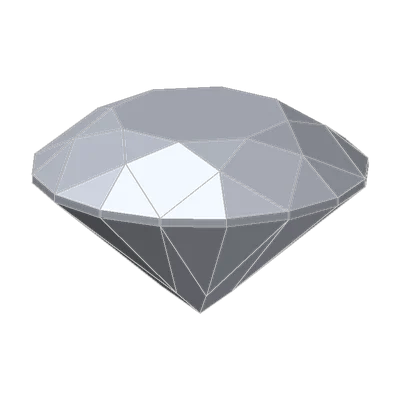
This 10-second clip has no sound. What you see:
The T73 in the Hearts & Arrows Scope, arrows face up, turned over to the hearts.
Sixteen small facets, one carat
Picture a rough diamond that's going to come out at 0.99 ct. A hundredth short of the one-carat line, and a real step down in price.
A cutter has a quiet trick. Tilt the small facets along the girdle (the upper halves, the lower halves or both) a little toward the big facets beside them. That leaves a touch more diamond at the girdle, and sometimes it's enough to cross the line. GIA's cut booklet calls it painting, and its opposite digging out. It notes that cutters can use both to save weight, for example to reach a round number like half a carat, one carat or two.
The price is the look. In our Cut Grading Tool, significant painting or digging takes a T73 down to Good, even when it's Excellent in every other way. Let's meet those small facets properly.
Two lengths
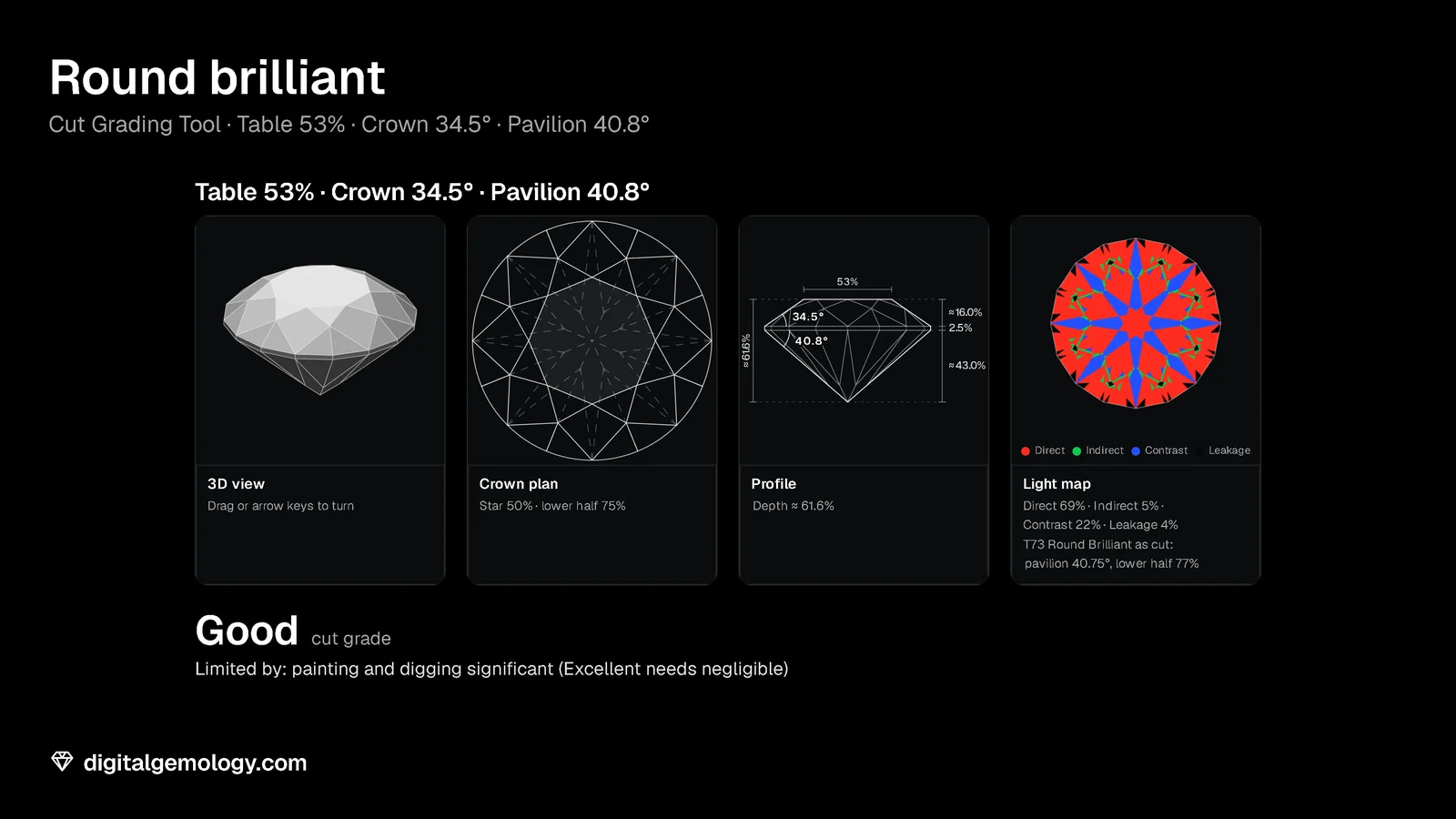
The crown angle and the pavilion angle belong to the big facets: bezels and mains. Two lengths set the small facets around them:
- Star length: how far the star facets reach from the edge of the table toward the girdle, as a percentage of that distance. Long stars give smaller bezels.
- Lower half length: how far the lower half facets reach from the girdle toward the culet, as a percentage of that distance. Long lower halves leave narrower pavilion mains.
The T73 has stars at 50% and lower halves at 77%. (The tool's slider moves in 5% steps, so it shows 75%.)
For an Excellent grade, GIA's limits are 45 to 65% for star length and 70 to 85% for lower half length. For Very Good, they are 40 to 70% and 65 to 90%. Past the Very Good ranges, GIA's tables allow any value at Good. So on their own, these two lengths can never take a stone below Good. Their job is the pattern: how the bright and dark slivers are arranged face up. (The tool's sliders stop at the Very Good limits. So in the tool, the worst you'll see is Very Good.)
The lower halves draw the hearts
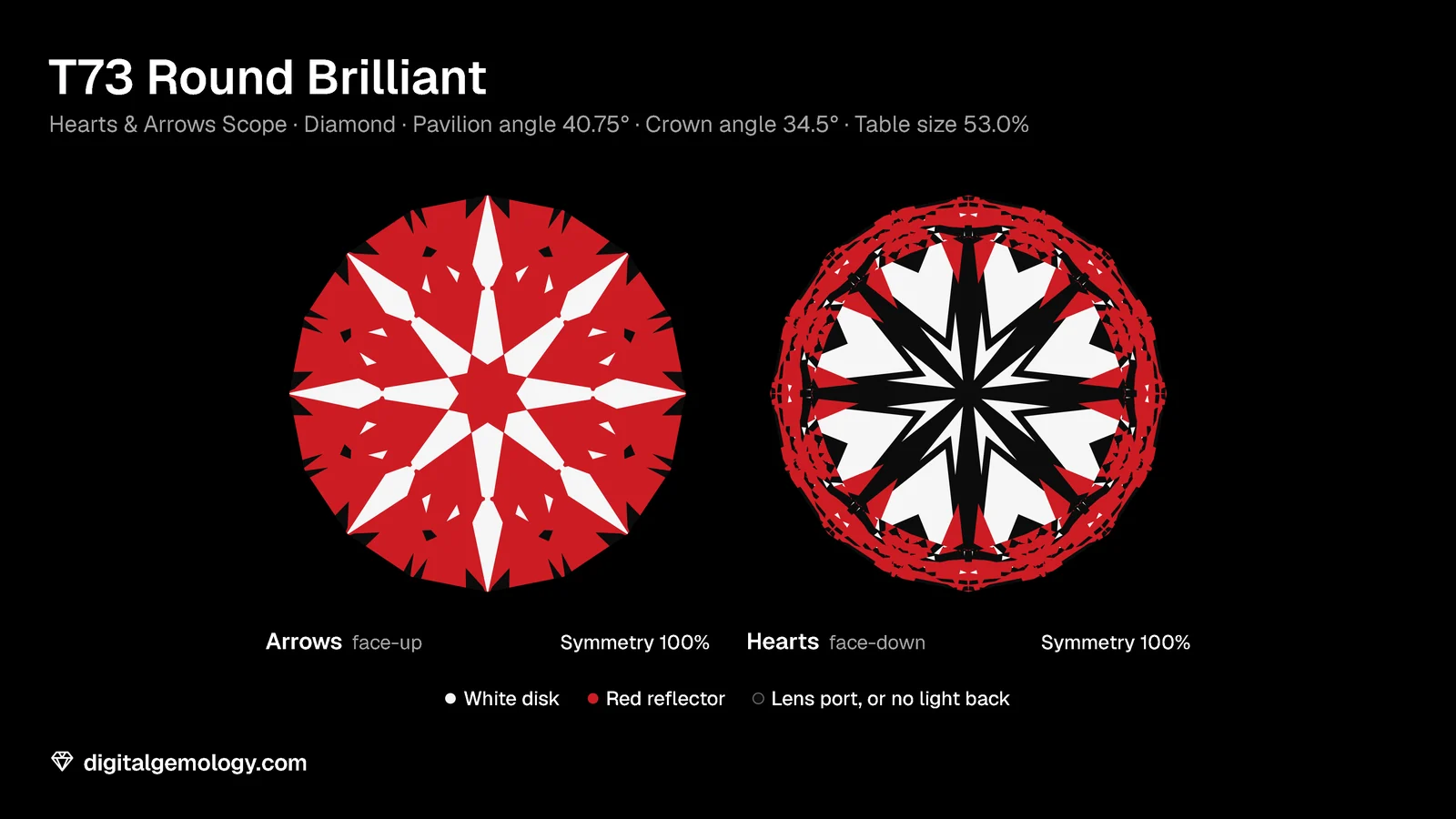
In a Hearts & Arrows viewer, a well-made round shows eight arrows face up and eight hearts face down. The shaft of each arrow is a pavilion main reflected in the main opposite it, and the crown adds the arrowhead. You see each heart through the pavilion. It is made of six facet reflections: four from the pavilion mains make its body, and two half facets square off its top.
The lower halves decide their shape. Our Hearts & Arrows research notes say this:
- lower halves of about 75% or less give fatter hearts with little gap between them;
- 80% or more gives thinner hearts, further apart.
In the decades after 1919, cutters made the lower halves longer and the mains narrower. That change is what lets a modern round show hearts and arrows at all.
Try it yourself
- Open Cut Grading Tool. Open More proportions.
- Move Star length from 40% to 70% and watch the Crown plan. How do the stars and bezels change? Note where the grade changes.
- Do the same with Lower half length, 65% to 90%.
- Put both back. Set Painting and digging to Moderate, then Significant, then Severe.
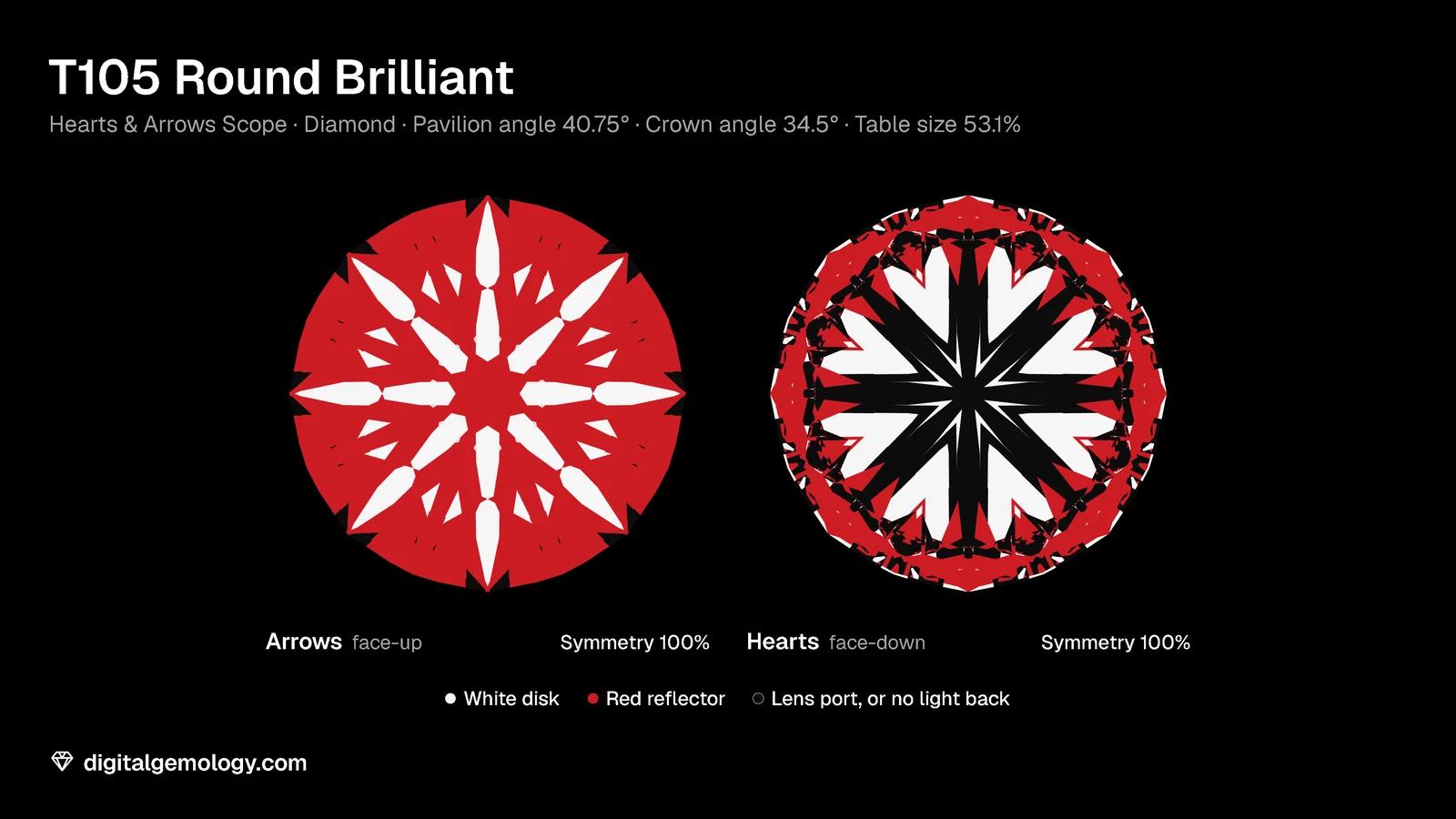
- Open Hearts & Arrows Scope with the T73 Round Brilliant in diamond. Then switch the cut to the T105 Round Brilliant, which splits each lower half into three rows. Compare the hearts.
What the Cut Grading Tool and the H&A Scope show
The lengths. Short stars (40%) leave big bezels and grade Very Good. From 45% to 65% the stone stays Excellent. At 70% it's Very Good again. Lower halves behave the same way: Very Good at 65% and 90%, Excellent between them. In the tool, these two lengths change the drawing and the grade. They do not change the light map or the brilliance, because the tool traces those on the T73's own star and lower half.
Painting and digging. Moderate gives Very Good, Significant gives Good, Severe gives Fair. GIA's observations explain why. Given the choice, most viewers liked stones with only the slightest painting or digging, or none. Heavy painting on the pavilion breaks the pattern into broad dark zones. In the end, the round starts to look like the old single cut with its few facets. Heavy digging out can drain the contrast and leave a grayish stone. Cutters also dig out to grind away an inclusion near the girdle.
The hearts. The T73 and the T105 have the same main angles, but their hearts look different. The T105's extra rows of small pavilion facets redraw them. Both read 100% symmetry. Symmetry tells you that the eight hearts match each other. The small facets decide what each heart looks like. The T73's own lower halves, at 77%, sit between the "fat" and "thin" heart lengths.
Key points
- Star length and lower half length set the small facets around the bezels and mains. Each is a percentage of the distance that the facets span.
- GIA's Excellent limits are 45 to 65% (star) and 70 to 85% (lower half). On their own, they can't take a stone below Good.
- They shape the face-up pattern and the hearts, not the main angles. Longer lower halves give thinner hearts, further apart.
- Painting and digging out tilt the half facets, often to save weight or to pass a carat threshold.
- In the Cut Grading Tool, painting or digging lowers the grade: Moderate Very Good, Significant Good, Severe Fair.
Go further: the T105 cut page shows its extra star halves and three rows of lower halves.
Try it free
- Hearts & Arrows Scope: See the arrows face up and the hearts face down as you change the cut.
- Cut Grading Tool: Grade a round brilliant from its proportions and see its light map change.
Free, in your browser, no account.
Quick quiz
Five questions on this lesson, a couple of minutes. Pick an answer and see at once if you got it, and why.
Cuts in this lesson
We sell the files of these cuts: 3D models and cutting files, with a personal-use license.

Keep exploring
- Next lesson: Diamond girdle thickness: thin, medium, thick and what it costs you
- Try another topic · How to read a diamond grading report: What "ideal cut" means on a diamond report
Previous lesson · Diamond anatomy and proportions: all lessons · All topics