Ten percent heavier, and it doesn't show
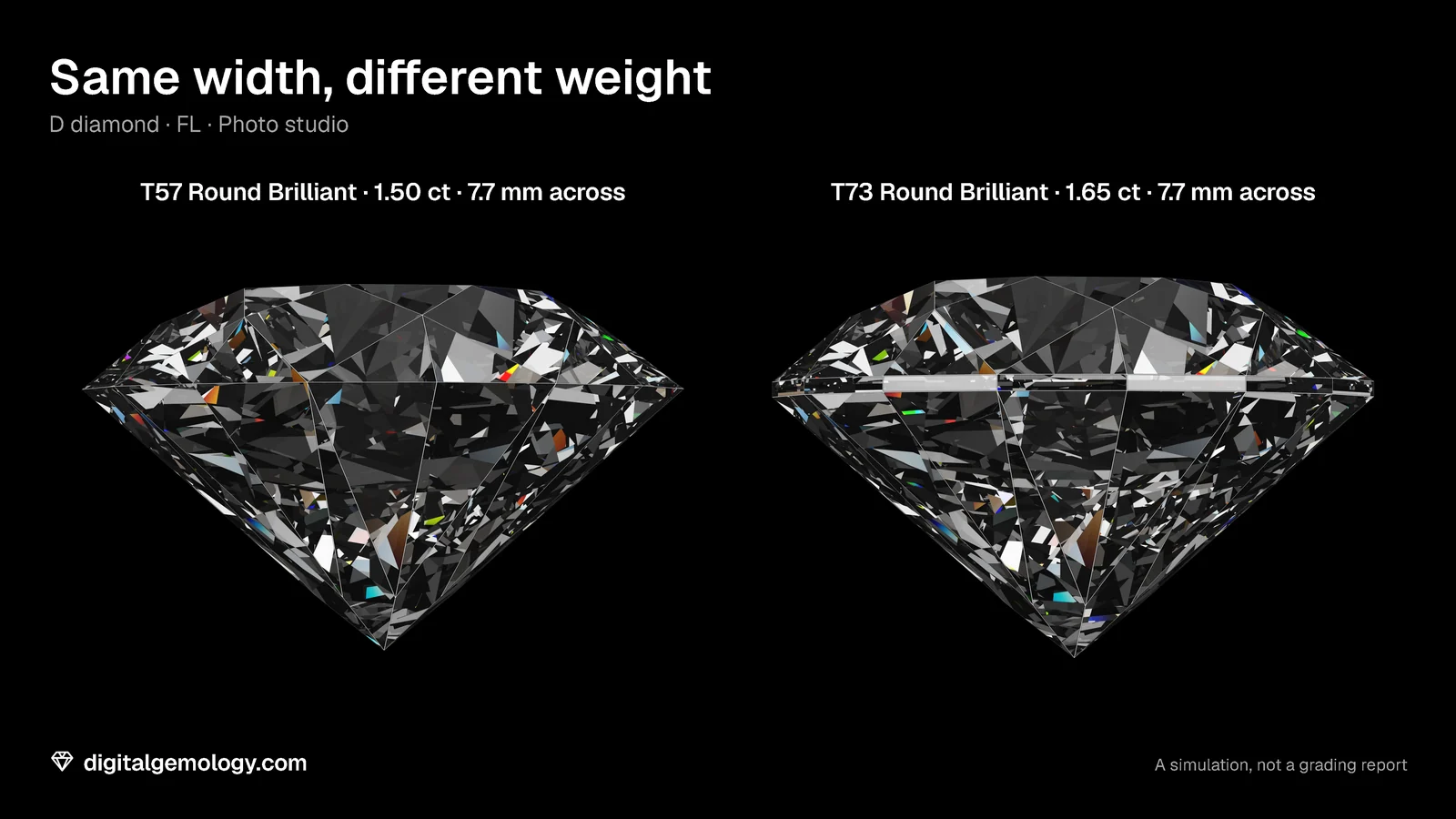
Two round brilliants, side on, both 7.7 mm across. Same crown, same pavilion, same angles. One weighs 1.50 ct, the other 1.65 ct.
The only difference is a thin band around the middle. The T57, cut to Tolkowsky's 1919 proportions, has a knife-edge: the crown and the pavilion meet in a sharp line. The T73 has a girdle band of 16 small facets, the finish of most rounds today. That band makes the T73 about 10% heavier at the same width: at 8.15 mm, 1.99 ct against 1.81 ct.
That is weight you pay for and can't see face up. Now push it further. In our Cut Grading Tool, a thicker girdle on the T73, from 2.5% to 7.5%, takes it from Excellent to Fair. Not a single angle changes.
What the girdle is for
The girdle is the narrow band between the crown and the pavilion. It is the setting edge of the stone: the prongs grip it, and it takes the knocks. A girdle that is thick enough lowers the risk of damage. A girdle that is too thin chips easily. Labs also use the girdle as a place to write: a GIA report notes any inscription on the girdle, such as the report number.
Its surface has three finishes. The thickness is graded the same way for all three:
- bruted: left with the surface from the process that shapes the stone round;
- polished: smooth;
- faceted: cut into a row of small facets, like the T73's sixteen.
Valleys and hills
The girdle of a round is not an even band. The final faceting leaves it scalloped: 16 valleys, where the upper and lower half facets come closest, and 16 hills between them. The grader judges the thickness at the valleys, as a share of the diameter, from the thinnest to the thickest. So a report gives it as a range, such as "Thin to Medium", in eight steps:
Extremely Thin · Very Thin · Thin · Medium · Slightly Thick · Thick · Very Thick · Extremely Thick
A knife-edge, with no girdle at all, is called Extremely Thin. GIA's chart gives typical valley values for the others, for example about 1.8% for Medium and 7.5% for Extremely Thick. The lab also measures an average girdle thickness as a percentage with an optical device. The words come from a grader who looks at the stone in profile at 10x.
Both ends cost something. Too thin is a durability risk. Too thick adds weight that the stone doesn't show face up. GIA counts that against the stone as weight ratio: too much weight for the diameter. Part of this shows in the total depth.
Try it yourself
- Open 3D Gemstone Simulator. Load the T57 Round Brilliant, turn on Facet mesh and set View to profile. Then load the T73 and compare the edge.
- Open Cut Grading Tool. Under More proportions, move Girdle thickness from 1.0% to 8.0%. Watch the total depth in the Profile, and the grade with its Limited by line.
- Find the safe zone: the thinnest and the thickest girdle percentages that keep the T73 Excellent.
- Set Girdle description to each of the eight words, from Extremely thin to Extremely thick. Which ones allow Excellent?
What the simulator and the Cut Grading Tool show
The safe zone. The T73 is Excellent from 2.0% to 3.5%. At 1.5% the girdle reads Very Thin and the grade is Very Good. At 1.0%, Extremely Thin, it's Good. At 4.0% the grade drops to Very Good. The cause is not the girdle itself but the total depth: 63.1%, just past the Excellent limit of 63.0%. At 5.5% it's Good, and at 7.5% it's Fair.
The words. Thin, Medium and Slightly Thick allow Excellent. Very Thin and Thick limit the stone to Very Good. Extremely Thin and Very Thick limit it to Good, and Extremely Thick to Fair. The thin end is about durability. The thick end is about weight.
The T57 and T73. Same angles, same face-up pattern. The T73's band adds depth (61.7% against 59.2%) and weight, and it gives the setter something to hold. The girdle always makes that trade.
Key points
- The girdle is the setting edge. It must be thick enough to protect the stone, and thin enough not to waste weight.
- It can be bruted, polished or faceted. The thickness is judged the same way.
- The girdle of a round is scalloped into 16 valleys and 16 hills. The thickness is read at the valleys and reported as a range, in eight words from Extremely Thin to Extremely Thick.
- A knife-edge counts as Extremely Thin. Very thin girdles are a durability risk. Thick girdles add weight that the face doesn't show.
- In the Cut Grading Tool, the T73 stays Excellent from a 2.0% to a 3.5% girdle. At 7.5% it's Fair.
Go further: the T57 and T73 cut pages give the depth and weight of both stones at the same 8.15 mm.
Try it free
- Cut Grading Tool: Grade a round brilliant from its proportions and see its light map change.
- 3D Gemstone Simulator: Turn a cut in seven gemstones and set its carat, color, clarity and cut grade.
Free, in your browser, no account.
Quick quiz
Five questions on this lesson, a couple of minutes. Pick an answer and see at once if you got it, and why.
Cuts in this lesson
We sell the files of these cuts: 3D models and cutting files, with a personal-use license.

Keep exploring
- Next lesson: The diamond culet: none, pointed or large
- Try another topic · Historic diamond cuts: the history of the brilliant: Tolkowsky's 1919 ideal cut: the brilliant that was calculated
Previous lesson · Diamond anatomy and proportions: all lessons · All topics