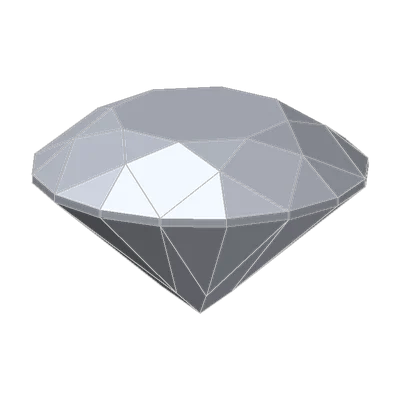
Two lines, one secret
Two grading reports, both for a 1.00 ct round diamond. The measurements read:
- Stone 1: 6.48 – 6.48 × 4.00 mm
- Stone 2: 6.16 – 6.16 × 4.16 mm
You cannot see either stone. Which one faces up bigger, and which one hides weight where you can't see it?
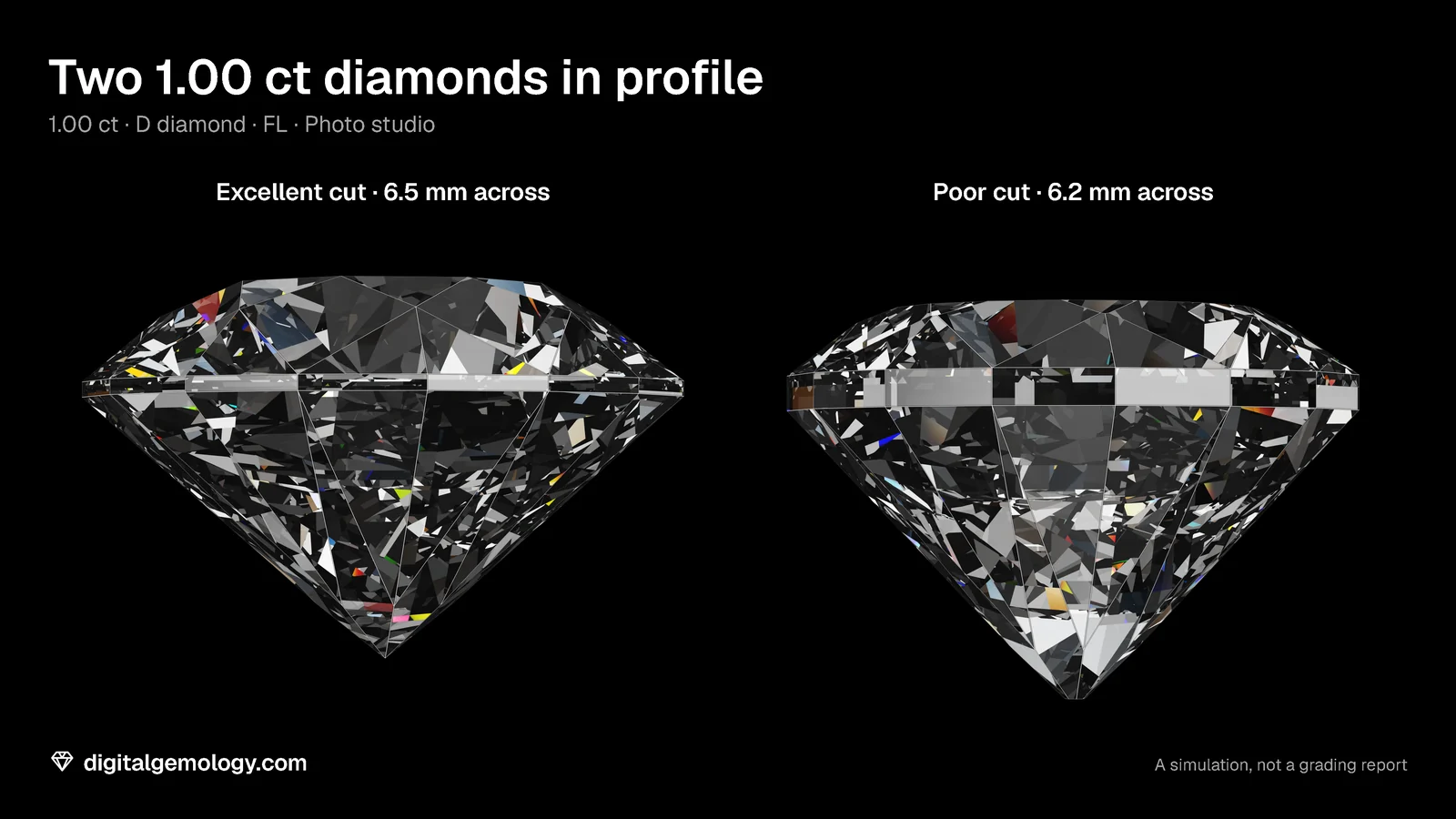
Divide the depth by the diameter. Stone 1 is 61.7% deep. Stone 2 is about 67.5% deep. (The simulator's report uses unrounded figures and says 67.6%.) That stone is narrower and taller, so the same carat sits lower down, out of sight. Those two lines are the T73 in our simulator at Excellent and at Poor cut. This page shows you how to read a report the same way.
Everything is a share of the diameter
On a report, the size of a round diamond is written as minimum diameter – maximum diameter × depth, in millimeters. (Fancy shapes give length × width × depth.) No round is perfectly round. So the lab measures the narrowest and the widest diameter across the girdle. Their average is the yardstick for all the other numbers. A big gap between the two shows that the stone is out of round.
Every other proportion is an angle, in degrees, or a percentage of that average diameter:
- table size: the width of the table;
- crown height: from the girdle to the table;
- girdle thickness;
- pavilion depth: from the girdle to the culet;
- total depth: from the table to the culet;
- culet size.
With percentages, you can compare stones of any size: a 0.5 ct and a 5 ct with the same proportions read the same numbers. The habit is old. In 1919, Tolkowsky calculated his ideal round. He set the diameter at 100 units. He gave the table as 53.0, the part above the girdle as 16.2 and the part below as 43.1.
The lab measures all this with an optical device that never touches the stone. The report draws the result as a proportion diagram: the profile of the stone, with its numbers.
Three heights make the depth
Look at a diamond side on. The total depth has three stacked parts:
crown height + girdle + pavilion depth = total depth
Two of those parts come from the angles. The crown height depends on the crown angle and on the width of the crown's ring (the table takes the rest). The pavilion depth depends on the pavilion angle only.
Here are the numbers in our Cut Grading Tool:
- The T73's 53% table and 34.5° crown give a crown height of 16.2%.
- Its 40.8° pavilion gives a pavilion depth of 43.2%.
- With its 2.5% girdle, the tool calculates a total depth of 61.6%.
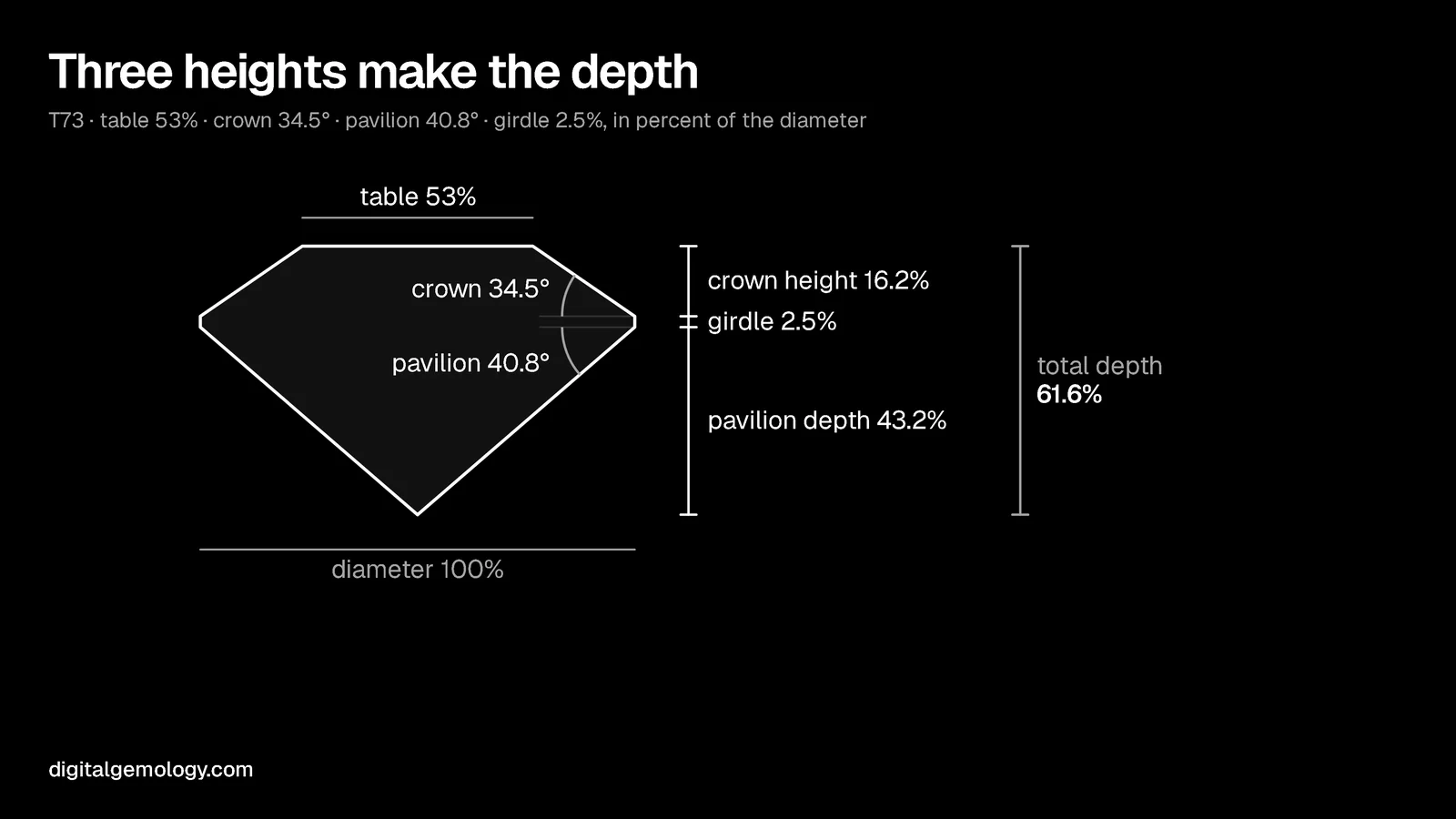
Two small details explain why the sums are never exact. The tool's profile rounds the crown height and the pavilion depth to the nearest half percent. Also, its depth formula subtracts a small calibration (0.25%). We measured the T73's own 3D model directly: it is 61.7% deep.
The girdle is the one height with no angle. That makes it a quiet way to add depth, and weight.
Try it yourself
- Open Cut Grading Tool. It starts on the T73 as cut. Look at the Profile view. Read the crown height, the girdle, the pavilion depth and the total depth.
- Open More proportions and raise Girdle thickness from 2.5% to 7.5%. Which numbers in the profile move, and which stay the same? Watch the grade.
- Put the girdle back and change the Crown angle. Which numbers move now?
- Report detective. Calculate the total depth of these three made-up 1.00 ct rounds. Which one do you look at first?
- A: 6.48 – 6.52 × 4.00 mm
- B: 6.20 – 6.22 × 4.18 mm
- C: 6.40 – 6.60 × 3.95 mm
What the Cut Grading Tool shows
The girdle moves only the total. From 2.5% to 7.5%, the crown height (about 16.0%) and the pavilion depth (about 43.0%) do not change. But the total depth climbs from 61.6% to 66.6%, and the grade falls from Excellent to Fair. The tool tells you why. The total depth is past even the Good limit (66.5%), so the stone has a lot of extra weight for its diameter.
The crown angle moves the crown height. A steeper crown gives a taller crown, and the total depth follows. The pavilion does not change.
Report detective. A is 6.50 mm on average and 61.5% deep. B is 6.21 mm and 67.3% deep: narrow and deep, so B hides weight. C is 6.50 mm and 60.8% deep, but look at the diameters: 6.40 against 6.60, a 0.20 mm gap. C is out of round, and that gap needs a closer look.
Key points
- The measurements of a round diamond read minimum diameter – maximum diameter × depth. The average diameter is the yardstick.
- Every proportion is an angle or a percentage of the average diameter, so you can compare stones of any size.
- Total depth is crown height plus girdle plus pavilion depth.
- The angles set the crown height and the pavilion depth. The girdle adds depth with no angle at all.
- Divide the depth by the diameter. From the paperwork alone, this tells you if a stone has extra weight below its face.
Go further: the T73 cut page gives the model's own measurements: 8.15 × 8.15 × 5.03 mm, 61.7% deep.
Try it free
- Cut Grading Tool: Grade a round brilliant from its proportions and see its light map change.
- 3D Gemstone Simulator: Turn a cut in seven gemstones and set its carat, color, clarity and cut grade.
Free, in your browser, no account.
Quick quiz
Five questions on this lesson, a couple of minutes. Pick an answer and see at once if you got it, and why.
Cuts in this lesson
We sell the files of these cuts: 3D models and cutting files, with a personal-use license.
Keep exploring
- Next lesson: Diamond table percentage: what table size does to the light
- Try another topic · How to read a diamond grading report: How to read the proportion diagram on a diamond report
Previous lesson · Diamond anatomy and proportions: all lessons · All topics