Transcript
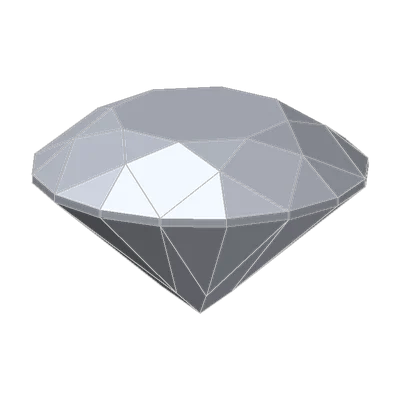
This 10-second clip has no sound. What you see:
The T73 turning, seen from 60°, with every facet edge drawn.
Turn the stone sideways
Cut decides how a diamond looks. To talk about cut, we need names for the parts.
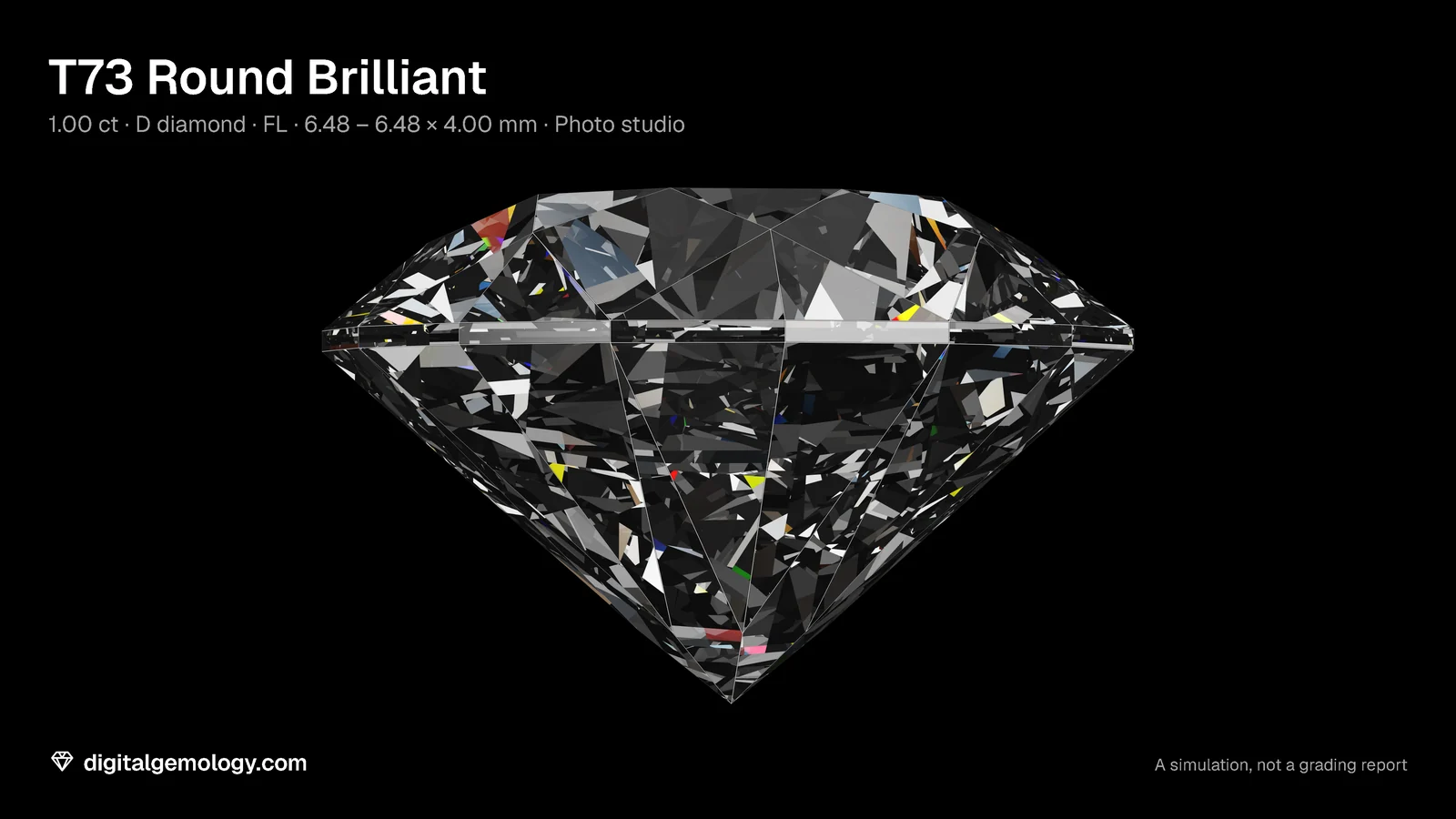
Face-up, a round diamond is a busy pattern of bright and dark slivers. Turn it on its side and it gets simple. You see a low roof on top, a thin edge at the widest point, and a deep cone below. Every cut term that we use belongs to one of those three parts.
Crown, girdle, pavilion
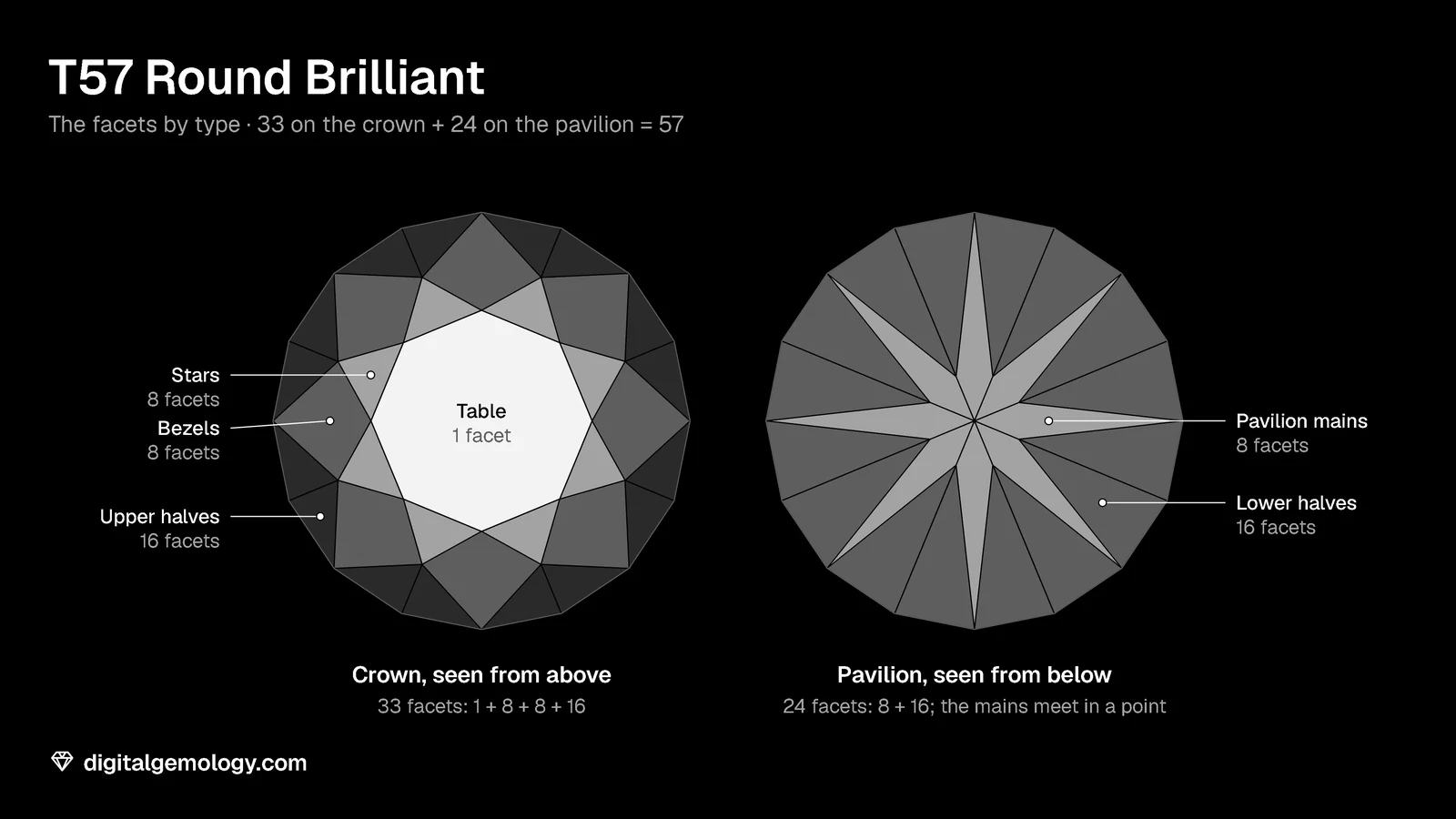
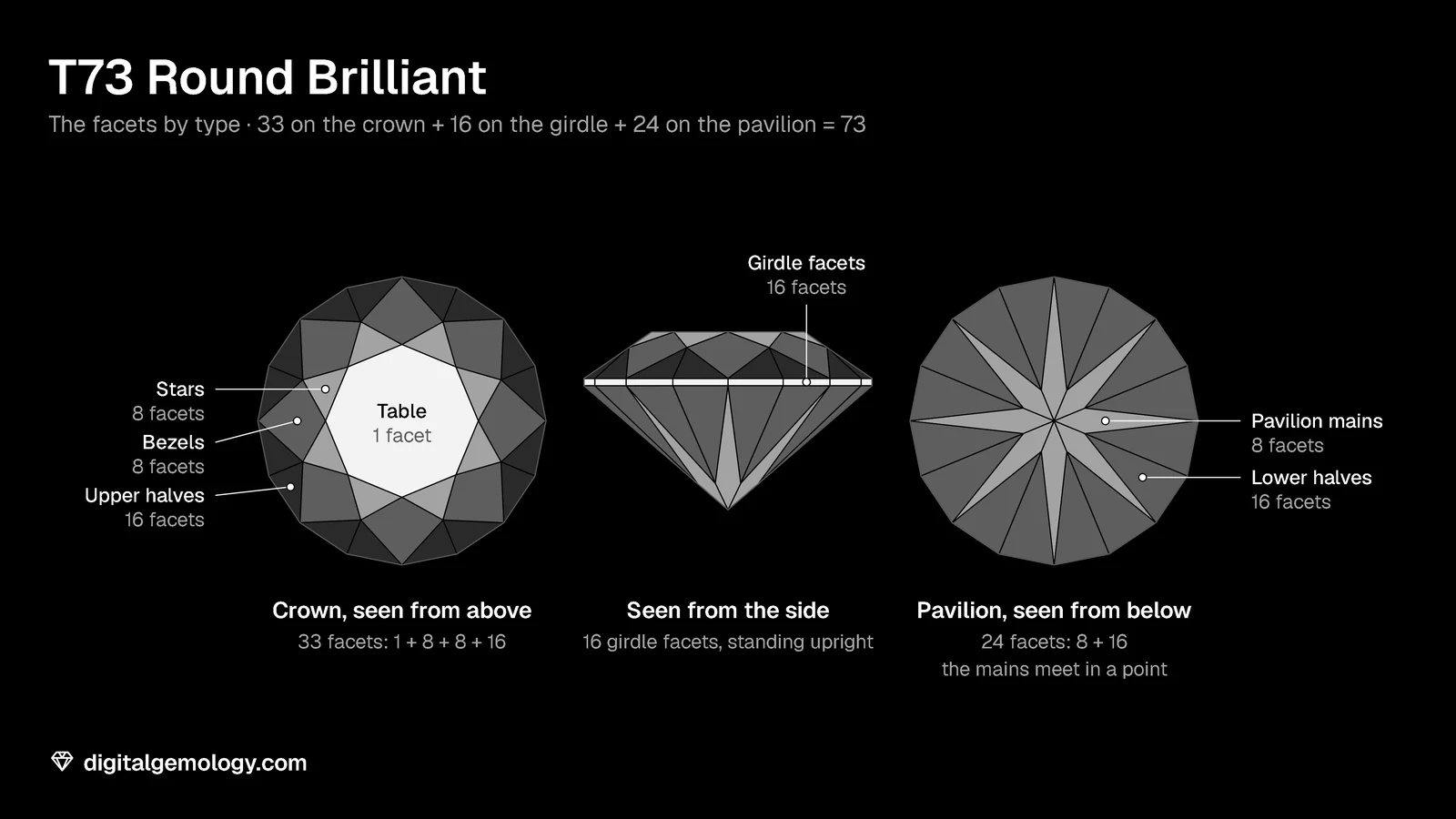
The crown is all of the diamond above the widest point. A standard round brilliant has 33 facets here:
- the table, the large flat octagon on top;
- 8 star facets, small triangles that touch the table;
- 8 bezel facets, the large four-sided facets that go from the table to the edge;
- 16 upper half facets, small triangles along the edge, two between each pair of bezels.
The girdle is the narrow band at the widest point. It is the edge that a setting grips. The cutter can leave it rough from shaping (bruted), polish it, or cut it into its own row of small facets.
The pavilion is the cone below the girdle. It has 24 facets:
- 8 pavilion mains, long facets that go from the girdle to the point;
- 16 lower half facets, long thin triangles along the girdle, two between each pair of mains.
The point at the bottom is the culet. Sometimes the cutter polishes it into a tiny flat facet, parallel to the table, to protect the tip. If not, the mains simply meet in a point.
So the count is 33 + 24 = 57 facets, or 58 with a culet facet. We count the girdle facets separately.
What each part does with light
Light enters through the crown, mostly through the table, and goes down to the pavilion. The pavilion facets work like mirrors. Light that hits them at a steep enough slant bounces back up. (This is simplified. Our page on the pavilion angle shows when the mirror fails.)
On the way out, the sloped crown facets bend the light. Each color bends by a slightly different amount. That spreads white light into flashes of color: fire.
The girdle and the culet have no optical job. They protect the edge and the point.
Try it yourself
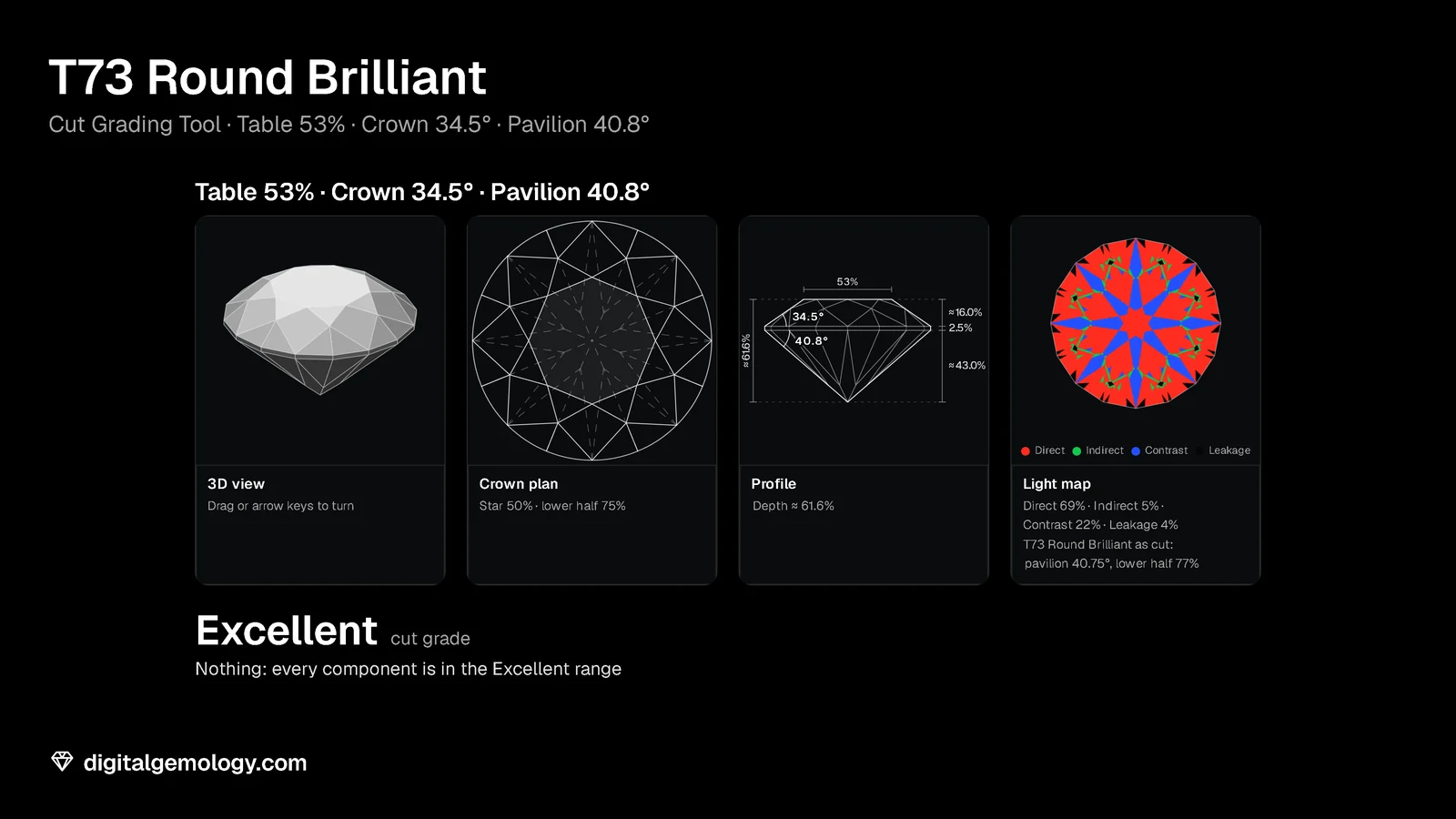
- Open Cut Grading Tool. It starts on the T73 Round Brilliant as cut.
- In the Crown plan, find the table. Then count the stars, the bezels and the upper halves.
- Switch to Profile and find the band where the crown meets the pavilion: the girdle.
- Open 3D Gemstone Simulator and load the T57 Round Brilliant. Turn on Facet mesh and turn the stone over. Count the pavilion mains.
- Load the T73 Round Brilliant and look at the edge. What changed?
What the T57 and the T73 show
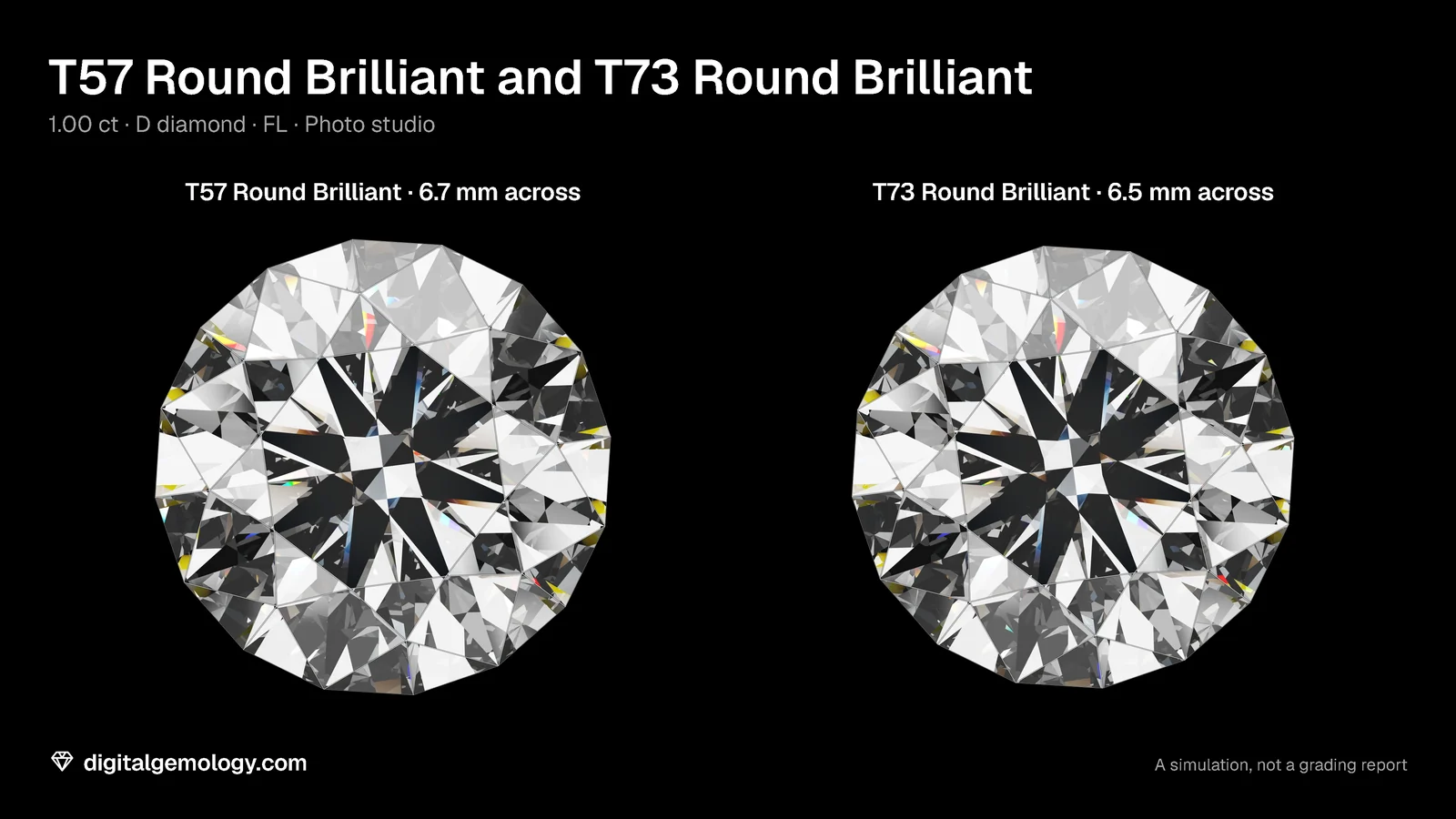
The T57 and the T73 have the same 57 facets at the same angles. The T57 has a knife-edge: the crown and the pavilion meet in a sharp line, with no girdle. The T73 adds a girdle band of 16 small facets. Most round brilliants get this finish today.
That thin band is important. At the same width, the T73 is 61.7% deep and weighs 1.99 ct. The T57 is 59.2% deep and weighs 1.81 ct. Our page on girdle thickness tells you more.
Key points
- A round brilliant has a crown on top, a girdle at the widest point and a pavilion below.
- The crown has 33 facets and the pavilion has 24: 57 in all, or 58 when the point is polished into a culet.
- Light enters and leaves through the crown. The pavilion reflects it back up, and the sloped crown facets spread it into color.
- The girdle and the culet give protection. They do nothing for light.
Go further: see the T57 and T73 cut pages, face-up and in profile.
Try it free
- 3D Gemstone Simulator: Turn a cut in seven gemstones and set its carat, color, clarity and cut grade.
- Cut Grading Tool: Grade a round brilliant from its proportions and see its light map change.
Free, in your browser, no account.
Quick quiz
Five questions on this lesson, a couple of minutes. Pick an answer and see at once if you got it, and why.
Cuts in this lesson
We sell the files of these cuts: 3D models and cutting files, with a personal-use license.
