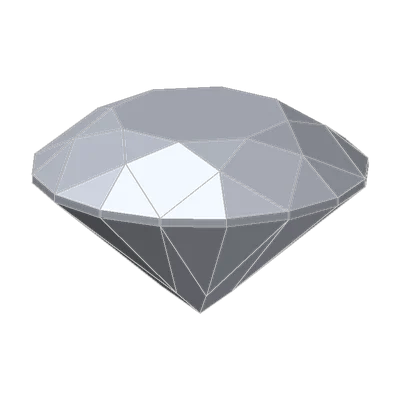
Transcript
The pavilion angle is the slope of the lower facets.
This is one pavilion facet, close up. The dashed line is square to the facet.
Close to square-on, most of the light goes out through the facet.
Tilt the light. At 24.4°, the critical angle, the light can no longer get out.
Past the critical angle, the facet reflects all the light: total internal reflection.
Light goes in through the top. It meets the pavilion at 40.8°.
That is more than 24.4°, so the facet reflects all of it.
It meets the other side at 57.6° and reflects again.
Then it goes out through the top, back to you. The pavilion works as a mirror.
A real diamond gets light from all sides. The Cut Grading Tool traces it in 3D.
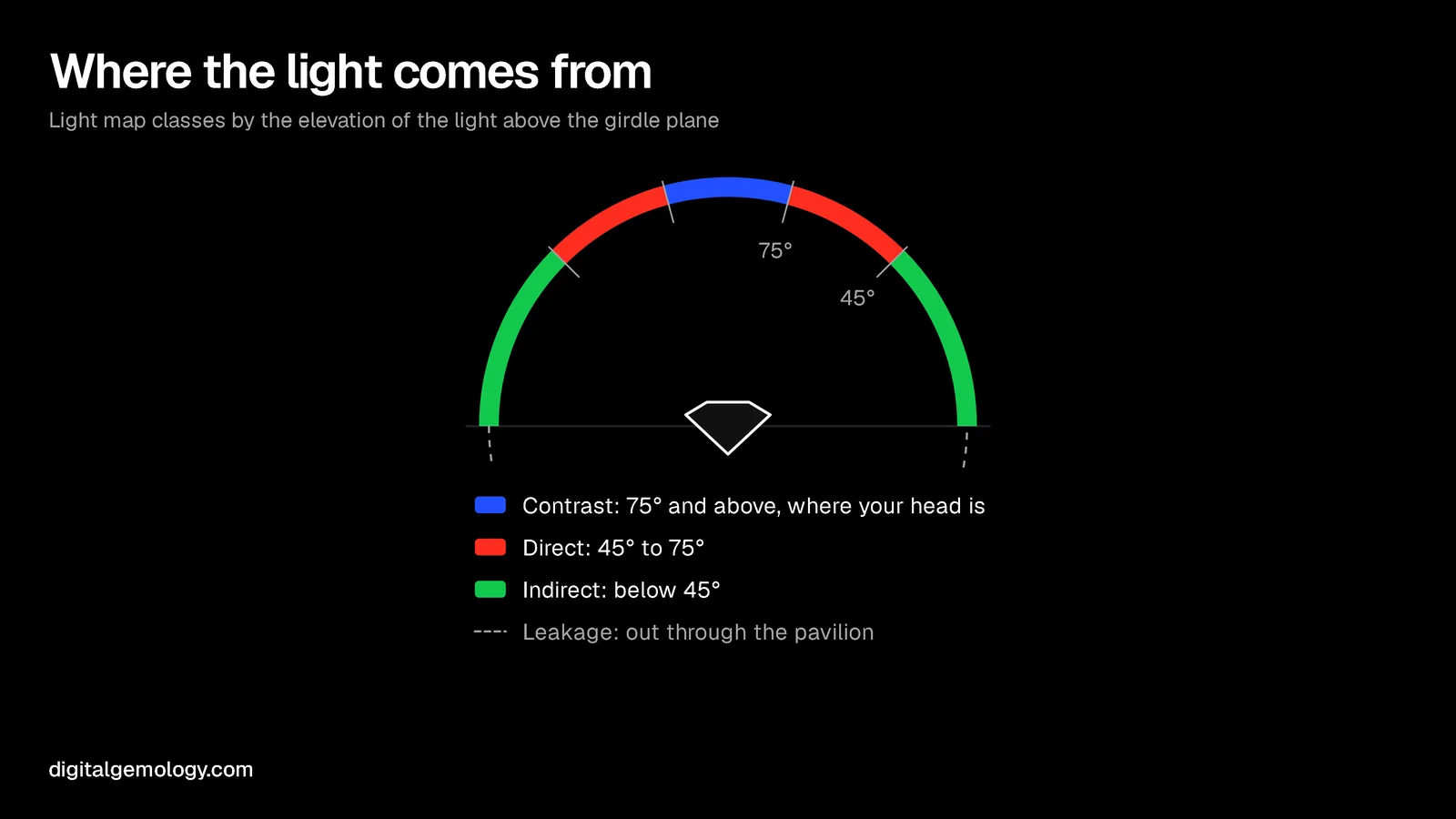
Red: light from above. Green: low light. Blue: your own head. Black: light lost.
The T73 at 40.8°: 69% direct light, and 22% contrast for the pattern.
Too shallow: blue grows to 36%. The stone shows you more of your own head.
Too steep: green grows to 30%, and 9% of the light goes out through the back.
Back to the T73 at 40.8°.
Excellent runs from 40.6° to 41.4° at this table and crown. The window is 0.8° wide.
Two tenths of a degree
Take the T73 in our Cut Grading Tool and change one number: the pavilion angle, from 40.6° to 40.4°. Two tenths of a degree. Nobody could see that on a stone. The grade drops from Excellent to Very Good.
Now go the other way. At the T73's table and crown, the pavilion is Excellent from 40.6° to 41.4°, a window only 0.8° wide. The crown angle has a window of two and a half degrees.
And here's the twist: at 42.4°, far outside that window, the tool's traced brilliance is the highest of the whole sweep. It reads 62.6%, against 54.2% at the T73's 40.8°. The brightest pavilion grades only Good. This page shows why. You'll also see that Tolkowsky refused the steeper pavilion too, in 1919, for a reason of his own: fire.
The pavilion is a mirror
The pavilion angle is the slope of the pavilion mains against the girdle plane. With the diameter, only this angle sets the pavilion depth: half the diameter × the tangent of the angle. At 40.8° that's about 43% of the diameter.
In the parts of a diamond we said that the pavilion works like a mirror. Here's when it does. Inside a diamond, light that meets a facet at a slant, far enough from square-on, can't get out: it reflects completely. The limit is the critical angle, 24.4° from the facet's perpendicular in diamond. At more of a slant than that, light reflects completely. Closer to square-on, most of it escapes out of the back. A well-cut pavilion catches the light at slants that keep it bouncing until it reaches the crown.
Change the pavilion angle and you change every slant at the same time. Is the pavilion too shallow or too deep? Then more of the light meets a facet that it can escape through, out of the bottom or the side.
What the light map shows
The tool's light map shows where the light that reaches your eye comes from:
- red for direct light from high above;
- green for lower, indirect light;
- blue for contrast (the reflection of your own head);
- black for leakage.
Try it yourself
- Open Cut Grading Tool. It starts on the T73: 53% table, 34.5° crown, 40.8° pavilion.
- Move the Pavilion angle down to 39.4° and up to 42.6°, one step (0.2°) at a time. Watch the Light map, its shares, the pavilion depth in the Profile, and the grade.
- Find the window: write down the first and the last pavilion angles that grade Excellent.
- Set Chart view to Brilliance. Watch the T73's marker move as you change the pavilion.
- Now set the table to 57% and the crown to 35.0°. Find the window again. Is it wider or narrower?
What the Cut Grading Tool shows
Too shallow. At 39.4° the light map floods with blue: 36% contrast against the T73's 22%. A shallow pavilion sends back light from almost straight above. That is exactly where your head is, so the stone looks darker. Leakage is only 1%, but the grade is Good.
Too steep. At 42.4° the blue shrinks to 7%, the green spreads to 30% and the leakage reaches 9% (13% at 42.6°). The stone now returns light from low, side angles and lets more light through the bottom.
The window. Excellent goes from 40.6° to 41.4° at the T73's table and crown. At a 57% table and a 35.0° crown, it goes to 41.6°: a little wider, but never generous. The pavilion depth goes from about 41% at 39.4° to 46% at 42.6°.
The paradox. The traced brilliance continues to climb past the window: 54.2% at 40.8°, 57.8% at 41.4°, 62.6% at 42.4°. So why does 42.4° grade Good? Because a grade is not light alone. The note in the tool says that it also weighs contrast and pattern, and these mark down very shallow and very deep pavilions. GIA's own examples say that steep stones are bright but have no strong, distinct pattern. A diamond with no contrast looks flat, even when it returns a lot of light.
Tolkowsky said it his way in 1919. A steeper pavilion would reflect more light, but it would cost the stone fire, and the trade isn't worth it. He chose 40°45'.
Key points
- The pavilion angle sets the pavilion depth: half the diameter × tan(pavilion angle), about 43% at 40.8°.
- The pavilion reflects light by total internal reflection. Light that meets a facet within 24.4° of square-on escapes.
- A pavilion that is too shallow floods the face with your own reflection. A pavilion that is too steep returns low-angle light and leaks.
- The Excellent window is narrow: 40.6° to 41.4° at the T73's table and crown.
- More light is not the full story. Contrast and pattern count too, so the brightest pavilion in the sweep grades only Good.
Go further: the T57 cut page lists seven gemstones. For each one, it gives the critical angle and how much of the pavilion reflects head-on light.
Try it free
- Cut Grading Tool: Grade a round brilliant from its proportions and see its light map change.
Free, in your browser, no account.
Quick quiz
Five questions on this lesson, a couple of minutes. Pick an answer and see at once if you got it, and why.
Cuts in this lesson
We sell the files of these cuts: 3D models and cutting files, with a personal-use license.

Keep exploring
- Next lesson: Star length and lower half length in a round brilliant
- Try another topic · Historic diamond cuts: the history of the brilliant: Hearts and arrows diamonds: precision you can see
Previous lesson · Diamond anatomy and proportions: all lessons · All topics