Transcript
This 10-second clip has no sound. What you see:
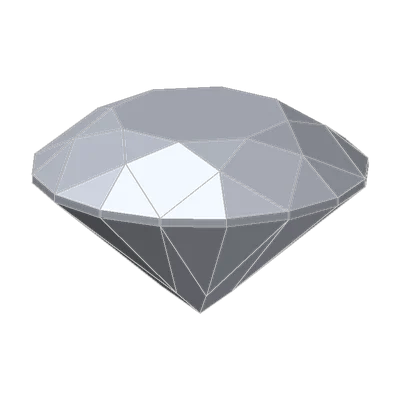
The T73 at 1.00 ct in diamond and in moissanite, turning side by side in sunlight.
Two round stones, side by side
Put a diamond and a moissanite next to each other: same cut, same weight. Both are colorless, both sparkle, and at arm's length most people can't say which is which. (Look closely: the moissanite is a little wider. We explain why in same size, different weight.)
But they are not two versions of one thing. They are two different materials that look alike, as a red spinel can pass for a ruby. Everything that separates them starts here: the fire, the doubled facets, the weight.
Two materials
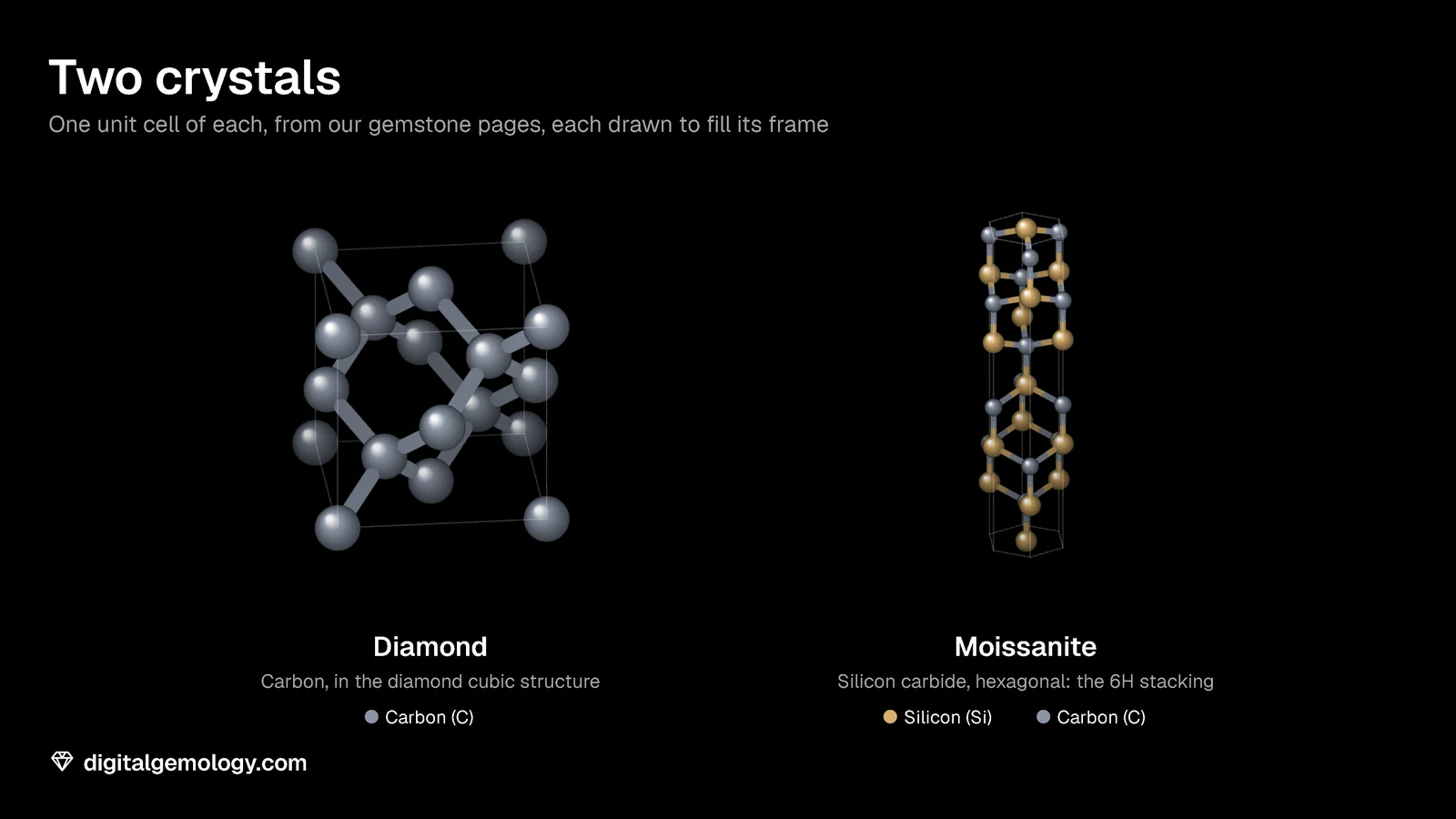
Diamond is a single element, carbon. Every atom holds on to four neighbors in a cubic network. Natural diamond is a deep-earth mineral. It forms under enormous heat and pressure about 160 km below our feet, and it only reaches the surface when an eruption carries it up. A laboratory-grown diamond is the same material, made by one of two methods: HPHT (high pressure, high temperature) or CVD (chemical vapor deposition). It has essentially the same composition, structure and properties. So it is diamond, just not from the ground.
Moissanite is silicon carbide: one silicon atom for every carbon atom, stacked in layers with hexagonal symmetry. The chemistry is different, and the crystal system is different. So moissanite is a different material, and no moissanite is a diamond of any kind.
Three boxes
Every colorless stone sold as, or next to, a diamond fits in one of three boxes:
- Natural diamond.
- Laboratory-grown diamond. Still diamond.
- Simulant: a look-alike that isn't diamond at all. GIA names cubic zirconia as the most common simulant today, and moissanite as the next.
Moissanite goes in box 3. Be careful with one word that does two jobs. A "lab-grown moissanite" and a "lab-grown diamond" are both made in a lab, but only one of them is diamond. A simulant is a different material, so it gives itself away somewhere: in how it handles light, in its weight, or in how it reacts to an instrument. Our other pages on diamond vs moissanite show which tests catch it and which tests don't.
Natural moissanite is real, but not in your ring
The mineral is named after the French chemist Henri Moissan. He found natural silicon carbide in the Canyon Diablo meteorite in Arizona. In 1905 the mineral got the name moissanite, in his honor.
On Earth it is very rare, and the crystals are tiny: usually under 1.5 mm. The largest known crystal comes from the Kishon River area in northern Israel. It measures 4.1 mm, and those crystals are blue to light green. No one cuts colorless jewelry stones from that.
So every faceted moissanite you will meet was grown in a laboratory. Its producer planned to release near-colorless moissanite to jewelers in early 1998. That was just after GIA published its first full study of the material, in the winter of 1997.
Try it yourself
- Open the diamond gemstone page and drag the crystal model at the top. You see one kind of atom, in a cubic cell.
- Open the moissanite gemstone page and turn its model. You see two kinds of atom, silicon and carbon, in hexagonal layers. The model shows 6H, the form that gem moissanite is made of. Its stack of layers repeats every six layers.
- Open 3D Gemstone Simulator with the T73 Round Brilliant in diamond. In the report, find Origin. You can set it to Natural or Laboratory-grown.
- Change the gemstone to moissanite. What happens to the Origin row?
What the simulator shows
For diamond, the Origin row is a choice. The same material can come from the earth or from a lab, and a report has to say which. For moissanite, the row locks to Laboratory-grown, because gem moissanite doesn't come out of the ground. So before anyone looks at the sparkle, the two stones already differ: in what they are made of, in how their atoms are arranged, and in where they can come from.
Key points
- Diamond is carbon in a cubic crystal; moissanite is silicon carbide in a hexagonal one.
- A laboratory-grown diamond is diamond. Moissanite is a different material, so it is a diamond simulant.
- Natural moissanite occurs only as tiny crystals (the largest known is 4.1 mm), so moissanite in jewelry is laboratory-grown.
- The two are different materials, so standard gem tests can separate them. But not every test can.
Go further: the diamond and moissanite gemstone pages list every property that we compare in diamond vs moissanite properties.
Try it free
- 3D Gemstone Simulator: Turn a cut in seven gemstones and set its carat, color, clarity and cut grade.
Free, in your browser, no account.
Quick quiz
Five questions on this lesson, a couple of minutes. Pick an answer and see at once if you got it, and why.
Cuts in this lesson
We sell the files of these cuts: 3D models and cutting files, with a personal-use license.