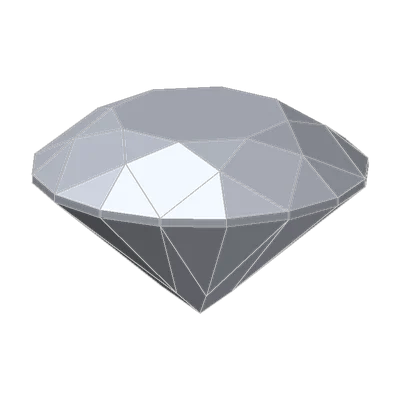
Colorless isn't one color
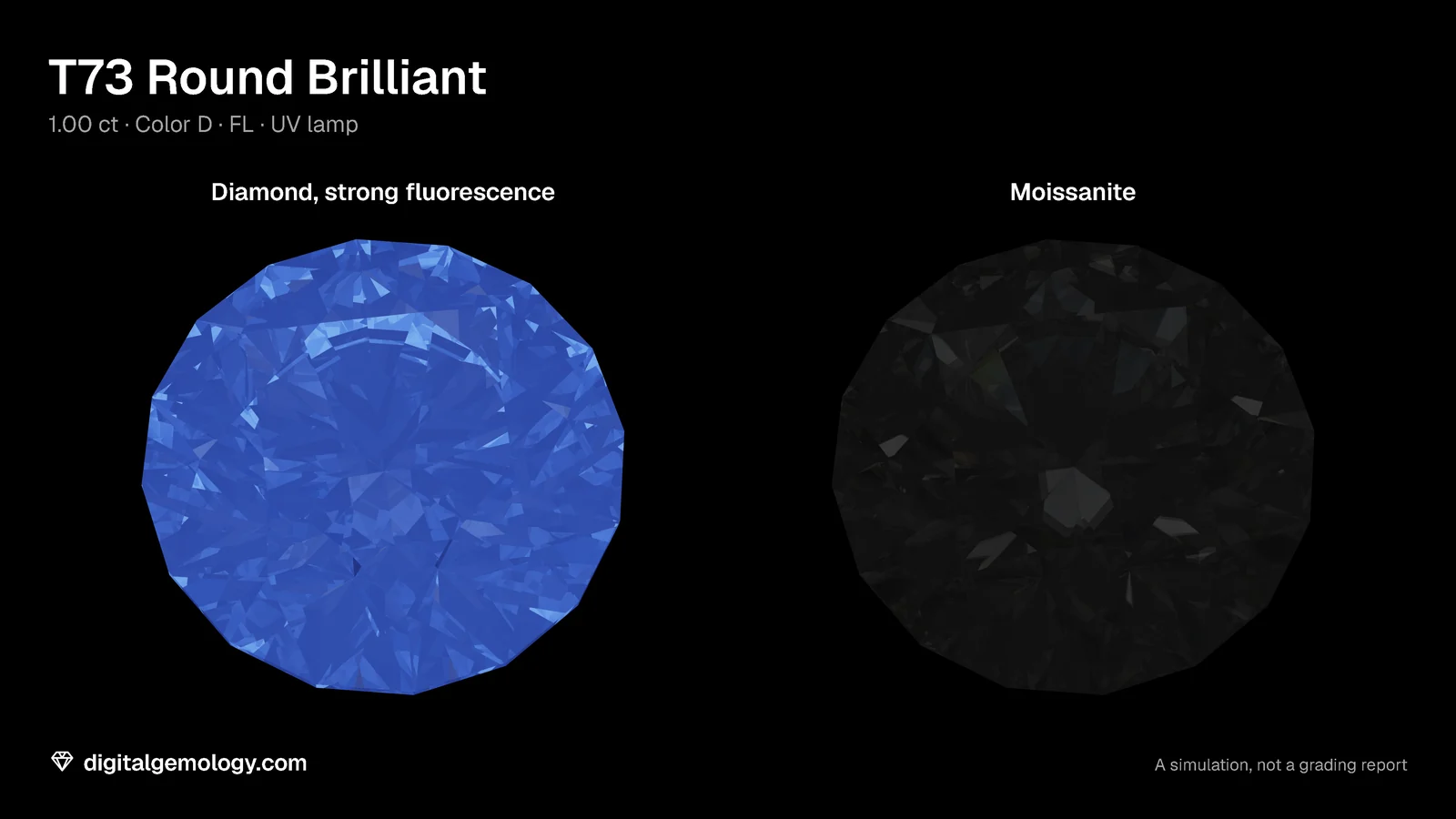
Put a diamond and a moissanite side by side on a white tray, table down, as graders do when they look at color. Two "colorless" stones rarely match exactly. A faint tint shows, and the kind of tint matters.
How diamond color is graded
On a GIA report, the color of a near-colorless diamond is a single letter on the D-to-Z scale. The scale measures how little color there is. D shows none, and each letter further down the alphabet shows a little more yellow or brown. Graders judge the letter by setting the stone beside reference diamonds of known grade. If the lab found a color treatment, the letter carries an asterisk. Diamonds with more color than Z, or with other colors, are graded as fancy colors.
The scale is built for the tints diamonds actually have: yellow and brown.
Moissanite's tint
When GIA studied the first gem moissanite in 1997, its stones ranged from near-colorless to light yellow, green and gray. Graders tried to give them diamond-equivalent grades, for research only, because GIA doesn't grade simulants. The best came out around I; others went down to U–V. Face-up, the better ones, around I to K, passed for colorless. Tint became visible from roughly L to N. The real problem was the kind of tint. Gray and green hues fall outside a scale built on yellow and brown, so the grades could only be approximate.
Production has moved on. In 2015, the original producer of moissanite launched its first colorless line. Since then, moissanite has been sold in D, E and F grades. Those letters come from the producer or from IGI (see moissanite certificates), not from GIA's diamond scale. Moissanite also comes in colors. GIA has examined blue-green, brown-yellow and deep green moissanites offered as colored diamonds.
Fluorescence
Some stones glow under ultraviolet light. A GIA diamond report has a line for it, Fluorescence. It describes how strong the glow is and what color it is, under long-wave UV. A report that says "None" can still hide a glow too faint to grade. Fluorescence doesn't change the color or clarity grade; it describes the stone.
Many near-colorless diamonds fluoresce, mostly blue. Many don't. In GIA's 1997 study, 19 of 23 moissanites were inert under long-wave UV. The other four glowed weak to moderate orange. Only one reacted to short-wave UV.
So a blue glow points to diamond. A dark, inert stone proves nothing, because many diamonds are inert too.
Try it yourself
- Open 3D Gemstone Simulator with the T73 in diamond. Under Color grade, choose the K–M range and K.
- Switch the gemstone to moissanite and keep K. Compare the tint face-up, then face-down.
- Go back to diamond. Set Fluorescence to Strong, and choose the UV lamp lighting.
- Set Fluorescence back to None. Then switch to moissanite under the same lamp.
What the simulator shows
At the same letter, the two tints aren't quite the same. The simulator gives moissanite its own body color, a little greener than diamond's yellow. On a real tray, this difference in hue, not just in depth, made early moissanite hard to grade.
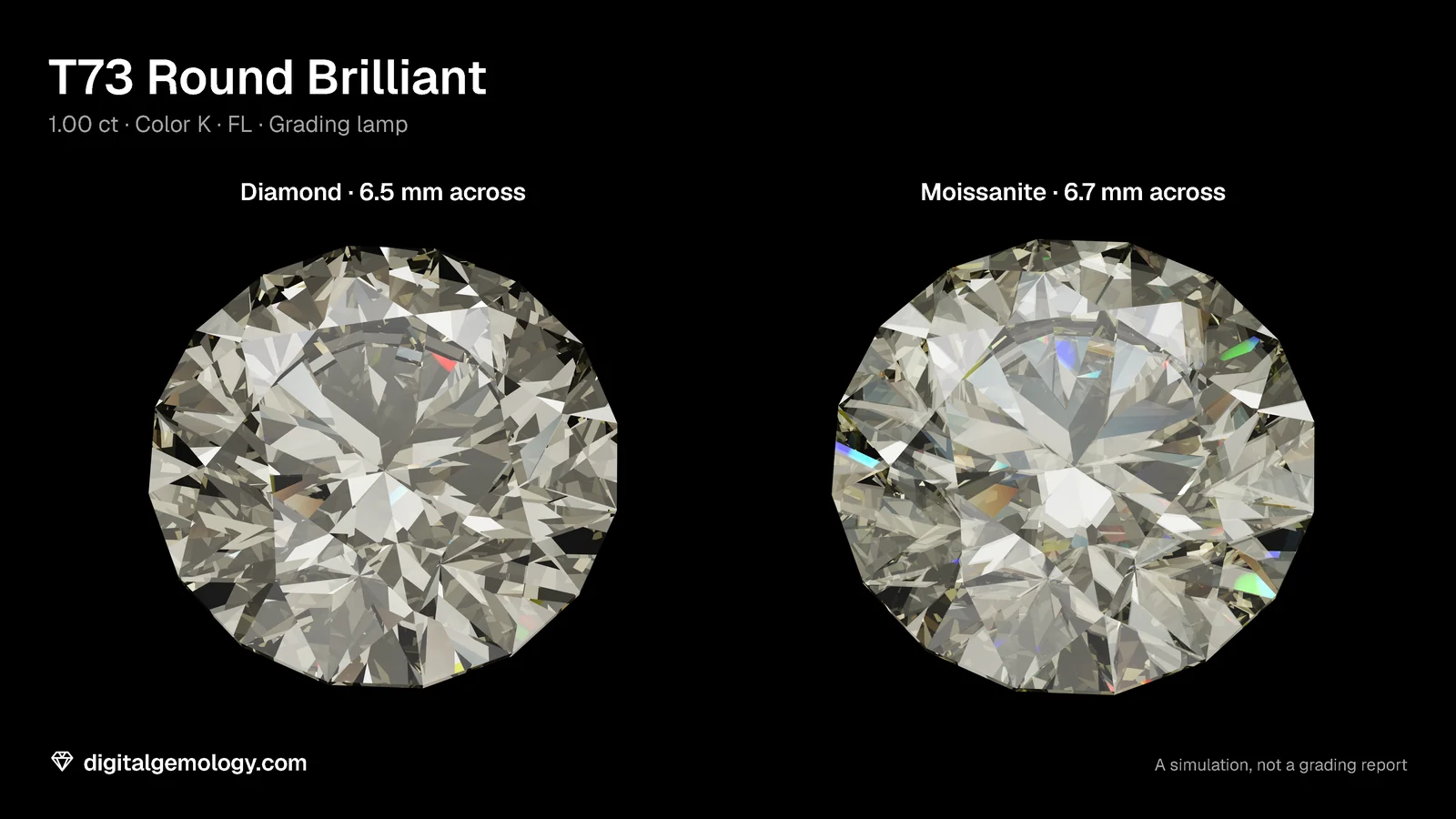
Under the UV lamp, the diamond with strong fluorescence glows blue. Set to None, it stays dark. The moissanite has no fluorescence setting at all, because in the simulator only diamond is graded for it. It stays dark, like an inert diamond. That's the point: a stone that stays dark under UV can be either one.
There's one more UV difference, and it shows up in instruments. Moissanite absorbs near-ultraviolet light that diamond lets through. An early moissanite tester used exactly that. After a thermal tester said "diamond", it checked whether near-UV passed through the stone. Our page on diamond testers and moissanite picks that up.
Key points
- Diamond color is graded D to Z for the absence of yellow or brown, against master stones. Stronger colors are fancy colors.
- Early moissanite had gray, green or yellow tints that didn't fit a scale built on yellow and brown. Colorless D–F moissanite has been sold since 2015.
- Moissanite color letters come from producers or IGI, not from GIA's diamond grading.
- Many diamonds fluoresce blue under long-wave UV. Most moissanite is inert; a few glow weak orange.
- A blue glow points to diamond. No glow proves nothing.
Go further: the simulator's notes on color, clarity and fluorescence explain how the tints and the UV glow are drawn.
Try it free
- 3D Gemstone Simulator: Turn a cut in seven gemstones and set its carat, color, clarity and cut grade.
Free, in your browser, no account.
Quick quiz
Five questions on this lesson, a couple of minutes. Pick an answer and see at once if you got it, and why.
Cuts in this lesson
We sell the files of these cuts: 3D models and cutting files, with a personal-use license.
Keep exploring
- Next lesson: Diamond testers and moissanite: what the instruments say
- Try another topic · Diamond anatomy and proportions: The parts of a diamond: crown, girdle and pavilion
Previous lesson · Diamond vs moissanite: all lessons · All topics