From the lab bench to the paper
In the end, a lab settles what a stone is, with spectra (see diamond testers and moissanite). A lab writes its findings down, and that document travels with the stone. The type of document is itself a clue: diamond and moissanite don't get the same paper.
What a diamond gets
GIA tests every stone it receives. The tests confirm whether the stone is diamond, and whether it is natural or laboratory-grown.
- A natural diamond gets a grading report. The report gives its four Cs (carat, color, clarity, cut), measurements, proportions, finish, fluorescence, any inscription and comments. The report number can be laser-inscribed on the girdle.
- A laboratory-grown diamond is graded on the same principles, but it gets a report that you can't mistake for a natural one. Its girdle carries the report number plus the word LABORATORY-GROWN. Since late 2020, GIA has issued these reports only in digital form.
What a moissanite gets
Send GIA a moissanite, and GIA examines it just as thoroughly. But the moissanite comes back with a different document, an Identification Report, because GIA doesn't grade simulants. Expect no D-to-Z letter and no clarity grade. For comparison, GIA's identification reports for colored stones list:
- the item's details (weight, measurements, shape, color, cutting style);
- the result (what the material is, with laboratory-grown material labeled as such);
- comments.
We haven't seen a moissanite one, so we can't quote its exact wording.
Since May 2024, IGI has issued grading reports for one producer's moissanite:
- cut and clarity on IGI's usual standards;
- color graded individually only for D and E, with F written as "colorless" and G–H as "near colorless";
- every stone laser-inscribed by IGI.
Moissanite from other producers gets an IGI identification report or a certificate of authenticity.
Many moissanites come only with a card from the seller or the brand. That card can be useful, for example as a warranty, but it isn't an independent lab report. Ask who issued it, and whether you can look its number up.
When the paper lies
In Lab Notes published in 2020 and 2022, GIA described moissanites that carried a fake GIA inscription. In one case, a 1.02 carat round came in for a diamond grading report. It carried the number of a real report, for an E-color natural diamond of the same weight, graded the year before. The weight matched. The measurements didn't, and the lettering of the inscription wasn't GIA's.
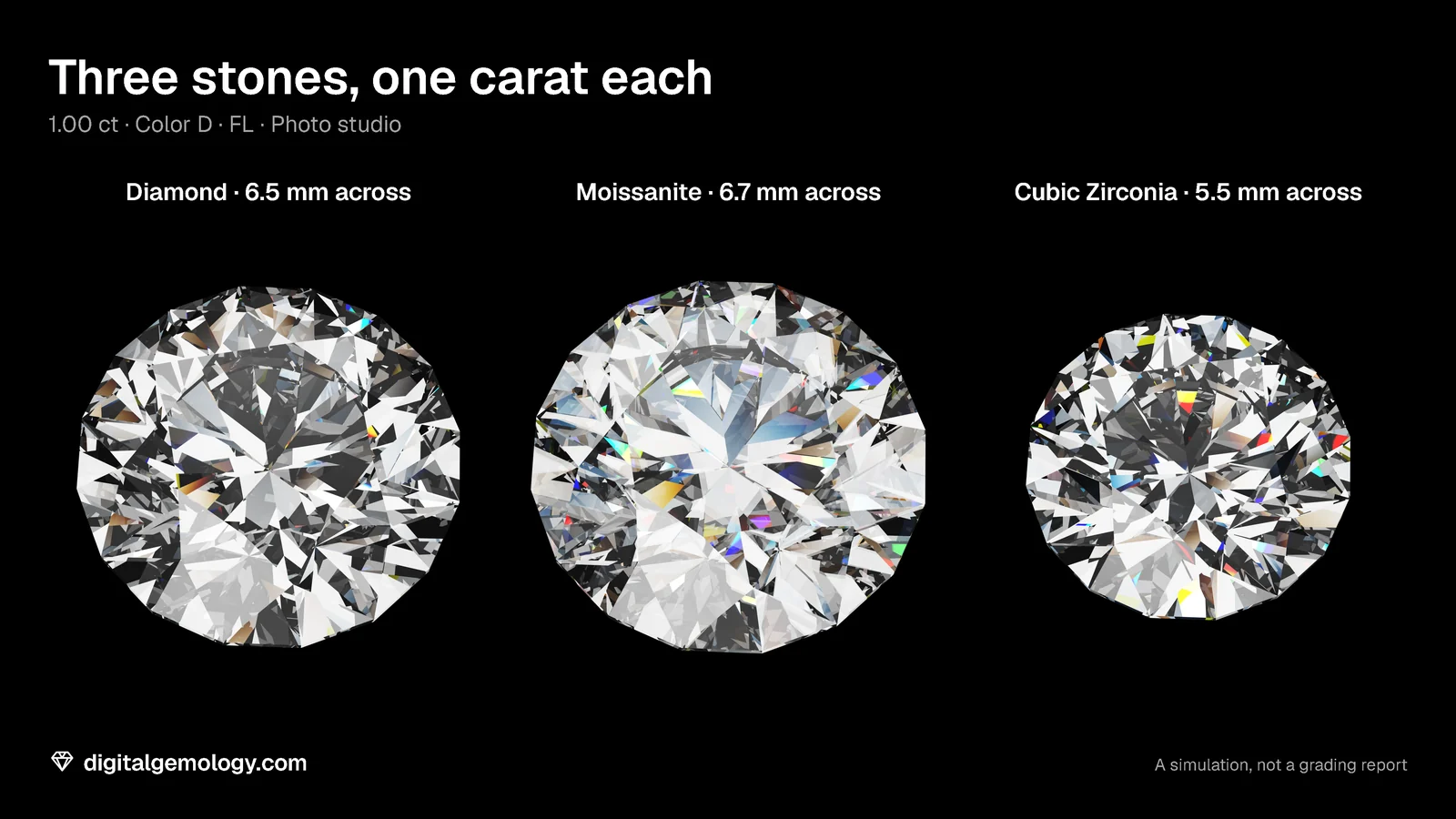
Same size, different weight explains why the weight can match but the size can't: at the same carat weight, a moissanite is about 3% wider.
Try it yourself
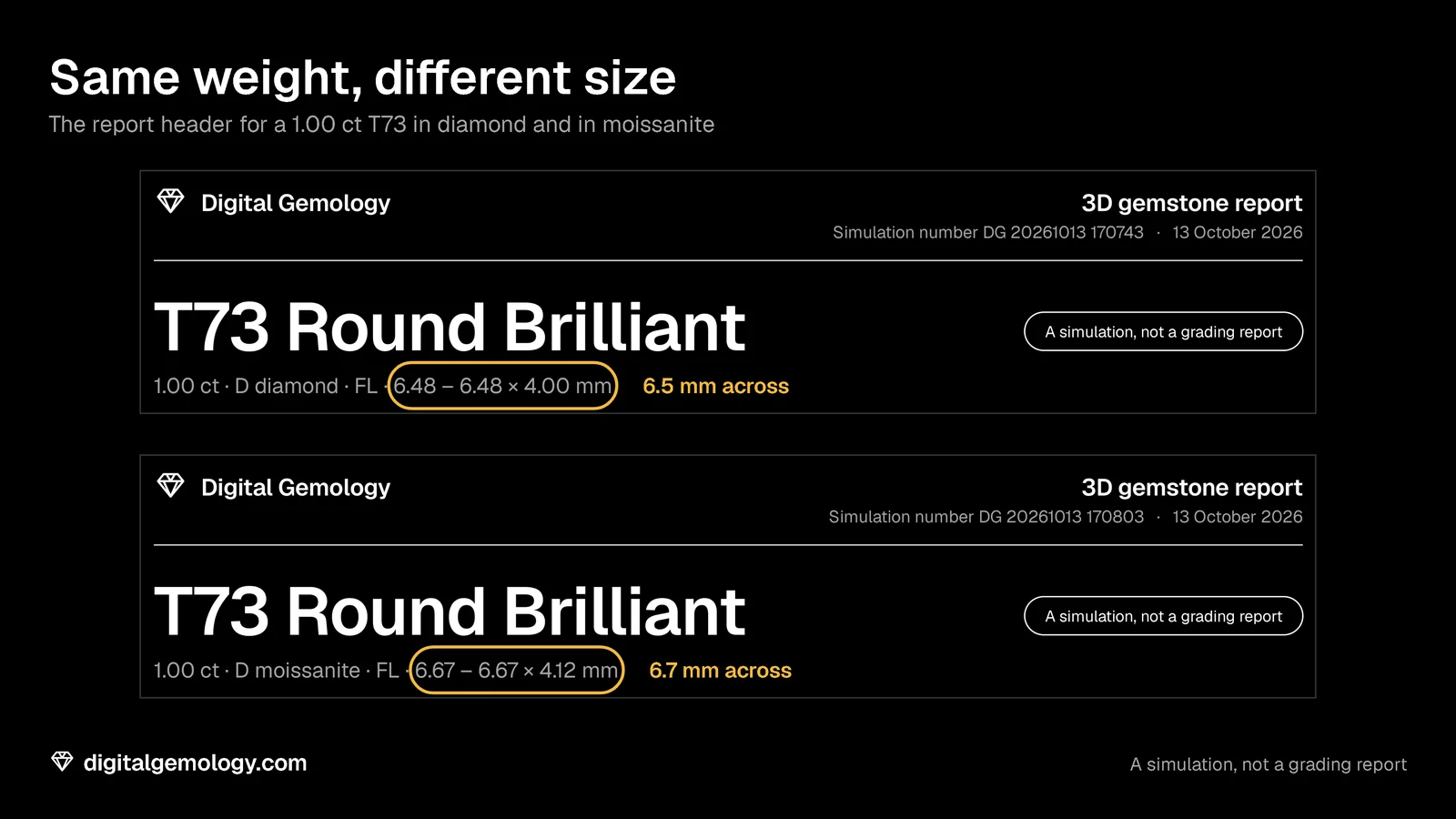
- Open 3D Gemstone Simulator with the T73 Round Brilliant in diamond at 1 carat. Treat its report as "the paper". Write down the carat weight and the measurements.
- Now play the stone that arrives with that paper. Switch the gemstone to moissanite, keep 1 carat, and read the measurements.
- Compare the two lines. Which field on a report would give the swap away?
- Scroll through the moissanite's report. Find two rows that a diamond grading report wouldn't have. Then find the line at the bottom that says what this document is.
What the simulator report shows
"The paper" says 1.00 carat, 6.48 – 6.48 × 4.00 mm. The moissanite weighs exactly the same and measures 6.67 – 6.67 × 4.12 mm. The weight checks out. The measurements are off by about 0.2 mm, and a gauge or a lab spots that immediately. So to check a report, check the stone against it. Look the number up on GIA's Report Check. Then compare weight and measurements, not just the number on the girdle.
The moissanite's report shows a Birefringence of 0.043 and an Origin locked to Laboratory-grown. It also lets you set color and clarity grades, so you can learn the scales. A GIA document wouldn't grade a moissanite at all. The last line says it plainly: a simulation, not a grading report.
Key points
- GIA tests every stone. A diamond gets a grading report, natural or laboratory-grown, and the two reports look distinctly different.
- GIA issues no grading report for simulants. A moissanite gets an Identification Report, with no color or clarity grade.
- IGI has graded one producer's moissanite since 2024. Other moissanite gets an identification report or a certificate of authenticity.
- A seller's or brand's card isn't an independent lab report.
- Check the stone against its report. Look up the number, then compare weight and measurements. A moissanite with a diamond's weight is about 3% wider.
Go further: our pages on how to read a diamond grading report walk through every field of a diamond report.
Try it free
- 3D Gemstone Simulator: Turn a cut in seven gemstones and set its carat, color, clarity and cut grade.
Free, in your browser, no account.
Quick quiz
Five questions on this lesson, a couple of minutes. Pick an answer and see at once if you got it, and why.
Cuts in this lesson
We sell the files of these cuts: 3D models and cutting files, with a personal-use license.
Keep exploring
- Next lesson: Moissanite vs diamond: wear, care and cleaning
- Try another topic · The bow-tie effect: Fixing a bow-tie: the steep belly of DG-Bowtie
Previous lesson · Diamond vs moissanite: all lessons · All topics