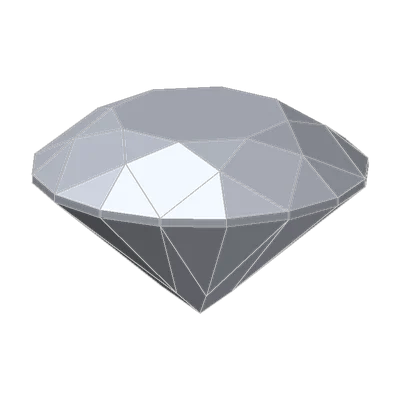
Living with each stone
This page is about the stone on a hand. Then it puts in order every check from our pages on diamond vs moissanite.
Scratches. Diamond is the hardest gem: Mohs 10. Moissanite, at 9.25, is harder than sapphire (9). The real gap up to diamond is larger than those numbers suggest (see the property card).
Knocks. Hardness doesn't stop chipping; toughness does. Diamond's toughness is good along its cleavage directions and exceptional in others. So a hard knock in the wrong direction can split or chip it. GIA found no cleavage in moissanite. It breaks with curved, shell-like fractures, and its girdle could chip under hard wear. Neither stone is unbreakable.
Heat. Moissanite is reportedly stable in air to 1700 °C. GIA's researchers saw moissanites cast in place in a gold ring without apparent damage. They expected no problem with prong repairs while the stone stays in place.
Cleaning. For diamond, GIA's cleaning chart adds a caution to ultrasonic and steam cleaning for stones with feathers, many inclusions or a fracture filling. For moissanite, GIA did no durability testing of its own. The producer reported no problems with ordinary setting, repair and cleaning.
The bench routine
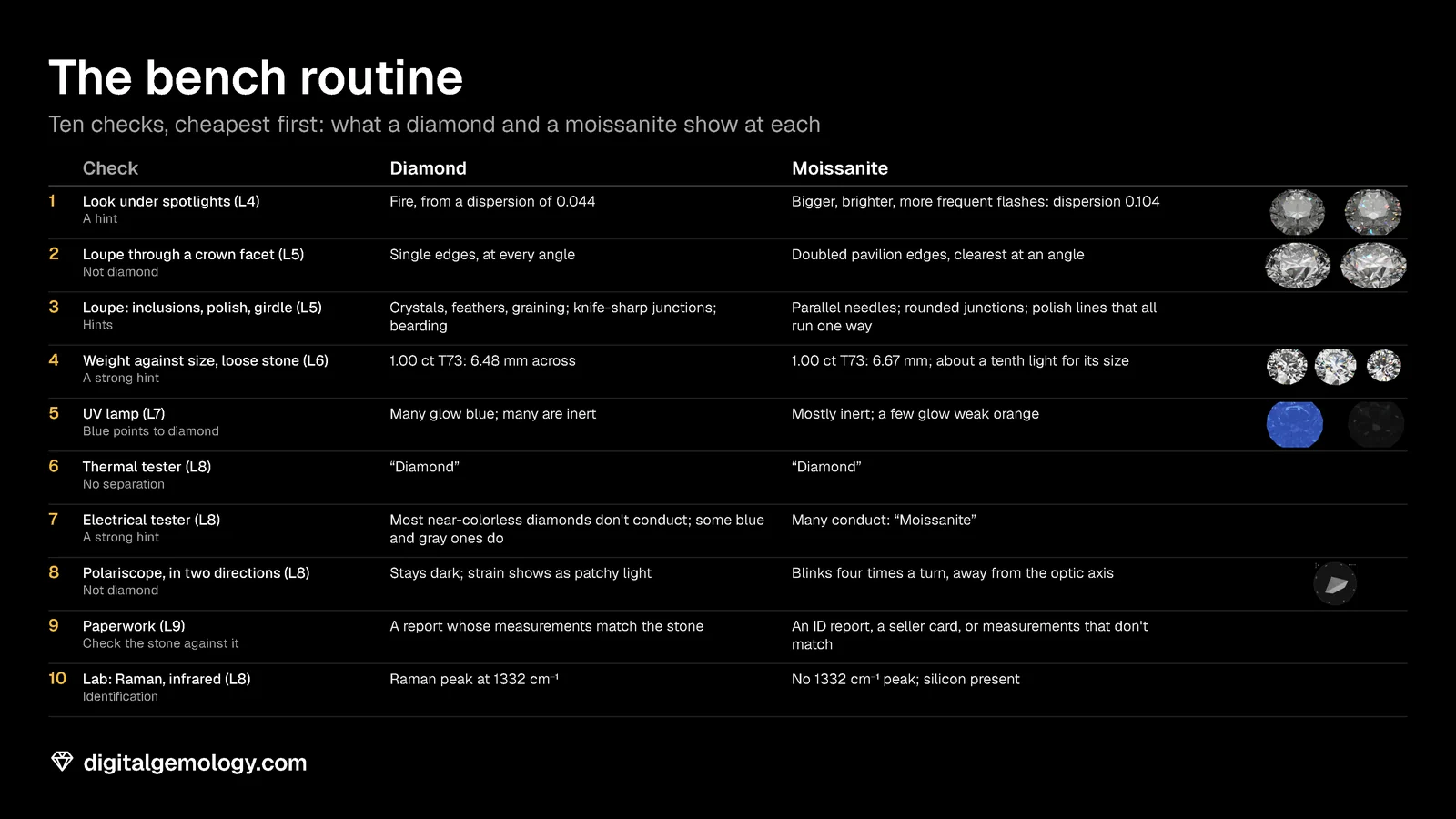
Here are the checks in order, from free to lab, with what each result proves. The most important rule comes from GIA's first study. Many tests prove that a stone is not diamond. No single test proves that it is moissanite.
| Step | Check | Points to moissanite | What it proves |
|---|---|---|---|
| 1 | Look under spotlights (fire) | Strong, broad colored flashes | Nothing; a hint |
| 2 | Loupe through a crown facet (loupe test) | Doubled pavilion edges | Not diamond |
| 3 | Loupe: inclusions, edges, polish, girdle (loupe test) | Parallel needles running down from the table; rounded edges; polish lines that run one way on every facet; frosted, polished or striated girdle | Hints; one-way polish lines on every facet rule out diamond |
| 4 | Weight against size, loose stone (carat and size) | About a tenth light for its size | A strong hint |
| 5 | UV lamp (fluorescence) | Inert or orange | Blue points to diamond; dark proves nothing |
| 6 | Thermal tester (testers) | "Diamond" | Diamond or moissanite |
| 7 | Electrical or combined tester (testers) | "Moissanite" | Strong hint; refer blue or gray stones |
| 8 | Polariscope, in two directions (instruments) | Blinks when viewed away from the optic axis | Not diamond |
| 9 | Paperwork (certificates and reports) | Identification report, seller card, or a report whose measurements don't match | Depends on the document; check the stone against it |
| 10 | Lab: Raman, infrared (the lab) | No 1332 cm⁻¹ peak, silicon present | Identification |
Two more rules of thumb. First, write each result down as you go, including the results that prove nothing. Second, this routine separates moissanite from diamond. It can't tell a natural diamond from a laboratory-grown one. That needs a screening device or a lab.
Try it yourself
Run the routine on screen, one column per stone. Use the same cut in both.
- Look: open 3D Gemstone Simulator with the T73, Club lighting and a slow turn. Note the fire.
- Loupe: set At an angle and turn the facet mesh off. Doubled edges, yes or no?
- Weight for size: set 1 carat. Note the measurements.
- UV: choose the UV lamp lighting. For diamond, try Fluorescence None and Strong.
- Refractometer and Polariscope: open Refractometer, then Polariscope at 0° and 90° tilt.
- Paper: read the simulator's report rows for Origin and Birefringence.
What the routine shows
On the stone itself, the two columns split in three places, and nowhere else for certain:
- at the loupe (step 2);
- at the measurements (step 3);
- at the polariscope, tilted across the axis (step 5).
The paper split too (step 6): a birefringence of 0.043 against none, and an origin locked to laboratory-grown. On a real stone, the paper is only as good as the document behind it (see moissanite certificates vs diamond reports). Fire leaned toward moissanite but proved nothing. The UV lamp only spoke when the diamond glowed. The refractometer gave the same answer twice.
That's what a good routine looks like: several independent checks that agree, each one cheap, and a clear point where you stop and send the stone to a lab.
Key points
- Diamond (Mohs 10) resists scratches best but can cleave. Moissanite (9.25) showed no cleavage but can chip at the girdle.
- Moissanite is reportedly stable at high heat, and GIA saw stones cast in place without apparent damage.
- For diamond, take care with ultrasonic and steam if it has feathers, many inclusions or a fracture filling.
- Many tests prove "not diamond". No single test proves "moissanite". Combine independent checks.
- The routine separates moissanite from diamond, not natural from laboratory-grown diamond.
Go further: take the diamond vs moissanite quiz. Then read our pages on how to read a diamond grading report for every field of a diamond report.
Try it free
- Polariscope: Turn a gemstone between crossed polarizers and read its optic figure.
- 3D Gemstone Simulator: Turn a cut in seven gemstones and set its carat, color, clarity and cut grade.
- Refractometer: Read the shadow edges of seven gemstones on a gem refractometer.
Free, in your browser, no account.
Quick quiz
Five questions on this lesson, a couple of minutes. Pick an answer and see at once if you got it, and why.
Cuts in this lesson
We sell the files of these cuts: 3D models and cutting files, with a personal-use license.
Keep exploring
- Try another topic · Diamond anatomy and proportions: Crown angle and crown height in a round diamond
Previous lesson · Diamond vs moissanite: all lessons · All topics