Transcript
This 10-second clip has no sound. What you see:
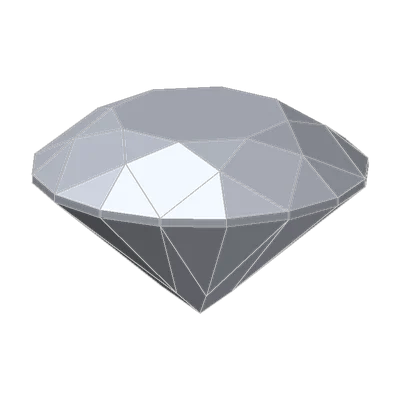
Diamond with strain (illustrative): patchy light that never goes dark all at once.
Not every test is a test
Some differences you can't see. Moissanite absorbs near-ultraviolet light that diamond lets through (see color and fluorescence). Gem labs and jewelers use instruments to turn differences like that into a reading. But an instrument only helps if the two stones read differently on it. For diamond and moissanite, several classic instruments give the same answer for both. A few give an answer that looks like proof and isn't.
The four gem instruments
Refractometer. It reads refractive index, up to the limit of its contact liquid, 1.81. Diamond (2.417) and moissanite (2.648 to 2.691) are both far above it. So both read over the limit (OTL): no number, no edges, and moissanite's double refraction stays hidden. Cubic zirconia reads the same way. Result: no separation.
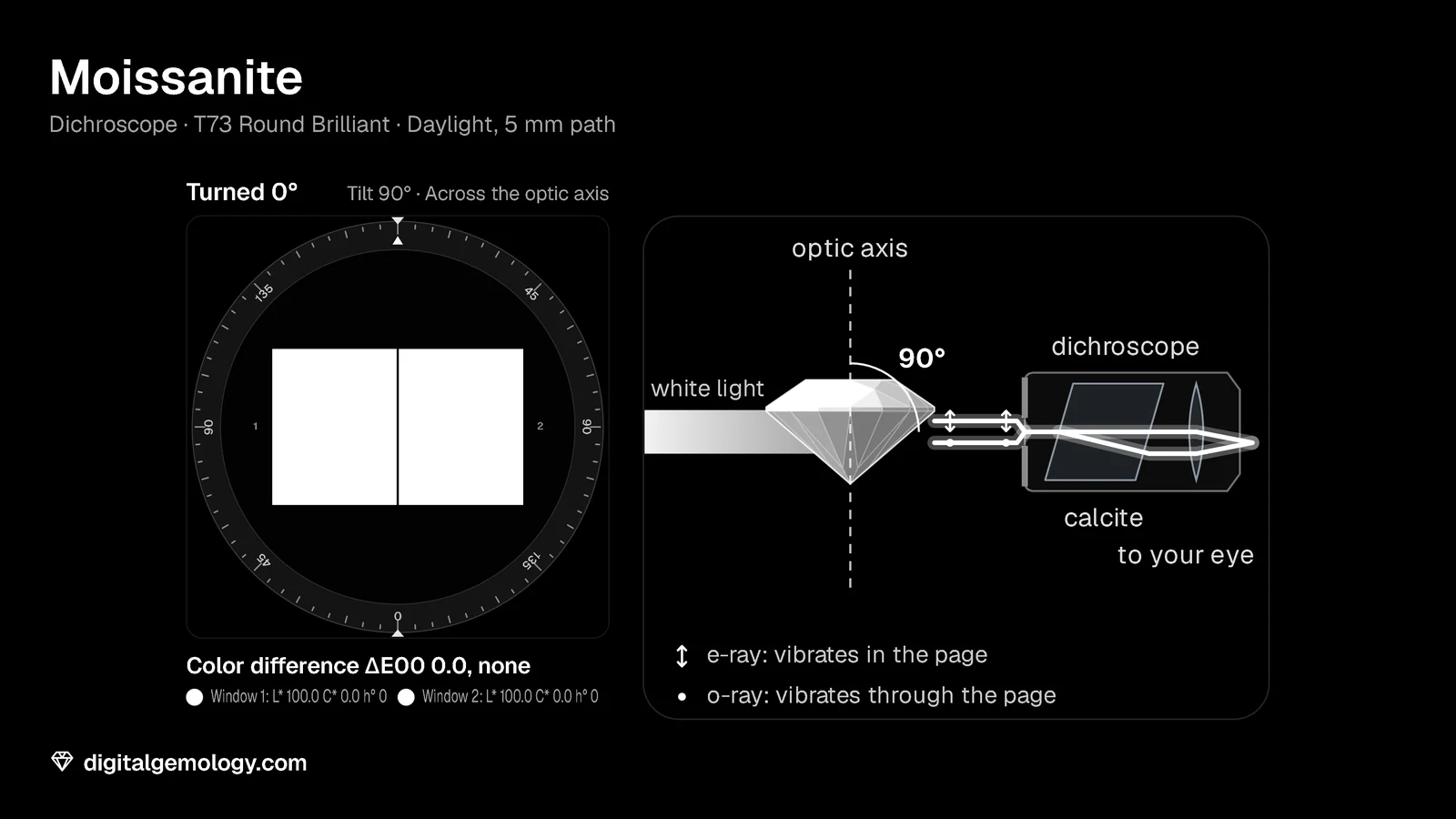
Dichroscope. It shows whether a stone sends out different colors in different directions. Both stones are colorless, so the two windows match for both. Moissanite does split light into two rays, but it absorbs neither ray, so they leave with the same color. Result: no separation. Also a reminder: "no difference" doesn't prove that a stone is singly refractive.
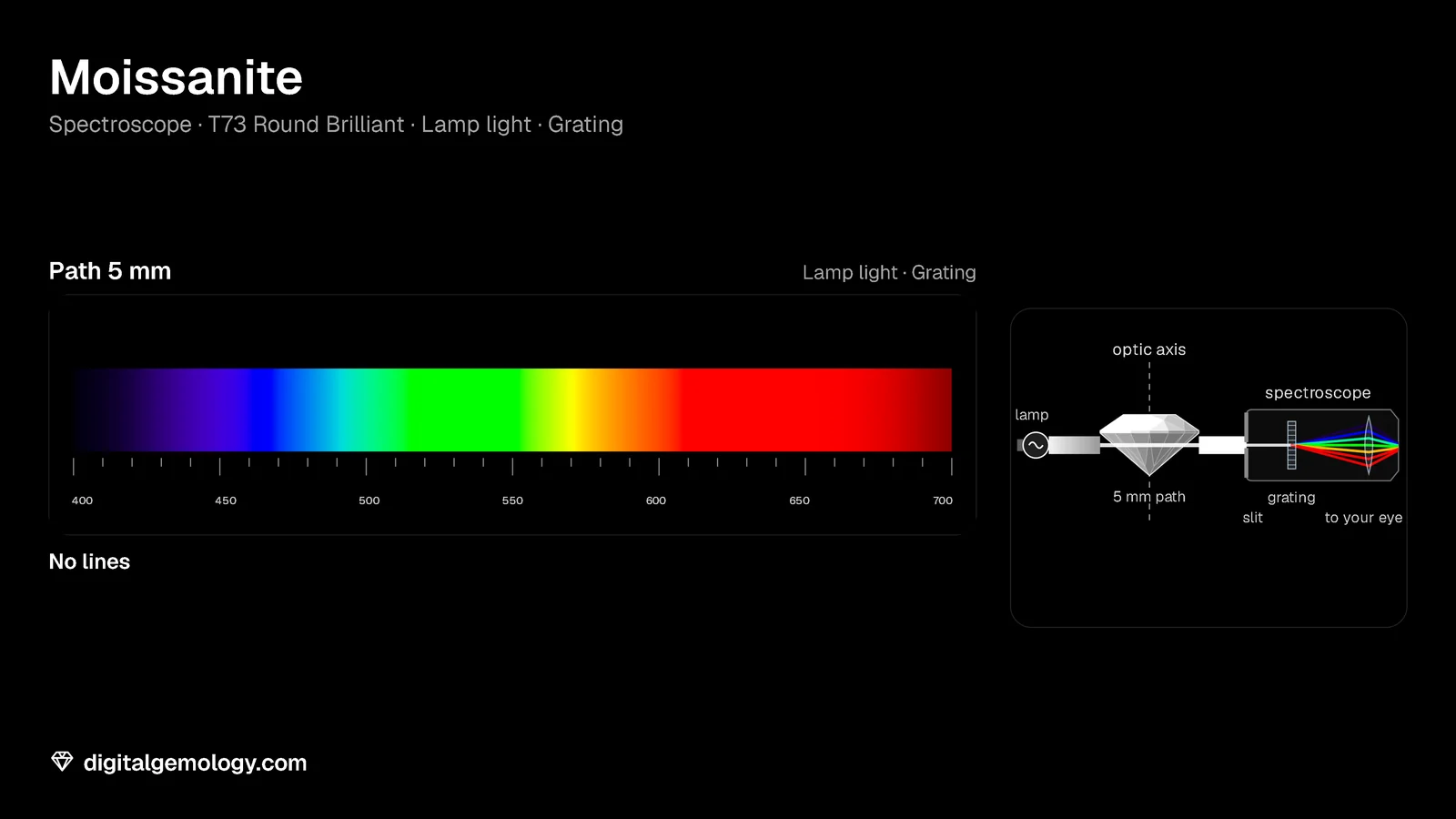
Spectroscope. It shows dark lines where a stone absorbs light. Our model treats both stones as perfectly colorless and shows an unbroken spectrum for both. Real stones can differ at the violet end. Many near-colorless diamonds show a fine line at 415 nm. Moissanite absorbs everything below about 425 nm. GIA noted that both are easy to misread with a hand spectroscope. Result: a hint for experienced eyes, not a test.
Polariscope. Two crossed polarizing filters, with the stone between them. A singly refractive stone stays dark as it turns. A doubly refractive stone blinks: light and dark four times a turn. This instrument does separate diamond and moissanite, if you use it right.
Try it yourself
- Open Refractometer and choose diamond, then moissanite. Read the eyepiece both times.
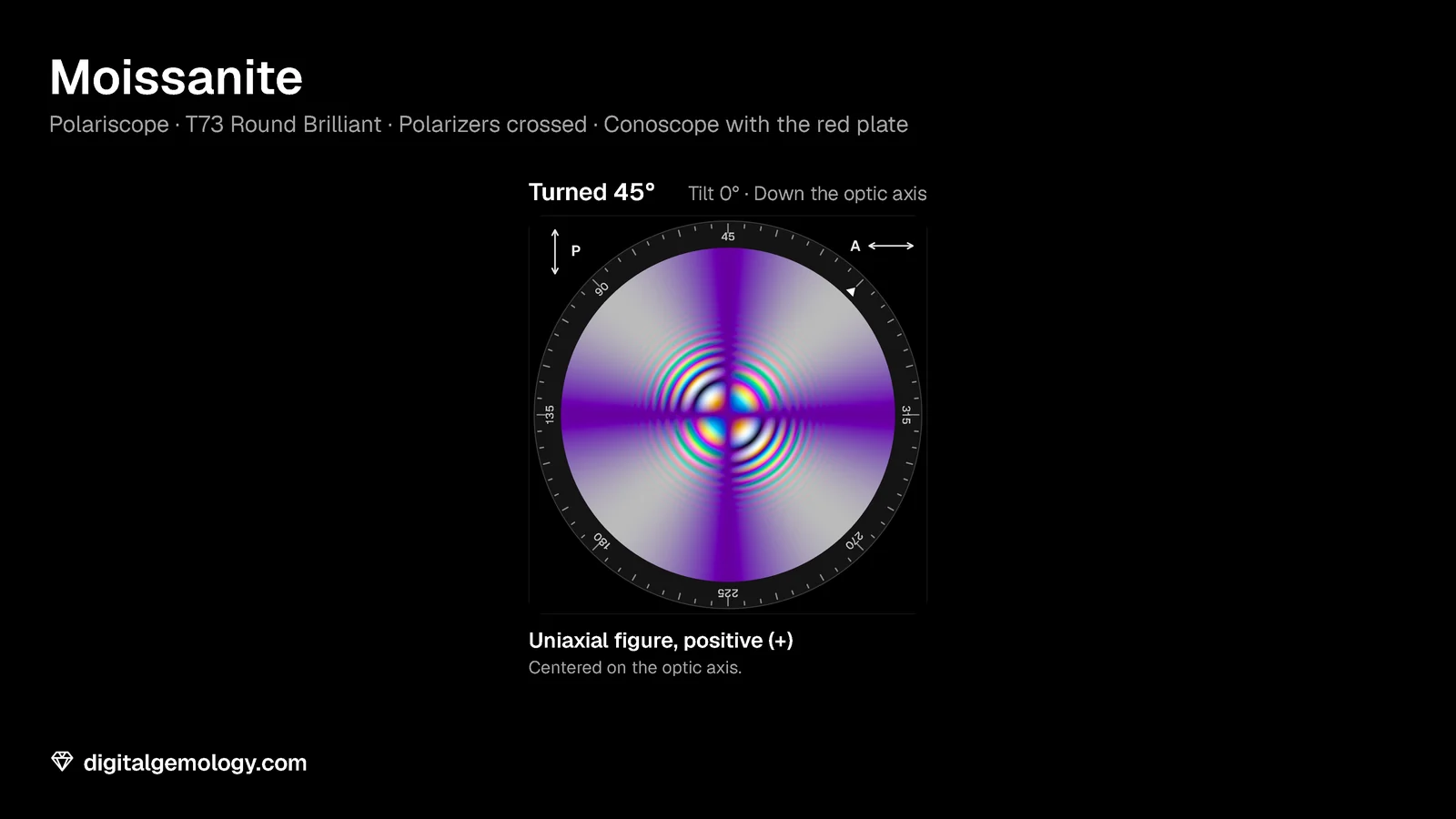
- Open Polariscope. Choose Moissanite and the T73 Round Brilliant shape. Drag the Tilt slider to 0°. Now you look straight down the optic axis, as you would through the table. Turn the stone.
- Drag the tilt to 90°, across the axis. Turn the stone again.
- Turn on the Conoscope and set the tilt back to 0°. Then add the Red plate.
- Choose Diamond and turn on Strain. Turn the stone.
What the Refractometer and Polariscope show
The refractometer gave the same non-reading twice: over the limit.
The polariscope sprang the trap from the loupe test. Straight down the optic axis, moissanite stayed dark as it turned, exactly like a singly refractive stone. Our tool says so: dark is not always singly refractive. GIA described this trap in 1997. Face-down, all its moissanites passed for singly refractive. They showed their double refraction only from other sides, the girdle above all. Tilted away from the axis (the tool's 90° looks straight across it), the moissanite blinked. The conoscope showed a uniaxial interference figure. The red plate turned it blue in the northeast quadrant: optically positive.
Diamond stays dark at every turn and tilt. With strain on, it shows patchy gray light that never goes dark all at once. Many diamonds carry internal strain, which makes them weakly doubly refractive in patches. A truly doubly refractive stone goes dark everywhere at once, four times a turn. Strain points to diamond. GIA saw no strain in moissanite.
The testers
Thermal testers measure how fast the stone draws heat from a hot tip. Diamond conducts heat extremely well, and so does moissanite. In GIA's study, every moissanite read "diamond" on every thermal tester tried. A thermal "diamond" means diamond or moissanite.
Electrical testers check whether the stone conducts electricity. Many moissanites do (13 of the 23 GIA tested), and most near-colorless diamonds don't. But some gray and blue diamonds conduct as well. A blue diamond that conducts is type IIb, colored by boron, and labs grow boron-blue diamonds too. GIA's study called conductivity an indication, never a diagnosis. So a "moissanite" reading on a blue or gray stone needs a lab. Combined testers use a thermal reading and a second reading together. The first one, in 1997, checked near-UV transparency after the thermal test.
Screening devices, such as GIA's DiamondCheck and iD100, separate natural diamonds from laboratory-grown diamonds and simulants. Most answer Pass (natural) or Refer. A referred stone may still be natural, and it goes to a lab. One warning matters here. Depending on how it tests, a screener may fail to refer a simulant and pass it as natural. So know what your device covers before you trust a Pass on a moissanite.
The lab settles it with spectra. Moissanite's Raman spectrum lacks diamond's peak at 1332 cm⁻¹. Its infrared spectrum looks nothing like diamond's. And X-ray fluorescence finds silicon, which an untreated diamond doesn't contain. That's how GIA identifies moissanites submitted as diamonds today.
Key points
- Refractometer, dichroscope and (in practice) spectroscope don't separate colorless diamond and moissanite.
- The polariscope does. Diamond stays dark (strain shows as patchy light). Moissanite blinks when you look at it away from its optic axis, for example through the girdle, not straight down through the table.
- A thermal tester reads both as "diamond".
- An electrical tester flags most moissanite, but some blue or gray diamonds conduct too.
- Screeners answer Pass or Refer. A lab confirms with Raman and infrared spectra.
Go further: the Polariscope's How we measure page explains blinking, strain and the red plate.
Try it free
- Polariscope: Turn a gemstone between crossed polarizers and read its optic figure.
- Refractometer: Read the shadow edges of seven gemstones on a gem refractometer.
- Spectroscope: Read a gemstone's absorption lines through a prism or a grating.
- Dichroscope: See the two colors of a gemstone side by side in a dichroscope.
Free, in your browser, no account.
Quick quiz
Five questions on this lesson, a couple of minutes. Pick an answer and see at once if you got it, and why.
Cuts in this lesson
We sell the files of these cuts: 3D models and cutting files, with a personal-use license.
Keep exploring
- Next lesson: Moissanite certificates vs diamond grading reports
- Try another topic · The four Cs of diamonds: Carat weight vs size: why a 2 ct diamond isn't twice as big
Previous lesson · Diamond vs moissanite: all lessons · All topics