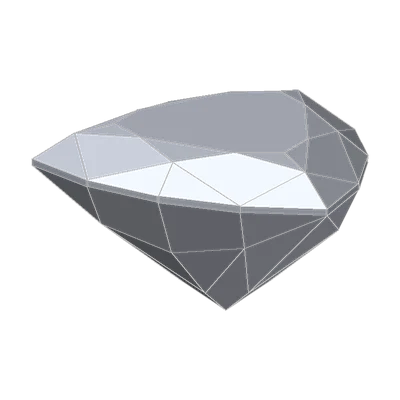
3D model and faceting diagram · 72 facets · 7.61 x 7.61 mm
The trilliant: a three-sided brilliant with straight sides. It is bold and graphic. Jewelers often set a pair of trilliants as side stones, one on each side of a center stone.
The trilliant: a three-sided brilliant with straight sides. It is bold and graphic. Jewelers often set a pair of trilliants as side stones, one on each side of a center stone.
A setting should protect its sharp corners.
Trilliant Cut specifications
Measured from the delivered model, not quoted from a standard.
CategoryJewelry cuts
Facets58 + 12 girdles = 70 facets in the cutting design; the 3D model has 72 planar faces
OutlineLength to width 1.000
Total depth58.9% of width
Crown angle (main)33.0°
Pavilion angle (main)39.0°
Reference size7.61 x 7.61 x 4.48 mm at 1.54 ct in diamond
Volume87.48 mm³
Cutting file accuracyEvery crown and pavilion facet within 0.007° of the 3D model (average under 0.001°); girdle facets within 0.029°
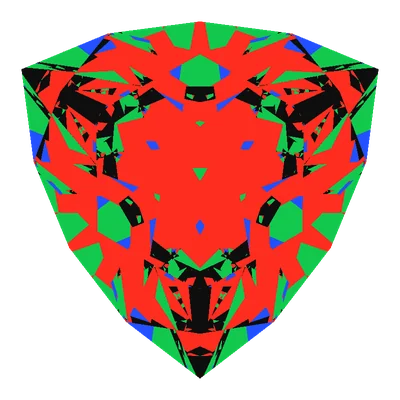
Face-up: the crown facets, drawn from the model's own edges.Profile: 58.9% total depth.
Light Return map of the Trilliant Cut in diamond. A computed render of the model's geometry, not a photograph.
How the Trilliant Cut performs in seven gemstones
The Trilliant Cut performs best in cubic zirconia, where its brilliance and fire together are highest: 84 for brilliance and 94 for fire. In diamond it scores 78 for brilliance and 83 for fire, against 93 and 78 for the T73 benchmark. Its scintillation, 79, comes from its pattern of facets, so it is the same in every stone.
Brilliance, fire and scintillation of the Trilliant Cut in seven gemstones, out of 100, with the T73 Round Brilliant benchmark in each
Score out of 100T73 Round Brilliant, our benchmark, in the same stoneBest overall: the highest brilliance and fire together
Brilliance is the share of face-up light that the stone returns. Fire is the share of that
light that splits into color. Both come from our face-up light census. Scintillation is the sparkle that the
facets give as the stone moves, and we read it from its facets. They are the same figures as the
Cut Performance Wheel, where you can compare the Trilliant Cut with any other cut. A simulation
of the geometry, not a grading report.
Head-on reflection, critical angle and weight in each stone
The same geometry behaves differently in every material. Light that meets a pavilion facet at less than the
critical angle of the stone does not reflect. It passes straight out of the back and shows face-up as a window.
For each stone, we measured how much of the pavilion of this model, seen face-down, is steeper than that angle. We
also measured what the model weighs at its reference size. The pavilion mains of this design sit at 39.0°. A round design needs at least 40.4° in amethyst for head-on light to reflect off both sides of the pavilion and leave through the table. So it is worth making the mains steeper for emerald, amethyst.
Head-on light in amethyst: a steep facet reflects it, a shallow facet lets it out of the back.
Open it in the 3D Gemstone Simulator. Set its carat, color, clarity and cut grade in any of seven
gemstones. Turn it under ten kinds of light, and watch its 3D gemstone report change as you go. Free, in your
browser.
Six formats. STEP is the exact faceted solid for CAD, and 3DM is for Rhino. STL and OBJ are meshes. FBX is for Blender, 3ds Max, Maya, Cinema 4D, Unity and Unreal. GLB is for the web and AR. All are in millimeters at real-world scale, with 72 planar facets.
Is there a faceting diagram for the Trilliant Cut?
Yes. The cutting files contain a GemCad .asc design (58 + 12 girdles = 70 facets, 96 index, 3-fold mirror-image symmetry) and a printable faceting diagram. They also contain a tier table in CSV, with the angles, indices and cutting order.
Does the Trilliant Cut work in sapphire, emerald or amethyst?
We measured the pavilion of this model against the critical angle of each stone. In Diamond, Moissanite, Cubic Zirconia, Ruby, Sapphire, the whole pavilion reflects head-on light. In Emerald, Amethyst, part of the pavilion lets light out of the back, so we advise a steeper pavilion. The pavilion mains of this design sit at 39.0°. A round design needs at least 40.4° in amethyst for head-on light to reflect off both sides of the pavilion and leave through the table. So it is worth making the mains steeper for emerald, amethyst.
How accurate is the Trilliant Cut cutting file?
We check it facet by facet against the 3D model that it was written from. Every crown and pavilion facet within 0.007° of the 3D model (average under 0.001°); girdle facets within 0.029°. The angles are the ones you set on the machine. The 3D model is the same stone that you render or set.
How big is the Trilliant Cut model, and what does it weigh?
The model measures 7.61 x 7.61 x 4.48 mm, which is 1.54 ct in diamond. At the same size, it weighs 1.41 ct in moissanite, 2.54 ct in cubic zirconia, 1.75 ct in ruby, 1.75 ct in sapphire, 1.19 ct in emerald, 1.16 ct in amethyst. You can scale it uniformly to any size: the weight follows the cube of the size.
Twice the size holds eight times the material, so it weighs eight times as much.Can I 3D print or cast the Trilliant Cut model?
Yes. The mesh is watertight and manifold, with outward normals and no duplicate vertices, so it prints and casts without repair. Use the STEP file when you need the exact faceted solid in CAD.