Ten numbers, one grade
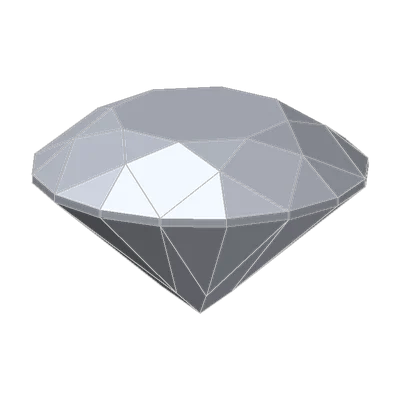
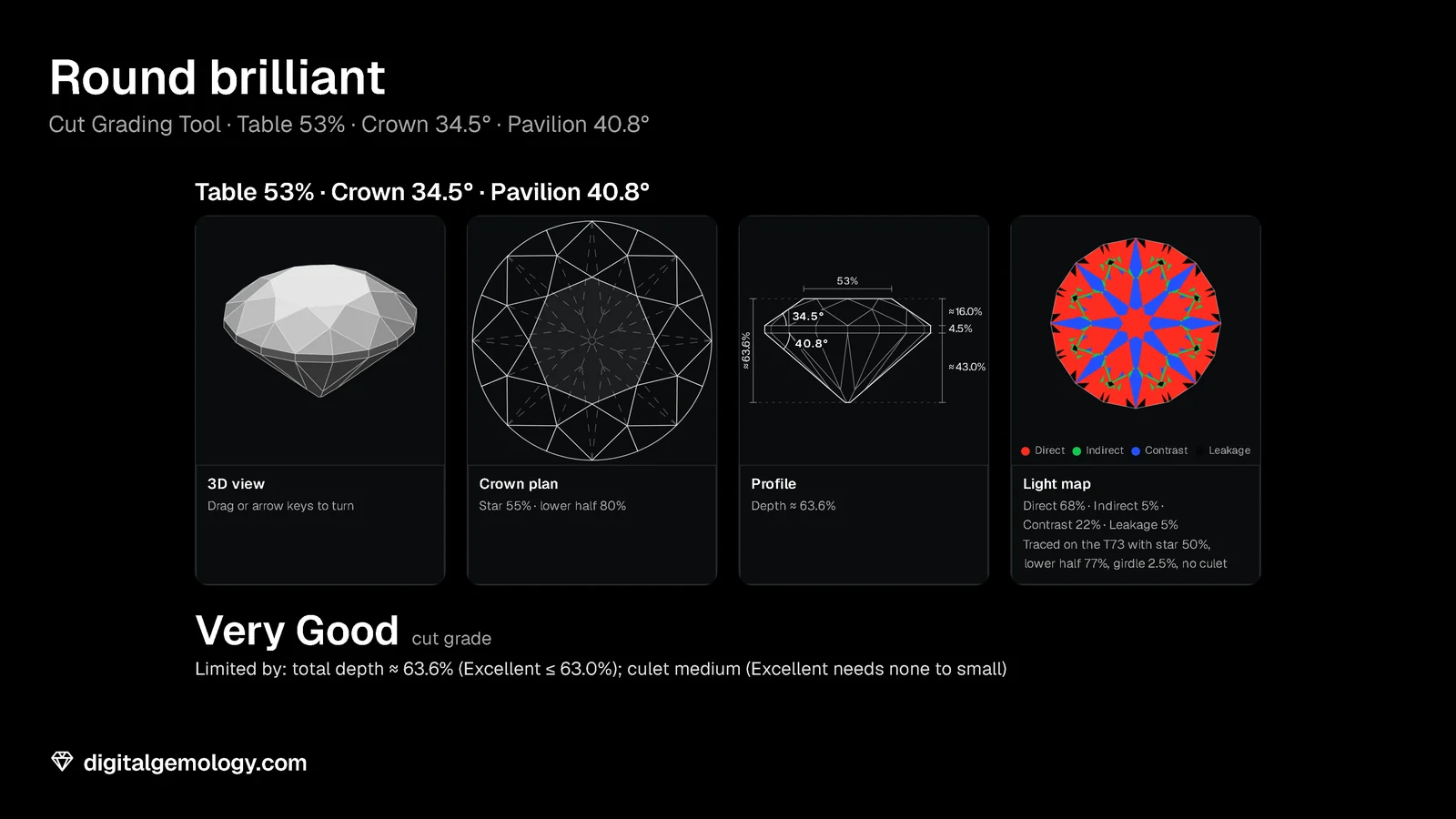
Here's a round brilliant, as a report would describe it:
| Table | Crown | Pavilion | Star | Lower half | Girdle | Culet | Polish | Symmetry |
|---|---|---|---|---|---|---|---|---|
| 53% | 34.5° | 40.8° | 55% | 80% | 4.5%, Slightly Thick | Medium | Excellent | Excellent |
Those are the T73's own angles, the ones Tolkowsky calculated in 1919. Is it Excellent?
No. It's Very Good, and two of those numbers decide it. At the end of this page you'll find them in seconds. Every stone on this page comes from a worked example in GIA's cut booklet. We'll decode four of them.
A decoding routine
All the proportions of a round fit into one routine. Use it on any set of proportions:
- The depth sum. Crown height + girdle + pavilion depth must come out close to the total depth. A total depth over 63% says that the stone has extra weight. GIA's Excellent range is 57.5 to 63%.
- The angle pair. Check the crown (Excellent 31.5° to 36.5°) and the pavilion (40.6° to 41.8°). Remember that they're graded as a pair with the table (see our pages on the table, the crown and the pavilion). A pavilion near the edge of its range is the first suspect.
- The edges. Girdle: Thin to Slightly Thick allows Excellent. Culet: Small or less.
- The finish. Polish and symmetry of Very Good or better allow Excellent. Good limits the stone to Very Good.
- The small lengths. Star 45 to 65% and lower half 70 to 85% allow Excellent. On their own, they can never pull a stone below Good (see star and lower half lengths).
- The weakest wins. The grade is the lowest of all the checks above. Find that one number, and you've decoded the stone.
Try it yourself
Enter each stone in Cut Grading Tool. (Open More proportions for the girdle, culet and finish.) Predict the grade before you look. Then check the Limited by line.
| Stone | Table | Crown | Pavilion | Star | Lower half | Girdle | Culet | Polish | Symmetry |
|---|---|---|---|---|---|---|---|---|---|
| A | 57% | 35.5° | 40.8° | 55% | 80% | 3.0% | None | Excellent | Very Good |
| B | 53% | 34.5° | 40.8° | 55% | 80% | 4.5%, Slightly Thick | Medium | Excellent | Excellent |
| C | 53% | 32.0° | 42.8° | 55% | 80% | 3.5% | None | Excellent | Excellent |
The mystery stone, D: 61% table, 33.0° crown, 41.2° pavilion, star 55%, lower half 80%, girdle 2.5%, culet None, polish Very Good, symmetry Excellent. A 61% table is big. Excellent or not? Make your prediction before you check.
What the Cut Grading Tool shows
Stone A: Excellent. Crown height 15.3%, girdle 3.0%, pavilion depth 43.2%. With the tool's small calibration, that gives a total depth of about 61.2%. Every check passes. The symmetry is only Very Good, but a Very Good finish still allows Excellent.
Stone B: Very Good. The angles are the T73's, so the pair is fine. The depth sum shows the problem: 16.2 + 4.5 + 43.2, less the tool's small calibration, makes about 63.6%, past 63%. And the Medium culet also limits it to Very Good. Two numbers, both about the edges. Face up, you might not see a difference from an Excellent stone. The problem is the extra weight that it hides below the girdle. GIA's own note on this example says the same.
Stone C: Good. The crown is shallow but allowed. The pavilion, 42.8°, is past the Excellent limit of 41.8° and even past the Very Good limit of 42.4°. It's a steep pavilion. GIA's example calls the stone fairly bright, but with no strong, distinct pattern. The light map agrees: green at 22%, blue down to 7%.
Stone D: Excellent. A 61% table, and still Excellent: its flatter crown and slightly steeper pavilion balance the big table. Large tables leave little room, as our page on table percentage shows, but there is some.
Key points
- Total depth must match crown height + girdle + pavilion depth. Over 63% means extra weight.
- The crown and the pavilion are judged as a pair with the table. The pavilion is the most sensitive.
- The girdle and the culet are the "edges". Thick girdles and big culets limit a stone, even with perfect angles.
- Polish and symmetry of Very Good or better allow Excellent. Star and lower half lengths alone can't pull a stone below Good.
- The grade is the weakest of all of them. Find that one number, and you've decoded the stone.
Go further: take the diamond anatomy quiz. It tests everything from the three parts to the culet.
Try it free
- Cut Grading Tool: Grade a round brilliant from its proportions and see its light map change.
Free, in your browser, no account.
Quick quiz
Five questions on this lesson, a couple of minutes. Pick an answer and see at once if you got it, and why.
Cuts in this lesson
We sell the files of these cuts: 3D models and cutting files, with a personal-use license.
Keep exploring
Previous lesson · Diamond anatomy and proportions: all lessons · All topics