The writing on the edge
Many diamonds carry a tiny laser inscription on the girdle, the thin edge of the stone. You need magnification to read it. It looks like the easy answer: the stone says what it is.
It is useful. But the inscription is not a property of the diamond. Someone wrote it, and writing can be wrong.
What the laboratories write
A grading laboratory examines a diamond and writes a report. The report has a number. The laboratory can inscribe that number on the girdle, so that the stone and the report belong together.
For a laboratory-grown diamond, the inscription also says so. GIA inscribes the words "Laboratory-Grown" and the number of its document. An IGI report number for a laboratory-grown diamond starts with the letters LG, and the same number is on the girdle.
A natural diamond can have a report number on its girdle too. But many natural diamonds have no inscription. Small stones often have none at all, natural or laboratory-grown. So a girdle with no writing tells you nothing.
Why it is a claim
An inscription says: "a laboratory examined a stone and gave it this number". It does not prove that this stone is that stone.
In January 2024, GIA reported forged inscriptions. Laboratory-grown diamonds were cut to nearly match natural diamonds that had a GIA report. Then someone inscribed the natural stone's report number on them. GIA started a service to confirm a stone against its report for this reason.
So the right use of an inscription is a comparison. Look up the report with its number. Compare the weight, the measurements and the inclusions with the stone in your hand. If something does not match, or if much money depends on the answer, ask the laboratory to examine the stone again.
Try it yourself
- Open the Diamond Testing Bench and choose Inscription.
- Read the girdle of each stone.
- Read the line under each stone, then the note under all three.
- Answer for yourself: the natural stone has no inscription. Does that tell you that it is natural?
What the Bench shows
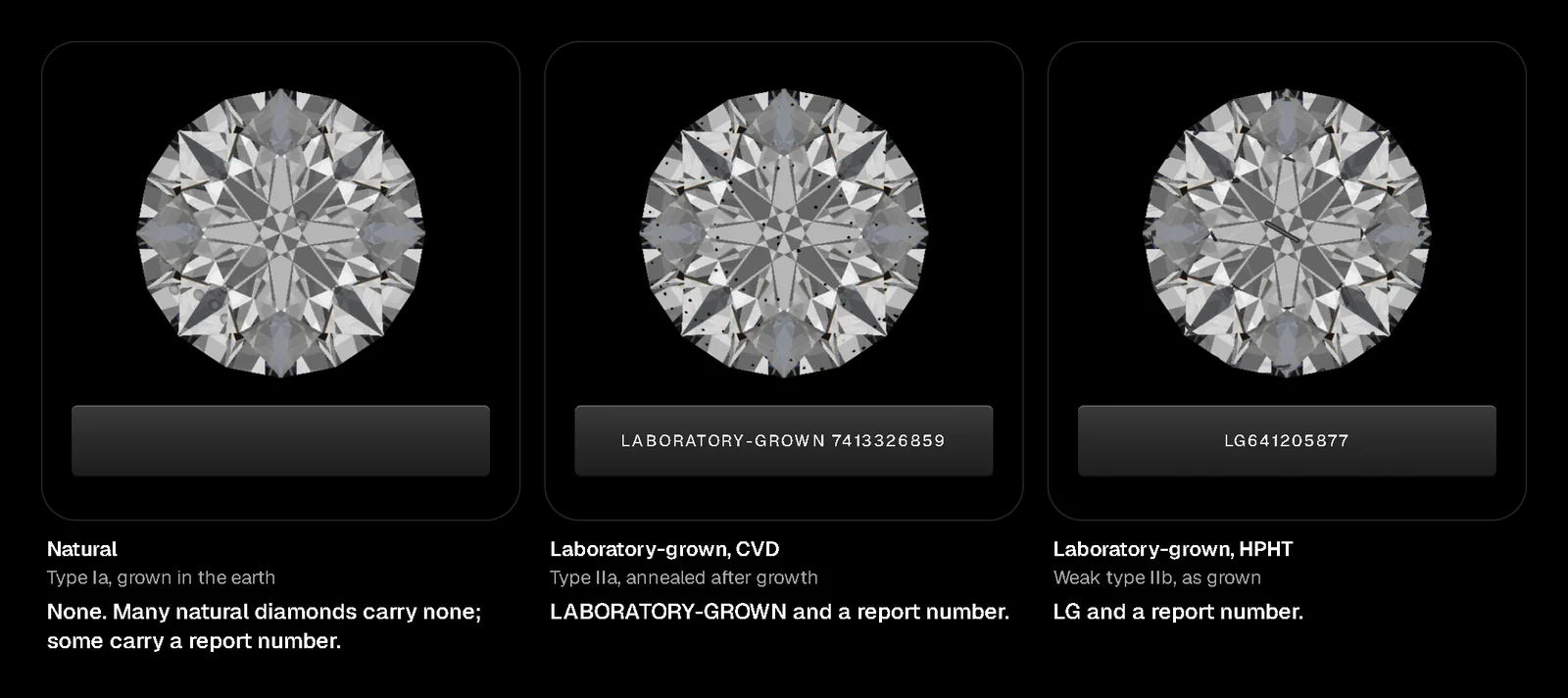
The CVD stone carries "LABORATORY-GROWN" and a number. The HPHT stone carries "LG" and a number. The natural stone carries nothing.
The Bench pairs each style with one stone only to show both styles. In real life each laboratory examines both kinds of laboratory-grown diamond. And the empty girdle of the natural stone proves nothing: an empty girdle is common on all kinds of diamond.
The Bench shows three typical stones. It does not read or check a real inscription or report.
Key points
- A girdle inscription connects a stone to a laboratory report. You need magnification to read it.
- GIA inscribes "Laboratory-Grown" and a number; an IGI number for a laboratory-grown diamond starts with LG.
- No inscription tells you nothing: many natural diamonds and most small stones have none.
- Forged inscriptions exist on laboratory-grown diamonds that were cut to match natural reports.
- Compare the stone with its report. When it matters, ask the laboratory to check.
Go further: The ID section of a diamond report shows where a report gives its number and its measurements.
Try it free
- Diamond Testing Bench: Put a natural, a CVD and an HPHT diamond through eleven tests, side by side.
Free, in your browser, no account.
Quick quiz
What does a report number on the girdle prove?
- That the stone is natural
- Nothing alone; it is a claim that you can compare with the report
- That the stone is laboratory-grown
Show the answer
b: An inscription is a claim; the comparison gives it value.
A diamond has no inscription. What does that tell you?
- It is natural
- It is laboratory-grown
- Nothing
Show the answer
c: Many diamonds of every kind have no inscription.
What did GIA report in January 2024?
- Forged inscriptions on laboratory-grown diamonds cut to match natural reports
- That inscriptions are no longer used
- That small stones always carry inscriptions
Show the answer
a: The stones were cut to nearly match natural diamonds with a GIA report.
You look up a report number. The weight on the report is 1.02 carats; your stone weighs 0.97. What do you do?
Show the answer
Do not rely on the inscription — the stone does not match its report, so ask the laboratory to examine it.
On the Bench, which stone carries the words "LABORATORY-GROWN"?
Show the answer
The CVD stone — the HPHT stone carries "LG" and a number.
Cuts in this lesson
We sell the files of these cuts: 3D models and cutting files, with a personal-use license.
Keep exploring
- Next lesson: Lab-grown diamonds under UV: fluorescence, afterglow and growth patterns
- Try another topic · Diamond vs moissanite: Why moissanite shows more fire than diamond
Previous lesson · Natural vs laboratory-grown diamond: all lessons · All topics