The same light, shorter waves
A UV torch gives long-wave ultraviolet, 365 nm. A gemological laboratory also uses short-wave ultraviolet, 254 nm, and a still shorter light below 225 nm. Each step shows more of how the crystal grew.
Short-wave UV
Most natural diamonds that glow do so more under long-wave than under short-wave UV. HPHT diamonds usually do the opposite. In GIA's data, only 2% of colorless HPHT diamonds reacted to long-wave UV, but 88% reacted to short-wave UV.
The more telling moment comes when the lamp goes off.
The afterglow
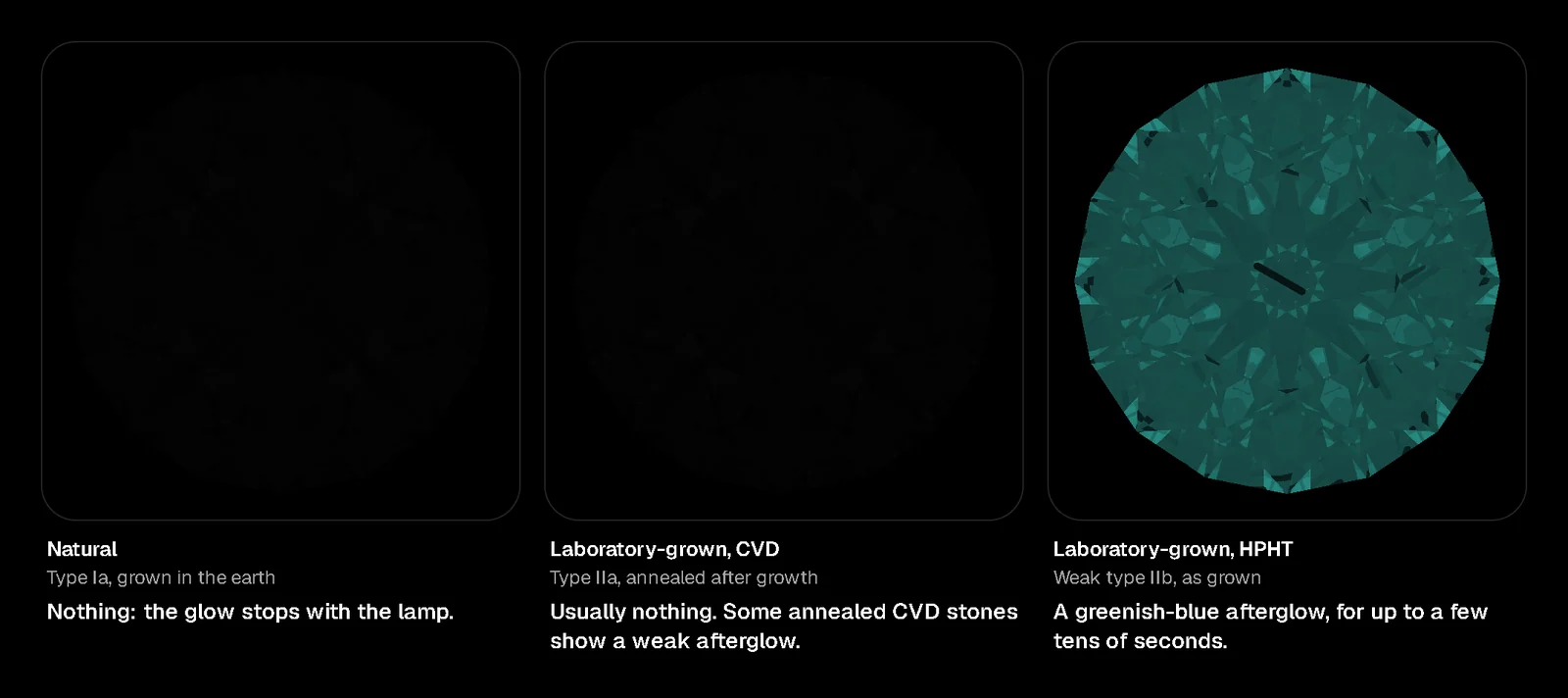
Some diamonds continue to glow after the lamp is off. The name for this is phosphorescence. Colorless HPHT diamonds typically show a greenish-blue afterglow. It comes from traces of boron in the crystal. GIA gives its duration as less than a second to a few tens of seconds.
A strong afterglow points to HPHT growth. But it is not proof, for three reasons from GIA's work:
- Low-dose irradiation can reduce or remove the afterglow of an HPHT diamond.
- A few natural type IIb diamonds show a similar afterglow.
- Some CVD diamonds do too.
The deep-UV image
Diamond absorbs light below 225 nm right at its surface. So this light makes almost every diamond glow, and only in a thin layer. An instrument with a camera can then show the pattern of growth on each facet.
- Most natural diamonds grew as octahedra. The image shows straight bands in that shape.
- A CVD diamond grew layer on layer. The image can show those layers.
- An HPHT diamond grew in sectors, in a cube-and-octahedron shape. The sectors often meet in a cross.
This is the most telling picture that a laboratory makes. But a person must read it. GIA reports that some recent CVD diamonds show no layers, and that their image looks much like a natural type II diamond.
Try it yourself
- Open the Diamond Testing Bench and choose Short-wave UV.
- Compare the three stones with the lamp on.
- Set Lamp to Off. Watch the three stones and the timer.
- Choose Deep-UV image. Find the bands, the layers and the cross.
What the Bench shows
With the lamp on, the HPHT stone glows greenish yellow, more strongly than it did under the torch. The natural stone glows a weak blue, weaker than under the torch.
With the lamp off, the natural stone goes dark at once. The HPHT stone keeps its greenish-blue glow, and the glow fades over seconds. The CVD stone usually shows nothing, but some annealed CVD stones show a weak afterglow.
In the deep-UV image, each stone shows its growth: blue bands, green-blue layers, a blue-green cross. The patterns on the Bench are drawings after the published descriptions. They are not photographs of real stones, and the Bench does not test a real stone.
Key points
- HPHT diamonds usually react more to short-wave than to long-wave UV: 88% against 2% of colorless stones.
- A greenish-blue afterglow of up to a few tens of seconds is typical of HPHT diamond. It comes from boron.
- Irradiation can remove the afterglow, and a few natural and some CVD diamonds show one too.
- Light below 225 nm shows the growth pattern: octahedral bands, CVD layers or HPHT sectors.
- Some recent CVD diamonds show no layers in this image.
Go further: the Spectroscope shows what visible light does in seven gemstones.
Try it free
- Diamond Testing Bench: Put a natural, a CVD and an HPHT diamond through eleven tests, side by side.
- Spectroscope: Read a gemstone's absorption lines through a prism or a grating.
Free, in your browser, no account.
Quick quiz
Which diamond typically glows after a short-wave lamp goes off?
- Natural type Ia
- HPHT
- Every diamond
Show the answer
b: Colorless HPHT diamonds typically show a greenish-blue afterglow.
What causes that afterglow?
- Traces of boron
- Nitrogen clusters
- Heat from the lamp
Show the answer
a: Boron; most colorless HPHT diamonds contain a trace of it.
An HPHT diamond shows no afterglow. Is that possible?
- No
- Yes: low-dose irradiation can remove it
- Only if it is not diamond
Show the answer
b: GIA showed that low-dose irradiation can reduce or remove it.
In a deep-UV image, a cross of growth sectors points to…
- Natural growth
- CVD growth
- HPHT growth
Show the answer
c: HPHT diamonds grow in cube-and-octahedron sectors.
On the Bench, what color is the afterglow of the HPHT stone?
Show the answer
Greenish blue.
Cuts in this lesson
We sell the files of these cuts: 3D models and cutting files, with a personal-use license.
Keep exploring
- Next lesson: Diamond type, strain and spectra: how a laboratory reads growth
- Try another topic · Diamond vs moissanite: Diamond testers and moissanite: what the instruments say
Previous lesson · Natural vs laboratory-grown diamond: all lessons · All topics