Four tools on the kitchen table
A loupe, a thermal pen, a UV torch and a magnet. You can buy all four for little money, and many videos say that one of them can find a laboratory-grown diamond.
Each tool answers a question. The trouble is that none of them answers the question people ask. Here is what each one does answer.
The loupe and the pen
Under a 10x loupe, inclusions can hint at how a diamond grew. A rod or a plate of metal points to HPHT growth, because the diamond grew in molten metal. Dark pinpoints occur in CVD diamonds. But similar marks occur in natural diamonds too, and many stones are too clean to show anything.
The thermal pen reads "Diamond" for a natural, a CVD and an HPHT diamond. It tells you the material, not the origin.
The UV torch
A long-wave UV torch (365 nm) makes some diamonds glow. The numbers come from GIA.
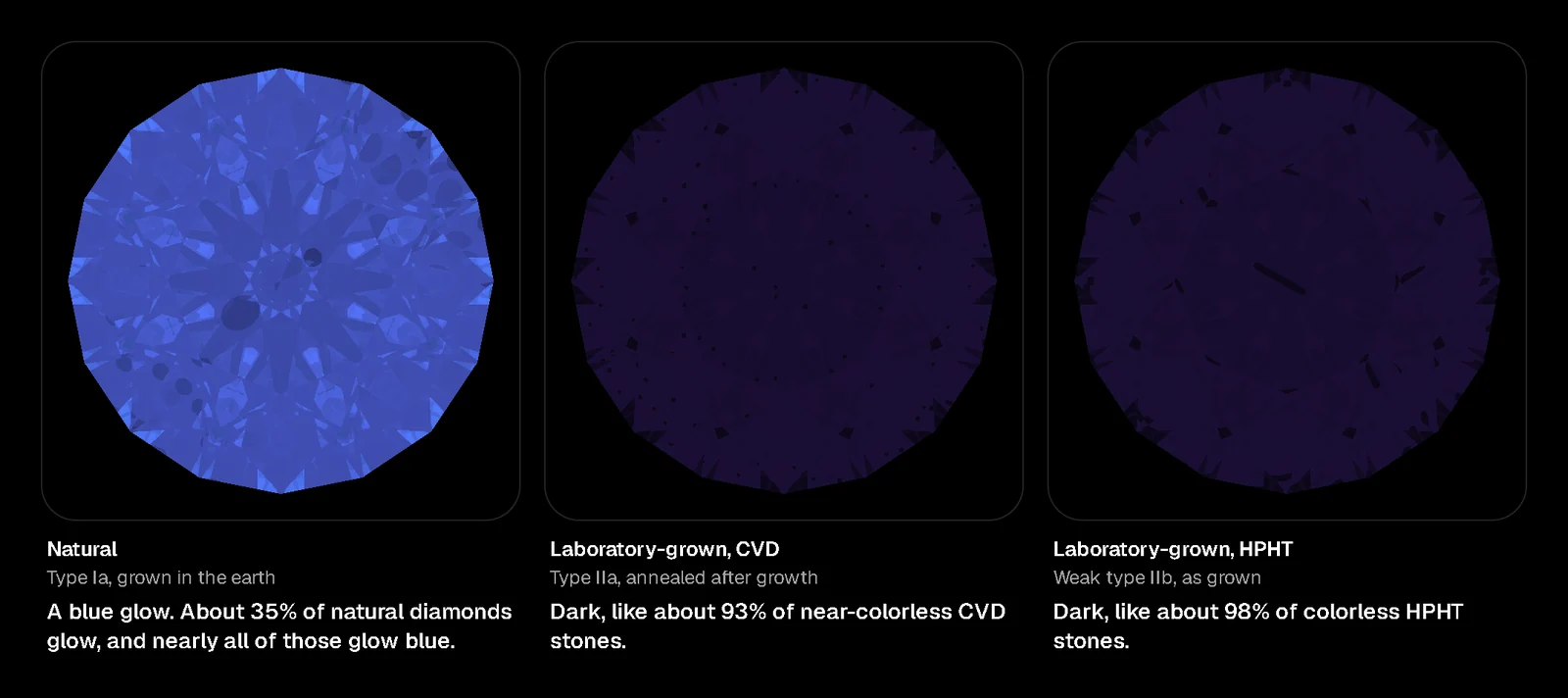
- In a sample of 26,010 GIA reports on natural diamonds, 35% of the stones glowed. Of the stones with a medium to very strong glow, 97% were blue.
- Only 7% of near-colorless CVD diamonds showed a glow under long-wave UV.
- Only 2% of colorless HPHT diamonds did.
Read those numbers again. Most diamonds of all three kinds stay dark. So a dark stone tells you nothing. A blue glow points to a natural diamond, but it is a hint and not proof.
The magnet
An HPHT diamond can contain metal from the press. A strong magnet can pull such a stone. In GIA's studies, HPHT stones of VS2 clarity or lower were weakly magnetic, and the pull was consistent only at SI and I clarity.
So a pull is a strong sign of HPHT growth. No pull tells you nothing: many HPHT stones are too clean to move, and CVD and natural diamonds normally do not respond.
Try it yourself
- Open the Diamond Testing Bench and choose UV torch.
- Which stone glows? Read the line under each stone.
- Choose Magnet. Which stone moves?
- For each test, read the note under the stones. Find the sentence that says what the test cannot tell you.
What the Bench shows
Under the torch, the natural stone glows blue and the two laboratory-grown stones stay dark. That is the typical result. But 65% of natural diamonds stay dark too, so on a real stone a dark result is no answer.
With the magnet, only the HPHT stone moves, because our HPHT stone has a metal inclusion. A clean HPHT stone does not move.
The pattern is the same for all four tools. A positive result is a hint. A negative result is nothing. The Bench shows three typical stones, and it does not test a real stone.
Key points
- No tool on the kitchen table can tell you where a diamond grew.
- 35% of natural diamonds glow under long-wave UV, and nearly all of those glow blue.
- Only 7% of near-colorless CVD diamonds and 2% of colorless HPHT diamonds glow under long-wave UV.
- A magnet can pull an HPHT diamond with metal inclusions; no pull does not exclude HPHT growth.
- For each of these checks, a positive result is a hint and a negative result tells you nothing.
Go further: the Polariscope has a strain option for diamond. It shows another test that looks simple and is not.
Try it free
- Diamond Testing Bench: Put a natural, a CVD and an HPHT diamond through eleven tests, side by side.
- Polariscope: Turn a gemstone between crossed polarizers and read its optic figure.
Free, in your browser, no account.
Quick quiz
Your diamond stays dark under a UV torch. What does that tell you?
- It is laboratory-grown
- It is natural
- Nothing
Show the answer
c: Most diamonds of all three kinds stay dark.
Your diamond glows blue under a UV torch. What does that tell you?
- It is natural, for certain
- It points to natural, but it is not proof
- It is HPHT
Show the answer
b: A blue glow is typical of natural diamond, but a hint is not proof.
What share of natural diamonds glowed in GIA's sample of 26,010 reports?
- 7%
- 35%
- 97%
Show the answer
b: 35%; of those with a medium to very strong glow, 97% were blue.
A magnet pulls a diamond a little. Which growth method does that point to, and why?
Show the answer
HPHT — metal from the press can stay in the stone as inclusions.
On the Bench, which test shows the same result for all three stones: the UV torch, the magnet or the thermal pen?
Show the answer
The thermal pen — it reads "Diamond" three times.
Cuts in this lesson
We sell the files of these cuts: 3D models and cutting files, with a personal-use license.
Keep exploring
- Next lesson: Lab-grown diamond inscriptions and reports: claims, not proof
- Try another topic · Diamond vs moissanite: Diamond testers and moissanite: what the instruments say
Previous lesson · Natural vs laboratory-grown diamond: all lessons · All topics