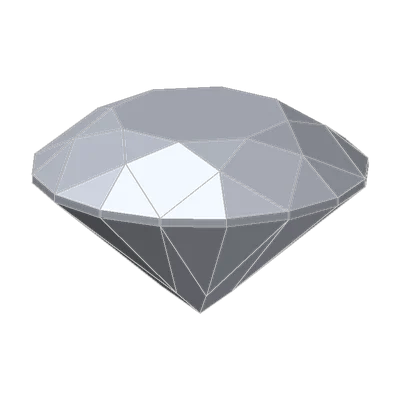
Three stones that look the same
Put a natural diamond, a CVD diamond and an HPHT diamond side by side. Give them the same cut. Your eye cannot tell them apart, and a 10x loupe usually cannot either.
That is not a trick. All three are diamond: carbon atoms in the same cubic crystal. A laboratory-grown diamond is not a look-alike such as moissanite or cubic zirconia. It is the same material, grown in a different place.
So the question "is it diamond?" has the same answer for all three. The harder question is "where did it grow?"
Three ways to grow a diamond
Natural. The crystal grew deep in the earth, over a very long time.
HPHT means high pressure, high temperature. A press holds carbon and molten metal at high pressure and temperature, and the diamond grows on a seed crystal.
CVD means chemical vapor deposition. A carbon-rich gas breaks down in a chamber, and the carbon settles on a diamond plate, layer on layer. Many CVD diamonds get a second step. They go into a press at high pressure and high temperature to remove a brown tint. About 80% of the CVD diamonds that GIA received since 2020 had this treatment.
The growth leaves marks in the crystal. Those marks are what a laboratory reads.
Diamond type: the first mark
Most natural diamonds contain nitrogen, in small clusters of atoms. Gemologists call this type Ia. A diamond with no nitrogen that an infrared instrument can measure is type II. Type IIa has almost no impurities. Type IIb contains boron.
GIA studied the diamond type of its D-to-Z natural diamonds. The result: 99.06% were type Ia, 0.83% type IIa, 0.09% type IaB and 0.02% type IIb.
All colorless laboratory-grown diamonds are type II. So type sorts most stones quickly. A colorless type Ia diamond did not grow in a laboratory. A type II diamond needs more tests, because about 1% of natural diamonds are type II too.
Try it yourself
- Open the Diamond Testing Bench. It starts with the Loupe.
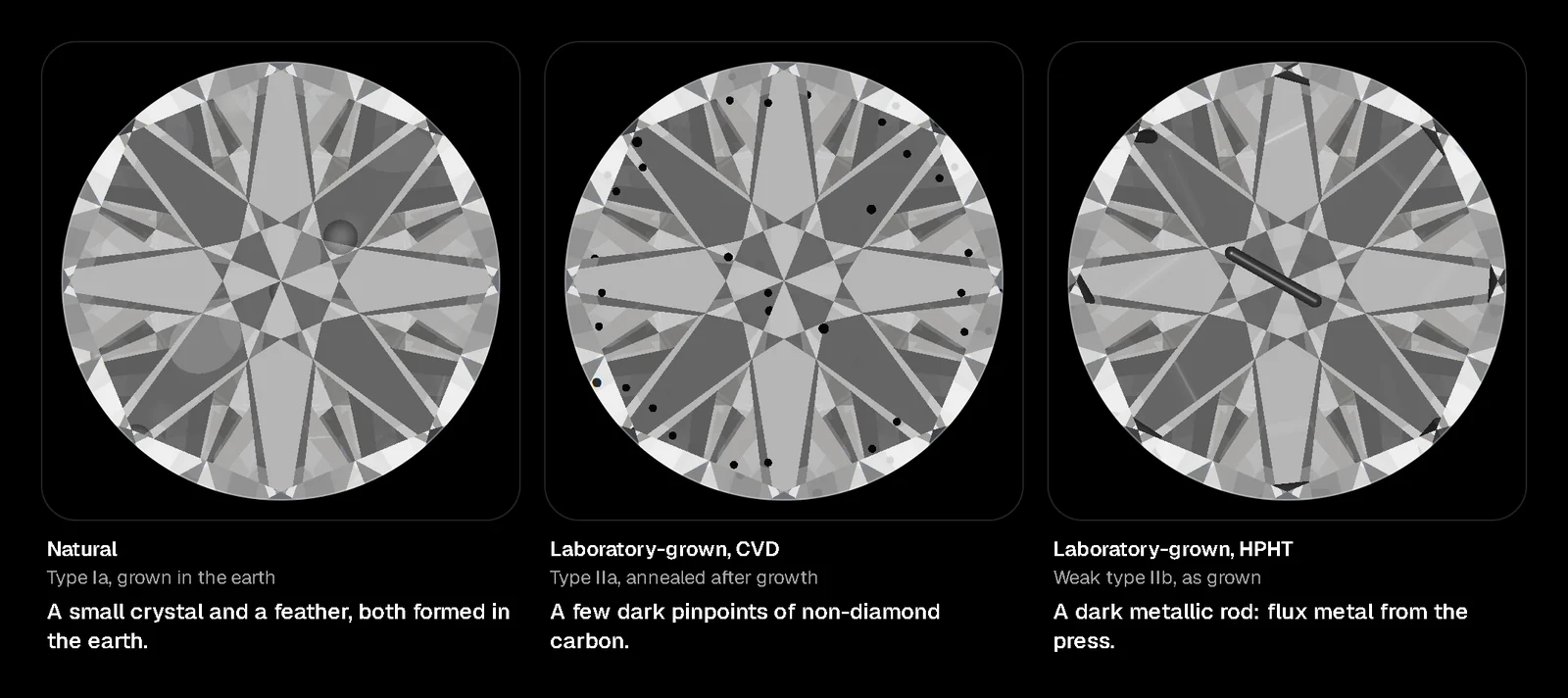
- Read the line under each stone. Find the inclusion in each picture.
- Choose Thermal pen. Read the three results.
- Read the note under the stones: what does the pen tell you, and what can it not tell you?
What the Bench shows
Under the loupe, each stone shows a different inclusion. The natural stone has a small crystal and a feather. The CVD stone has dark pinpoints of non-diamond carbon. The HPHT stone has a rod of metal from the press. These are hints. They are not proof, because similar marks occur in natural and laboratory-grown diamonds, and many stones show no inclusion at all.
The thermal pen says "Diamond" three times. The pen measures how fast a stone takes heat from its tip, and all diamond conducts heat very well. So the pen answers "is it diamond or glass?" It cannot answer "where did it grow?" It has one more limit: moissanite also reads as diamond on a thermal pen.
The Bench shows three typical stones. It is a model, and it does not test a real stone.
Key points
- Natural, CVD and HPHT diamonds are all diamond. They differ in how the crystal grew.
- About 80% of the CVD diamonds sent to GIA since 2020 were treated at high pressure and high temperature after growth.
- In GIA's study, 99.06% of natural D-to-Z diamonds were type Ia. All colorless laboratory-grown diamonds are type II.
- About 1% of natural diamonds are type II, so type II means "test further", not "laboratory-grown".
- A thermal pen reads "Diamond" for all three, and for moissanite too.
Go further: the diamond gemstone page shows the cubic crystal that all three share.
Try it free
- Diamond Testing Bench: Put a natural, a CVD and an HPHT diamond through eleven tests, side by side.
Free, in your browser, no account.
Quick quiz
A laboratory-grown diamond is…
- A look-alike such as cubic zirconia
- Diamond that grew in a laboratory
- A natural diamond with a treatment
Show the answer
b: The material is diamond; only the place of growth differs.
What does CVD mean?
- Chemical vapor deposition
- Cut very deep
- Carbon vacuum diamond
Show the answer
a: Carbon from a gas settles on a diamond plate.
A colorless diamond is type Ia. What does that tell you?
- It is natural
- It is laboratory-grown
- Nothing
Show the answer
a: All colorless laboratory-grown diamonds are type II.
A colorless diamond is type II. What does that tell you?
- It is laboratory-grown
- It needs more tests
- It is not diamond
Show the answer
b: About 1% of natural diamonds are type II too.
On the Bench, what does the thermal pen read for the HPHT stone?
Show the answer
Diamond — the pen reads "Diamond" for all three stones.
Cuts in this lesson
We sell the files of these cuts: 3D models and cutting files, with a personal-use license.
Keep exploring
- Next lesson: How to tell if a diamond is lab-grown at home: what four checks can show
- Try another topic · Historic diamond cuts: the history of the brilliant: Old European cut diamonds: when the outline went round
Natural vs laboratory-grown diamond: all lessons · All topics