Which would you wear?
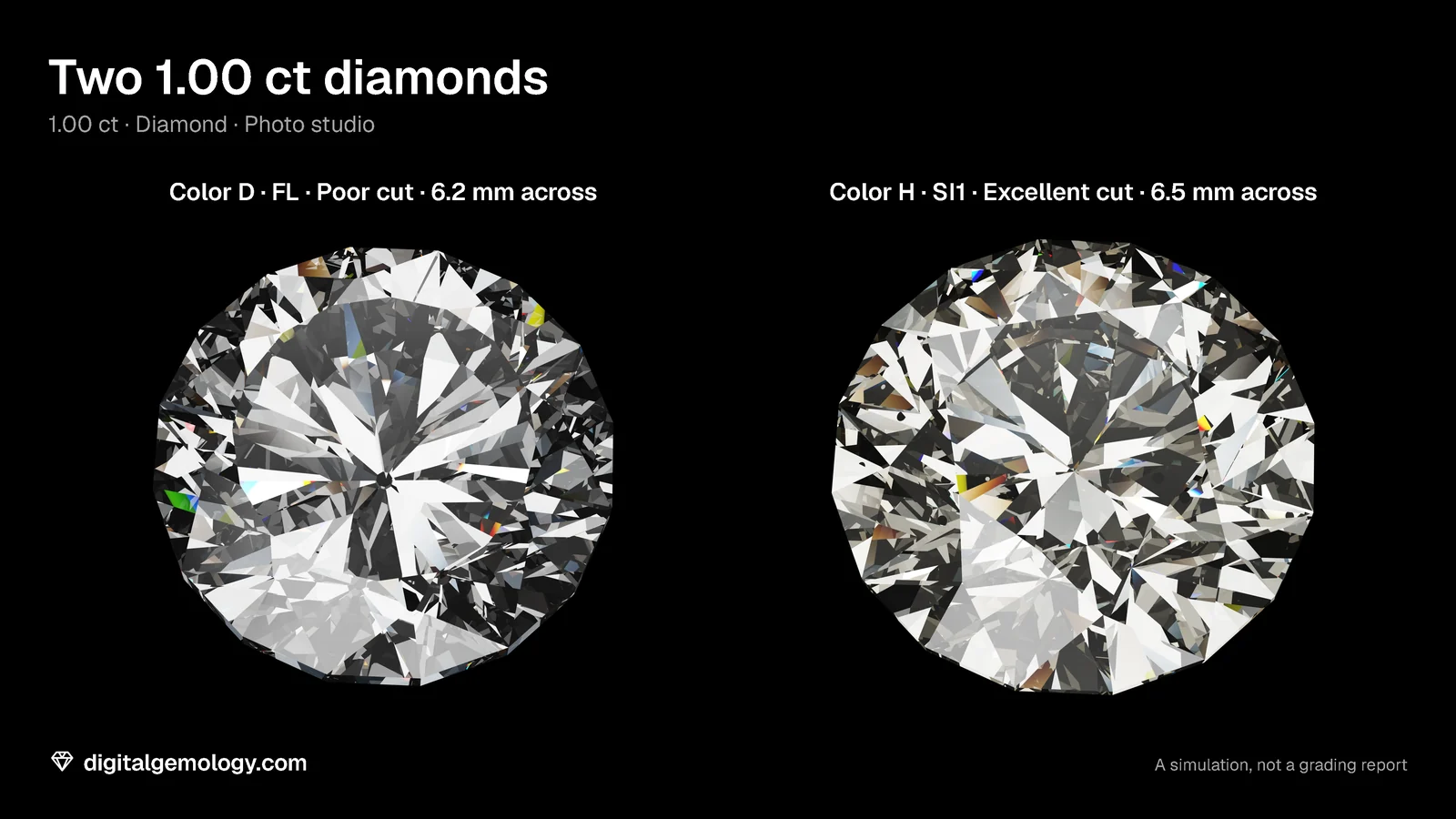
Two diamonds, both 1.00 carat. The first has the best color and clarity grades there are: D, Flawless. The second is an H, SI1: four color grades lower, and only one category above the included range.
On paper, there's no contest. Now look at them.
The H SI1 is crisp and bright, a sharp pattern of light and dark. The D Flawless looks flat and washed out across its wide table. And it's smaller: 6.2 mm across against 6.5 mm. The D Flawless has a Poor cut. The H SI1 has an Excellent cut. Under the light map, the D Flawless leaks 45% of its face; the H SI1, 4%.
The better grades on paper lose. That's the four Cs in one picture.
What each C does to the look
Here's what each C changes by itself, with the numbers from our simulator:
- Carat sets the size, but slowly: double the weight is 26% wider. Round "magic" weights cost a step that you can't see: 0.99 ct is 0.02 mm narrower than 1.00 ct.
- Color sets the tint. Near-colorless grades (G to J) look white face up. The tint shows beside a better grade, in larger stones and lower on the scale. Warm light can hide four letters.
- Clarity sets what a grader finds at 10x. In SI stones, graders find many inclusions only under magnification. And visibility changes with the angle and the light.
- Cut sets how the whole face handles light, and even how big a carat looks. A Poor 1.00 ct T73 faces up like an Excellent 0.86 ct.
No single C sets the value of a diamond. All four do, together. But they don't change the look equally. Color and clarity mostly matter where you can see them. Cut changes every square millimeter.
Trading one C for another
Real buying is about trade-offs. Here is a common one, straight from the advice of jewelers: to go up in size, go slightly lower on color, clarity or cut. Larger diamonds are rarer, so the price goes up faster than the weight. A step down in another C can pay for the step up in carat.
That's a fair trade for color and clarity, if you stay where the eye can't see the difference. Cut is different. It's the C you see, so a step down in cut costs you looks directly.
And remember: a cut grade points you to the looks that most people like, but light changes everything. GIA's own advice is to look at a diamond in several kinds of light, and then to choose the one that pleases your eye.
Try it yourself
- Open 3D Gemstone Simulator with the T73 in diamond, Photo studio.
- Stone A, bigger: 1.50 ct, color K, clarity SI2, cut Good. Write down the measurements and take a screenshot.
- Stone B, better cut: 1.00 ct, color G, clarity VS2, cut Excellent. Write down the measurements and take a screenshot.
- Look at both in Home light too, and with the Light map on.
- Make the decision: which one do you buy, and why? Then build your own pair with the same logic and test it.
What the simulator shows
Stone A is clearly bigger: 7.3 mm against 6.5 mm, about 27% more face. It shows a faint warmth. Its Good cut leaks 18% of the face, against 4% for Stone B. Stone B is smaller, whiter and crisper.
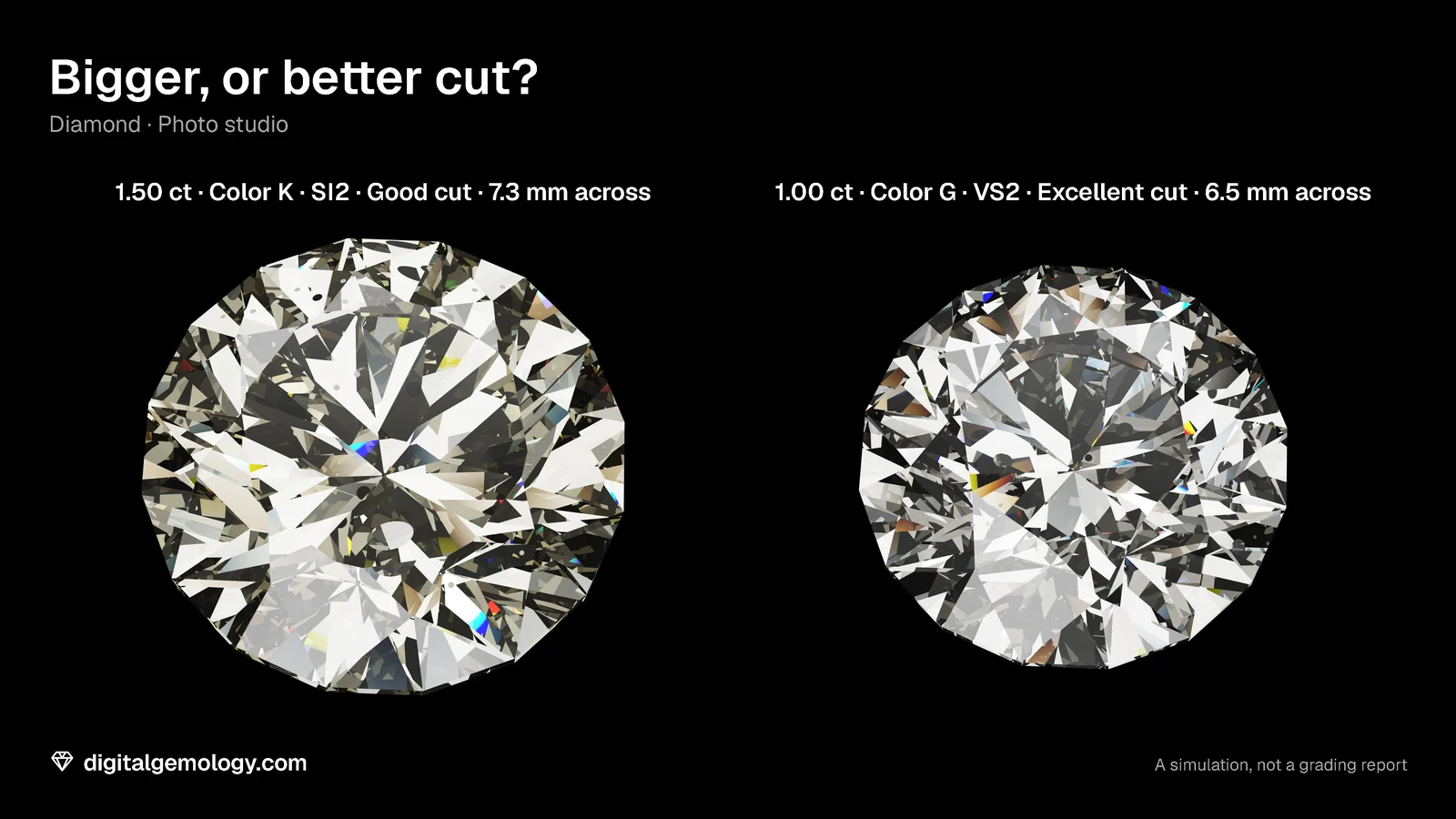
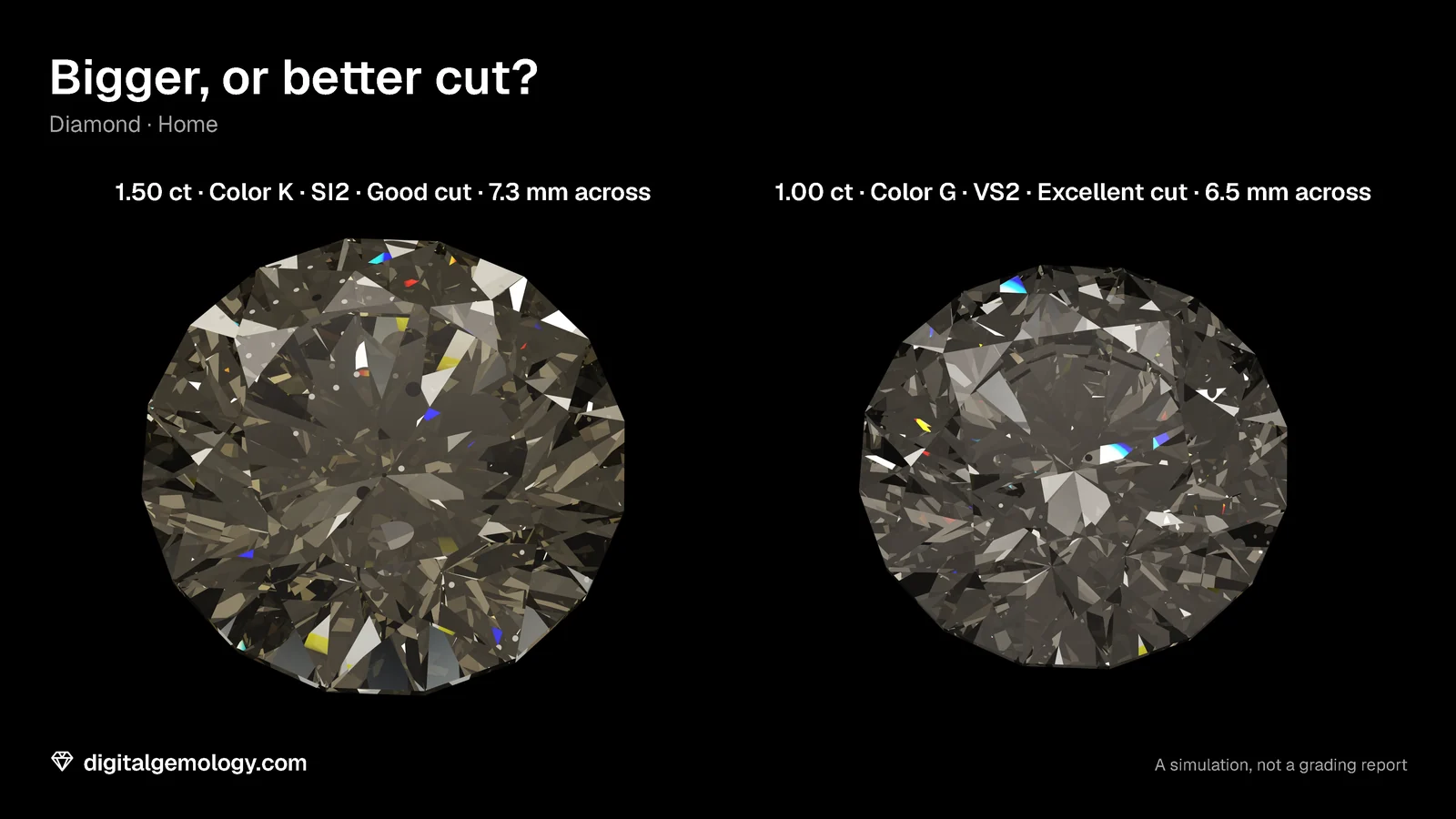
There's no wrong answer here, and that's the point. Some people want the size and don't mind the warmth. Others want the sparkle. Under warm home light, the color difference gets smaller, because the light is warm anyway. With the light map on, the cut difference stays the same. The four Cs give you a shared language to describe the choice. Your eyes make it.
Key points
- No single C sets the value of a diamond. All four do, together.
- They don't change the look equally. Cut changes the whole face. Color and clarity matter where you can see them.
- A stone with top color and clarity grades can look worse than a stone with lower grades and a better cut.
- It is common and fair to trade color or clarity for size, if you stay below what the eye can see. A trade that gives away cut costs looks directly.
- Look at any diamond in several kinds of light before you decide.
Go further: take the four Cs quiz to check all four Cs at once.
Try it free
- Cut Grading Tool: Grade a round brilliant from its proportions and see its light map change.
- 3D Gemstone Simulator: Turn a cut in seven gemstones and set its carat, color, clarity and cut grade.
Free, in your browser, no account.
Quick quiz
Five questions on this lesson, a couple of minutes. Pick an answer and see at once if you got it, and why.
Cuts in this lesson
We sell the files of these cuts: 3D models and cutting files, with a personal-use license.
Keep exploring
Previous lesson · The four Cs of diamonds: all lessons · All topics