Twins with different birth certificates
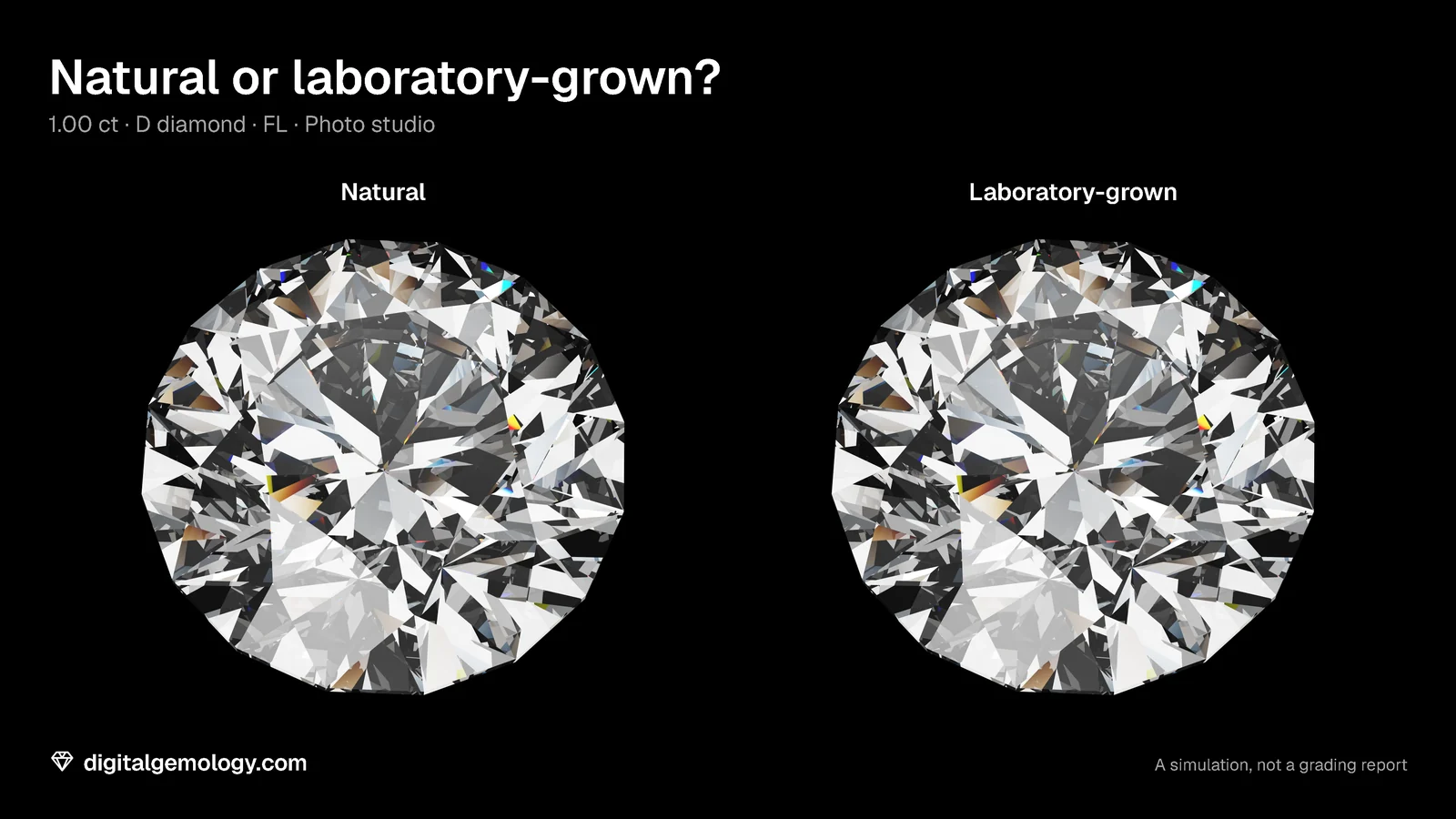
Two diamonds turn side by side. Same cut, same weight, D, Flawless. One formed deep in the earth. The other was grown in a laboratory. Which is which?
You can't tell, and neither can most jewelers by eye. Chemically and physically, a laboratory-grown diamond is a diamond: same carbon, same crystal, same way of handling light. Only a gem lab's instruments can tell the two apart. In our simulator the two render identically, pixel for pixel. Only one line on the report differs.
That's why the bottom of a report matters as much as the grades: the comments, the inscriptions and the report's own type.
Comments: what doesn't fit elsewhere
Comments hold any identifying characteristic or feature that has no other line on the report. Comments is also where a lab describes a treatment it has detected. If a color grade carries an asterisk, Comments explains it.
Treatments: graded, or not graded at all
Some diamonds are treated to improve their color or apparent clarity. Anyone who sells a treated gem must disclose the treatment. GIA sorts treatments by whether they last:
- HPHT (heating at high temperature under high pressure) can remove or change a diamond's color. GIA grades such a stone on a full grading report, not a Dossier: GIA doesn't issue a Dossier for HPHT-processed stones. GIA marks the color grade with an asterisk, explains it in Comments, and inscribes the girdle TREATED COLOR.
- Laser drilling bores a tiny channel to an inclusion, usually a small dark one. The channel lets the laser burn the inclusion away, or lets a bleaching agent in. GIA grades the stone, shows the drill hole in the key to symbols and describes the treatment in Comments.
- Coating (a very thin layer that masks the body color) and fracture filling (a glass-like filler injected into a crack) are unstable. GIA issues no grading report for them. It issues an Identification Report instead.
Origin: a report of its own
People grow a lab-grown diamond with machines; the earth doesn't form it. The usual methods are HPHT or CVD (chemical vapor deposition). Yes, HPHT appears twice: the same high pressure and temperature can grow a diamond, or treat a natural one.
GIA grades lab-grown diamonds on its Laboratory-Grown Diamond Report. This report looks distinctly different from the natural one, is digital, and appears on Report Check. Diamonds graded as lab-grown are inscribed with the report number and LABORATORY-GROWN.
Simulants such as glass or cubic zirconia aren't diamond at all. GIA doesn't grade them. It identifies them, on an Identification Report.
On an IGI report: every lab-grown diamond IGI reports is inscribed with "LG" before the report number, and Comments notes the inscription. On request, IGI also notes the growth method (HPHT or CVD) and any treatment in Comments. IGI discloses permanent treatments in Comments. For non-permanent ones, IGI issues no full grading report.
Try it yourself
- Open 3D Gemstone Simulator, T73 in diamond. In the report's Additional grading information, switch Origin from Natural to Laboratory-grown. What changes in the stone? On the report?
- Change Gemstone to moissanite. What does the Origin line say now, and why?
- Sort the treatments. For each one, say what GIA would issue: a grading report (and where the treatment would show), or an Identification Report. (a) HPHT color treatment, (b) laser drilling, (c) coating, (d) fracture filling.
What the simulator shows, and what GIA issues
Origin. Switching to Laboratory-grown changes one line: Origin. The stone doesn't change by a single pixel. A real lab-grown diamond is the same. The difference is in its growth history, which instruments read and the report records. (The simulator is a learning tool, not a lab report. It lets you "grade" moissanite, which GIA would only identify.)
Moissanite. The Origin line reads Laboratory-grown and you can't change it: moissanite and cubic zirconia used as gems are made in a laboratory.
The treatments.
- (a) HPHT: graded on a full report, with an asterisk on the color, an explanation in Comments and TREATED COLOR inscribed.
- (b) Laser drilling: graded, drill hole in the key to symbols, described in Comments.
- (c) Coating and (d) fracture filling: unstable, so an Identification Report, not a grading report.
Key points
- Comments hold features that have no other line on the report, and the description of any detected treatment.
- Permanent treatments (HPHT color, laser drilling) are graded and disclosed. Unstable ones (coating, fracture filling) get an Identification Report instead.
- Lab-grown diamonds are essentially identical to natural ones. Only a lab can tell, and they get their own report.
- GIA inscribes lab-grown stones with the report number and LABORATORY-GROWN; IGI with "LG" before the number.
- Simulants such as CZ aren't graded, only identified.
Go further: how a lab and a loupe tell a simulant from a diamond.
Try it free
- 3D Gemstone Simulator: Turn a cut in seven gemstones and set its carat, color, clarity and cut grade.
Free, in your browser, no account.
Quick quiz
Five questions on this lesson, a couple of minutes. Pick an answer and see at once if you got it, and why.
Cuts in this lesson
We sell the files of these cuts: 3D models and cutting files, with a personal-use license.
Keep exploring
- Next lesson: How to read a diamond grading report, start to finish
- Try another topic · Diamond anatomy and proportions: Pavilion angle and pavilion depth: how a diamond keeps the light in
Previous lesson · How to read a diamond grading report: all lessons · All topics